

Picture this: you’ve wrapped up a massive multi-country research project. Your insights look sharp, your methodology seems solid, and the presentation feels airtight. Then a client asks,
“How do we know the data can be trusted?”
That one question changes everything!
In market research, data governance is not just a technical term or a compliance exercise. It’s the foundation that determines whether your insights are credible or questionable. Strong governance turns data into a strategic asset. Weak governance turns it into a risk.
In this blog, we’ll break down what strong data governance really looks like in market research, why it matters, what happens when it fails, the key pillars that make it work, and how technology and culture are reshaping it for the future.
That’s the essence of strong data governance in market research, too. Trust and scalability are built into every step of the process.
What Data Governance Really Means in Market Research
At its core, data governance refers to the systems, standards, and behaviours that ensure data is accurate, consistent, secure, and ethically used. In market research, it means managing every step of the data lifecycle from collection to analysis and sharing with clear accountability and transparency.
Imagine running a global study where teams in different countries interpret “purchase intent” differently. Your aggregated results lose meaning. Strong governance eliminates that risk by setting standard definitions, unified metadata, and documented ownership across teams.
When Data Governance Fails, Research Fails
Let’s get real about what happens when governance slips:
- When teams don’t validate collection methods across regions, you might end up comparing entirely different behaviours. For instance, if one country uses online surveys while another relies on phone interviews, the data can’t be compared fairly.
- When respondent information isn’t securely stored, it’s not just a privacy breach; it’s a reputational disaster and, in many jurisdictions, a legal risk. For a primer on the regulatory basics that apply across borders, see this GDPR overview.
- When metadata and documentation are missing, future researchers have no clue how the data was cleaned or why specific responses were excluded. That makes your entire dataset unreliable.
Inconsistent governance doesn’t just cause errors; it chips away at credibility. Once a client questions your process, the insight loses its power.
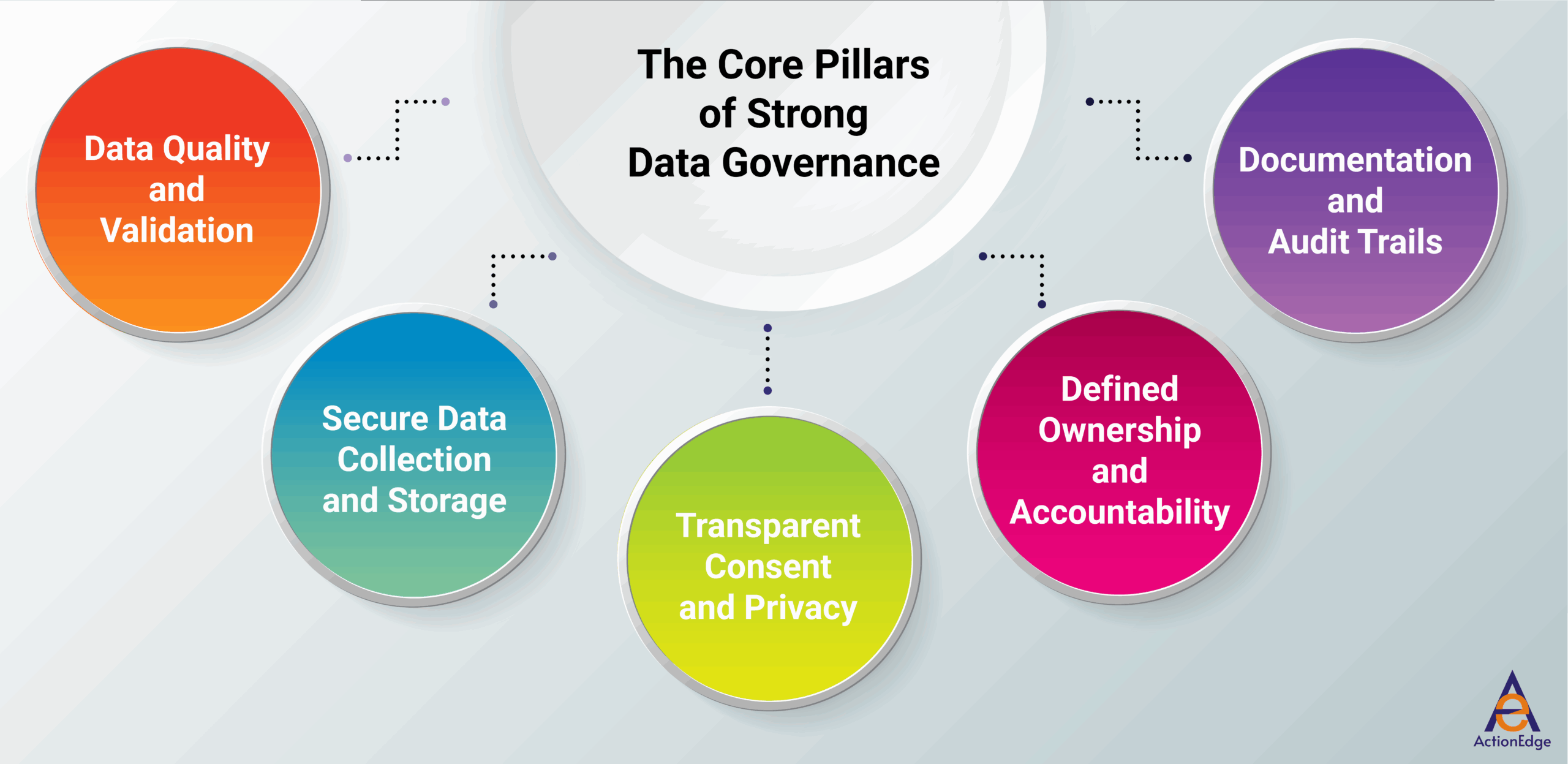
The Core Pillars of Strong Data Governance
If you want your research to stand up to scrutiny, these are the pillars to get right:
Data Quality and Validation
Establish quality checks and validation frameworks. For example, set clear rules for handling missing responses, defining outliers, and maintaining consistent weighting. Every adjustment should be traceable and documented.
Secure Data Collection and Storage
Limit access to sensitive data, apply encryption, and record who has handled the datasets. Store raw and cleaned data separately, so you can always trace the source.
Transparent Consent and Privacy
Respondents must know exactly how their data will be used. Use plain-language consent forms and keep records of every agreement. For global projects, localise privacy statements to match regional laws and expectations.
Defined Ownership and Accountability
Assign a dedicated data steward or governance lead. This person ensures policies are followed and data integrity is maintained across teams. Governance without ownership is just paperwork.
Claire Tolmay, Global Head of Analytics at Games Global, summed it up perfectly: “Data governance should be part of the foundations in any business. When it is working well, it provides the right accountability and ownership for understanding data and resolving data issues.”
In research, accountability is what separates trusted insights from questionable ones.
Documentation and Audit Trails
Keep detailed logs of every stage of data collection, cleaning, processing, and interpretation. This establishes traceability and protects your research in case questions arise later.

Compliance and Privacy Across Borders
Regulations such as GDPR in Europe and privacy frameworks in other regions raise the bar for responsible data handling. Market research companies operating across borders must map where data lives, who accesses it, and how long it is retained. That operational discipline is non-negotiable when clients expect defensible, compliant outputs.
Alongside these regulatory frameworks, industry standards such as ESOMAR’s Data Protection and Privacy Guidelines help ensure research firms maintain consistent ethical and legal safeguards across markets. These standards go beyond compliance, providing practical direction on transparency, respondent consent, and the ethical use of data across diverse geographies.
As data volumes grow and real-time analytics become standard, governance practices are shifting from periodic checks to continuous monitoring. With AI-driven policies and real-time oversight reshaping how organisations manage trust and compliance, experts are calling this the next phase of intelligent governance, as noted in recent industry analyses.
Technology’s Expanding Role
Good governance now depends as much on technology as on policy.
Modern research teams use AI tools for data classification, anomaly detection, and monitoring access controls. These systems automatically flag irregularities and maintain audit logs without manual intervention.
Cloud platforms and data-fabric models allow global collaboration while maintaining security at scale. Research firms also rely on automated data lineage tools showing who touched what, when, and why, giving clients complete visibility into the process.
If your tech stack can’t enforce governance, it’s just a checklist, not a system.
Building a Governance-First Culture
Policies don’t sustain governance; people do. Here’s what leading firms are doing differently:
Training with intent:
Every researcher understands that handling data responsibly is part of the job, not an IT responsibility.
Setting higher internal standards:
Going beyond basic compliance, firms publish their own transparency metrics, such as documenting non-response rates or weighting adjustments
Making governance visible:
Clients see governance practices as part of the pitch, not buried in the appendix. That visibility builds trust.
Balancing speed with ethics:
Quick turnarounds matter, but accuracy and transparency matter more.
When governance becomes a shared value, it stops feeling like bureaucracy and starts defining your credibility.
Frequently Asked Questions
Data governance in market research refers to the policies and processes used to manage research data securely, accurately, and consistently. Strong governance improves market research data quality, protects respondent information, and ensures reliable insights for better business decisions, especially as AI in market research and Hybrid market research continue to grow.
Poor data governance can result in inaccurate insights, inconsistent reporting, and compliance risks. Low-quality data affects decision-making, especially in projects involving Multi-mode surveys, Phone-to-web research (P2W), and AI in market research.
A strong framework includes data quality controls, respondent verification, compliance management, secure data storage, and standardized processes. It should also support qualitative and quantitative market research, in-depth interviews (IDI), Hybrid market research, and Multi-mode market research approaches.
As a global Market research company, ActionEdge Research Services uses structured quality checks, secure data handling, respondent validation, and compliance-focused workflows across projects including in-depth interviews (IDI), Hybrid market research, and phone-to-web via screen access (P2W SA).
Businesses choose ActionEdge Research Services for its expertise in secure, scalable, and high-quality market research services. The company supports AI in market research, Multi-mode market research, in-depth interviews (IDI), and hybrid research methodologies while maintaining strong data governance in market research standards.