Healthcare costs are rising at an unprecedented pace. According to the WTW Global Medical Trends Survey, they are projected to increase by 10.4% globally, with 64% of insurers expecting even higher trends ahead. This signals a clear shift. Healthcare is becoming more complex, and decision-making needs to be faster and more data-driven than ever.
Every treatment, device, and patient interaction now generates data. The real challenge lies in turning it into meaningful insights. This is where healthcare market research is evolving from a support function into a strategic necessity.
As innovation accelerates across pharma and life sciences, pharma market research is helping organizations stay aligned with clinical needs, market dynamics, and smarter decision-making in 2026.
Key Healthcare Market Research Trends to Watch in 2026
Healthcare research is evolving rapidly, driven by the need for faster, deeper, and more actionable insights.
Here are the key trends shaping how pharma and life sciences organizations approach research in 2026:
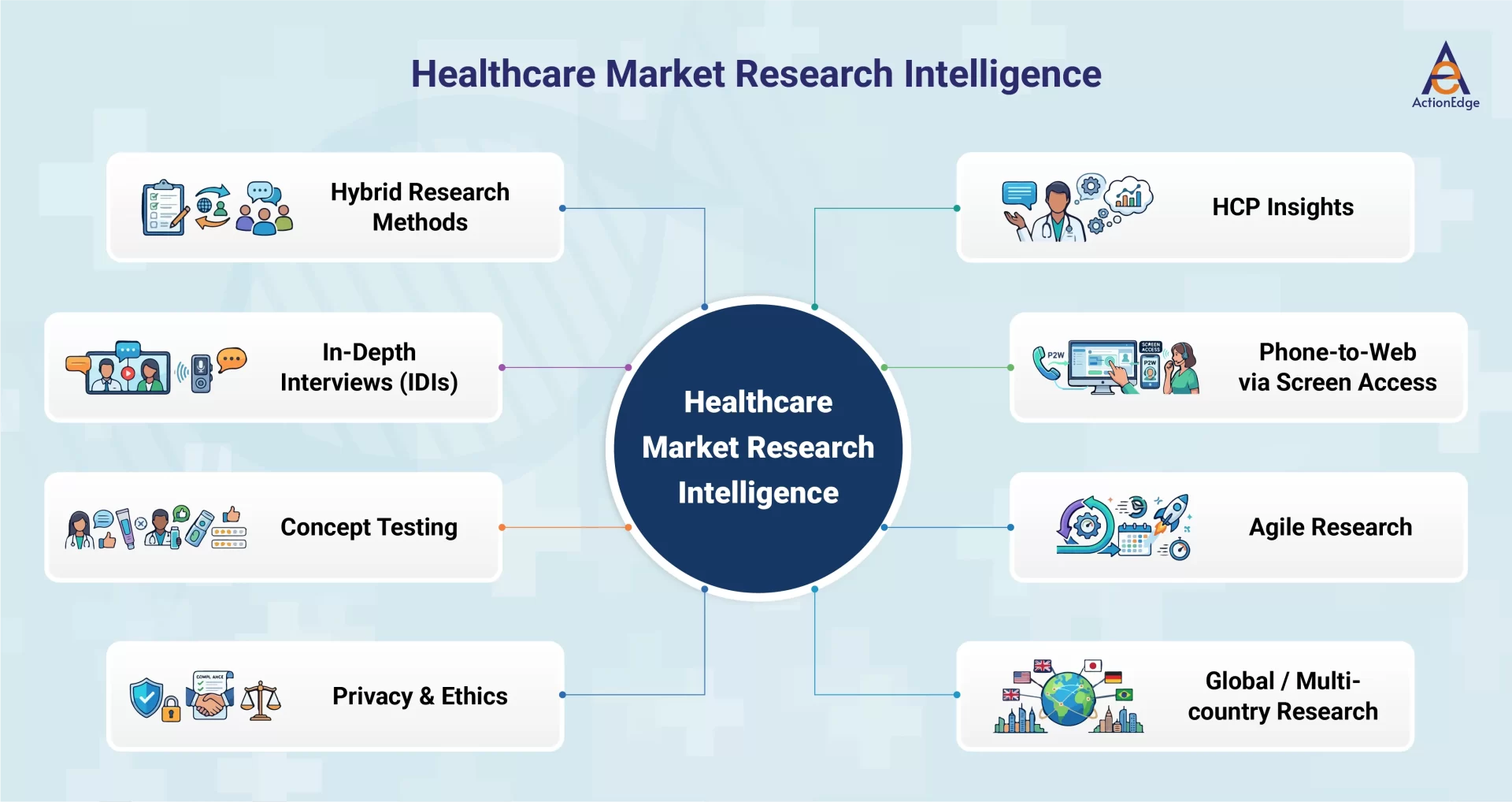
1. Rise of Hybrid Research Methodologies
As healthcare organizations operate in a dual-speed environment, balancing efficiency and digital transformation, research methodologies are evolving to combine speed with depth, making hybrid approaches increasingly essential.
Traditional methods are no longer enough to capture the complexity of modern healthcare. Hybrid approaches that combine healthcare qualitative research and healthcare quantitative research are becoming the norm.
While surveys highlight patterns, qualitative insights explain the “why” behind them. For example, physician preference data becomes far more meaningful when supported by in-depth interviews.
Multi-mode research, combining online surveys, telephonic interviews, and digital tools, further enhances reach, participation, and data quality.
2. Increased Focus on HCP (Healthcare Professional) Insights
Understanding the perspectives of healthcare professionals has never been more important. Doctors, nurses, and specialists are at the forefront of patient care, and their decisions directly influence treatment outcomes.
HCP research helps organizations uncover prescribing behaviors, treatment preferences, and unmet clinical needs. For example, a pharmaceutical company launching a new therapy must understand not just its efficacy, but also how it fits into existing treatment protocols.
Capturing these insights enables better product positioning, more effective communication strategies, and improved alignment with real-world clinical practice.
3. In-Depth Interviews (IDIs) for Complex Healthcare Insights
Healthcare decisions are rarely simple. They are influenced by clinical evidence, patient needs, regulatory considerations, and personal experience. This complexity makes in-depth interviews (IDI) an essential research tool.
Through one-on-one conversations, researchers can explore motivations, challenges, and decision-making processes in detail. These interviews are particularly valuable when studying sensitive topics or niche therapeutic areas.
For example, understanding why a specialist hesitates to adopt a new device often requires a deeper conversation than a standard survey can provide. IDIs bridge that gap, offering nuanced insights that support strategic planning and innovation.
4. Phone-to-Web via Screen Access (P2W SA) in Healthcare Research
Technology is transforming how researchers interact with participants. Phone-to-web via screen access (P2W SA) is emerging as a powerful method that combines the personal touch of phone interviews with the visual capabilities of digital platforms.
This approach allows respondents to view concepts, prototypes, or data in real time while discussing them with an interviewer. The result is more accurate feedback and higher engagement levels.
P2W SA is especially useful in concept testing and digital health research, where visual elements play a crucial role. It ensures that participants fully understand what they are evaluating, leading to more reliable insights.
5. Medical Device and Treatment Concept Testing
Innovation in healthcare comes with high stakes. Before launching a new device or treatment, organizations must ensure that it meets both clinical and market expectations.
Concept testing helps validate ideas early in the development process. By combining healthcare qualitative research with healthcare quantitative research, researchers can assess usability, effectiveness, and market potential.
For instance, testing a new surgical tool with a group of specialists can reveal practical challenges that may not be apparent during development. Addressing these insights early reduces risk and improves the chances of successful adoption.
6. Real-Time and Agile Healthcare Research
The healthcare landscape is constantly evolving, driven by new regulations, emerging diseases, and shifting patient expectations. As predictive analytics adoption accelerates at a projected CAGR of 26.5%, healthcare organizations are increasingly prioritizing real-time and continuous research approaches. In this environment, waiting months for insights is no longer practical.
Agile research focuses on delivering faster, ongoing insights through shorter feedback cycles. This enables organizations to adapt strategies in real time and stay responsive to market changes.
For example, during a product launch, continuous research can track physician responses and quickly highlight areas for improvement. This ensures strategies remain relevant, effective, and aligned with evolving healthcare needs.
7. Privacy-First and Ethical Research Approaches
With increasing reliance on data comes greater responsibility. Healthcare research involves sensitive information, making privacy and ethics a top priority.
Strict regulations and compliance requirements are shaping how research is conducted. Organizations must ensure secure data collection, storage, and usage while maintaining transparency with participants.
Building trust is essential. When respondents feel confident that their data is protected, they are more likely to provide honest and meaningful feedback. Ethical practices are no longer optional; they are fundamental to credible research.
8. Multi-Country and Multilingual Healthcare Research
Healthcare challenges vary significantly across regions. What works in one country may not be effective in another due to cultural, economic, or regulatory differences.
Global studies are becoming increasingly important as organizations expand their reach. Conducting research across multiple countries requires careful planning, including language adaptation and cultural sensitivity.
Localized strategies ensure that insights are relevant and actionable. This approach helps organizations tailor products and services to meet the unique needs of diverse populations.
How ActionEdge Can Help Pharma & Life Sciences Organizations
Navigating these trends requires expertise, advanced methodologies, and a deep understanding of the healthcare ecosystem. As a trusted market research company, ActionEdge supports pharma and life sciences organizations in making informed decisions.
With strong capabilities in both healthcare qualitative research and healthcare quantitative research, we deliver comprehensive insights tailored to specific business needs. Our expertise spans advanced methodologies such as CATI and CAWI Research, IDIs, and P2W SA.
The global reach, combined with multilingual capabilities, enables seamless execution of multi-country studies. From concept testing to HCP insights, we provide actionable intelligence that drives innovation and growth.
Conclusion
The future of healthcare market research is being shaped by technology, agility, and a deeper focus on human insights. As the industry continues to evolve, organizations that embrace modern research methodologies will be better equipped to navigate complexity and seize new opportunities.
Success will depend on the ability to combine data-driven approaches with a genuine understanding of stakeholders, from patients to healthcare professionals. Those who invest in advanced research strategies today will gain a significant competitive advantage tomorrow.
Turn insights into smarter healthcare decisions with ActionEdge. Connect with us today.
Frequently Asked Questions
As a global market research company, ActionEdge Research Services provides customized healthcare market research utilizing state-of-the-art and innovative research methodologies and quality healthcare data. ActionEdge Research Services has market research specialists who provide life sciences and pharma-related organizations with valuable and accurate research to assist organizations in achieving their research goals.
Ongoing healthcare market research can also help companies continue to monitor changes in patient behavior, trends in technology implementation/adoption, overall marketplace dynamics, and ultimately forecast demand for ongoing planning within their organizations.
Heavily used research methodologies such as HCP research, in-depth interviews (IDIs), Phone-to-Web via Screen Access (P2W SA), CATI and CAWI research usually provide both depth and scale of the impact of the research methodologies. In addition, using a mixed-mode approach to the methodology can allow an organization to gather more comprehensive and reliable data.
Combining healthcare qualitative research with healthcare quantitative research allows organizations to validate concepts, identify areas of need that currently are not being met, and identify any potential barriers to productivity prior to launching products into the marketplace. Collectively, this helps eliminate confusion and create more effective commercialization strategies.
Healthcare market research allows life sciences and pharmaceutical companies to understand new emerging trends in patient needs, treatment types, and the wants and expectations of various stakeholders. High-quality pharma market research can enable companies at every point in the product life cycle to make better decisions.