Choosing an insurance policy is rarely simple. It involves trust, financial planning, and uncertainty, with customers often comparing multiple options before deciding.
In today’s competitive market, expectations have evolved beyond affordability to include transparency, personalization, and seamless digital experiences. For insurers, understanding what customers choose is no longer enough. They need to understand why.
This is where in-depth interviews (IDI) play a crucial role, helping uncover the motivations, concerns, and emotions behind decisions, making insurance market research more insightful and actionable.
What Influences Policyholder Decision-Making?
Insurance decisions are shaped by a combination of rational and emotional factors. While pricing remains important, it is rarely the only driver.
Pricing and Premium Affordability:
Cost is often the first filter. Customers compare premiums across providers, but they also weigh value against coverage.
Trust and Brand Credibility:
Insurance is built on trust. Customers prefer brands that feel reliable, transparent, and dependable, especially when it comes to claims.
Coverage Benefits and Flexibility:
Policies that offer clear benefits, add-ons, and customization tend to stand out. Customers want solutions that fit their specific needs.
Digital Experience and Ease of Purchase:
A seamless online journey can influence decisions significantly. Complicated interfaces or unclear information can lead to drop-offs.
Claims Process Expectations:
Customers often base decisions on how easy or difficult they believe the claims process will be. Even perceived complexity can impact choice.
Understanding these factors requires more than surface-level data. It requires depth, which is where qualitative research in insurance becomes essential.
Why Traditional Surveys Don’t Capture the Full Picture
Surveys are widely used in insurance market research, but they often fall short when it comes to capturing real decision-making behavior.
Surface-Level Responses:
Most surveys rely on predefined options. While useful for measurement, they limit the depth of responses.
Limited Context:
A customer might select “price” as a key factor, but what does that really mean? Is it affordability, perceived value, or fear of overpaying?
Survey Fatigue and Bias:
Frequent surveys can lead to rushed or disengaged responses. Participants may also provide socially desirable answers instead of honest ones.
Missing Emotional Drivers:
Insurance decisions are often influenced by fear, trust, and past experiences. These emotions are difficult to capture through structured questionnaires.
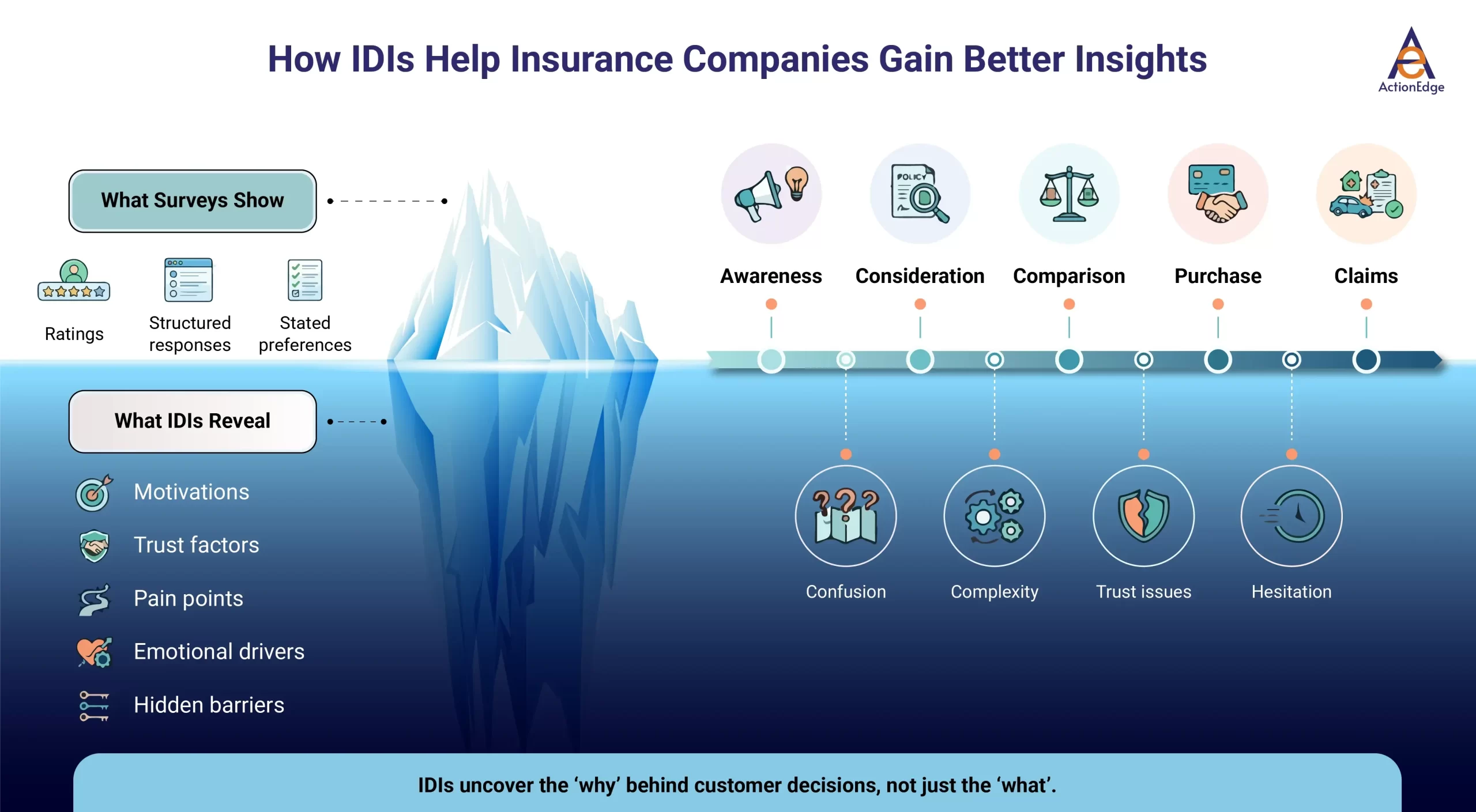
How IDIs Help Insurance Companies Gain Better Insights
This is where in-depth interviews (IDI) create real value. They go beyond structured responses and allow insurers to explore the full context behind customer decisions.
Uncover Motivations Behind Policy Selection:
Through open conversations, insurers can understand what truly drives a customer to choose one policy over another.
Understand Perceptions and Trust Factors:
IDIs help reveal how customers perceive different brands, what builds trust, and what creates hesitation.
Identify Pain Points in the Decision Journey:
From comparing policies to completing the purchase, IDIs highlight friction points that surveys often miss.
Explore Hidden Barriers to Adoption:
Customers may hesitate due to confusion, lack of clarity, or perceived complexity. These barriers often remain hidden in survey data.
Capture Emotional and Behavioral Insights:
Real conversations uncover emotions such as fear of rejection during claims or uncertainty about coverage, offering a more human view of decision-making.
For example, a survey might show that customers abandon a policy purchase midway. An IDI can reveal that the actual issue is unclear policy language or a lack of trust in claim approval.
This is exactly how in-depth interviews help insurance companies move from assumptions to real understanding.
When combined with qualitative and quantitative research, IDIs create a balanced approach. Many insurers are now adopting hybrid market research models that blend depth with scale, making insights more reliable and actionable.
How ActionEdge Can Help Insurance Companies
At ActionEdge, we help insurers move beyond surface-level data to uncover meaningful insights in insurance market research. As a trusted market research company, we combine qualitative and quantitative research, including specialized in-depth interviews (IDI), to understand real customer motivations and behaviors.
Using advanced methodologies like CATI, CAWI, and Phone-to-Web via screen access, along with multi-country and multilingual reach, we deliver insights that go beyond data, helping brands improve customer experience, build trust, and drive growth through our market research service.
Conclusion
Insurance decisions are rarely driven by numbers alone. They are influenced by trust, perception, experience, and emotion.
This is why relying only on traditional methods is no longer enough. To truly understand policyholders, insurers need deeper, more human insights.
That is where in-depth interviews (IDI) make a difference. They transform customer feedback into meaningful conversations, helping businesses uncover the real reasons behind decisions.
Stronger understanding leads to better products, clearer communication, and more confident customers. In a competitive market, that can be the difference between being considered and being chosen.
If you are looking to elevate your insurance market research and truly understand your customers?
Connect with ActionEdge today and start making smarter, insight-driven decisions that build lasting customer trust.
Frequently Asked Questions
As a result of being one of the leading providers of insurance market research, ActionEdge Research Services provides flexible, market research service solutions that include both qualitative and quantitative research in order to develop actionable insights about policyholders.
In-depth interviews (IDI) are utilized by insurance providers to understand the customer journey and to identify areas of friction within a claims process and/or other service interactions. Also, hybrid research methodologies and phone-to-web via screen access provide opportunities to gain additional insights.
Using qualitative research enables insurance companies to gain insight into potential customer needs and wants prior to launching new products into the marketplace; additionally, combining both qualitative and quantitative research techniques enables validation of concepts while minimizing risk.
One of the most important ways in which in-depth interviews assist insurance companies is to uncover “pain points,” customer expectations/requirements for service, and issues surrounding trust; understanding these nuances is key to retaining customers.
Insurance providers have begun to rely on qualitative methods (e.g., in-depth interviews) in order to glean information regarding motivations, concerns, and decision drivers for their customers; these would not be apparent with survey instruments alone. Therefore, qualitative research provides an excellent supplementary tool to conventional types of insurance market research methods.