A product launches with confidence, backed by months of planning and a strong internal vision. Yet within weeks, adoption slows, customer feedback turns inconsistent, and competitors move faster with solutions customers actually want.
This is the reality many businesses are facing in 2026.
Markets are shifting faster than ever. Consumer expectations evolve overnight, AI is changing industries at scale, and economic uncertainty continues to influence purchasing behavior. Decisions that once relied on experience or intuition alone are now far too risky.
Today, leaders are not just asking, “What should we do next?” They are asking, “What does the market actually need right now?”
That shift is making research more important than ever. Businesses are increasingly relying on evidence, customer intelligence, and real-time feedback to reduce uncertainty before making major decisions. Assumptions are being replaced with insight-driven strategies that are faster, smarter, and more adaptable.
In this environment, research is no longer a support function. It has become a critical tool for reducing business risk and building long-term resilience.
The Growing Role of Market Research in Decision-Making
Market research has evolved significantly over the last few years. What was once viewed as a reporting function is now becoming a strategic intelligence engine for organizations.
Decision-makers today use research to understand market dynamics, validate opportunities, anticipate risks, and guide investment decisions. Instead of relying solely on historical performance, businesses are turning to predictive and customer-centric insights to shape future strategies.
This shift is especially important in highly competitive industries where consumer preferences change rapidly. Organizations that consistently gather and apply market insights are often better positioned to adapt faster than competitors.
A well-designed market research survey can now do far more than measure customer satisfaction. It can reveal buying triggers, pricing sensitivity, unmet needs, and emerging market shifts before they become larger business problems.
Research is no longer just about collecting data. It is about reducing uncertainty.
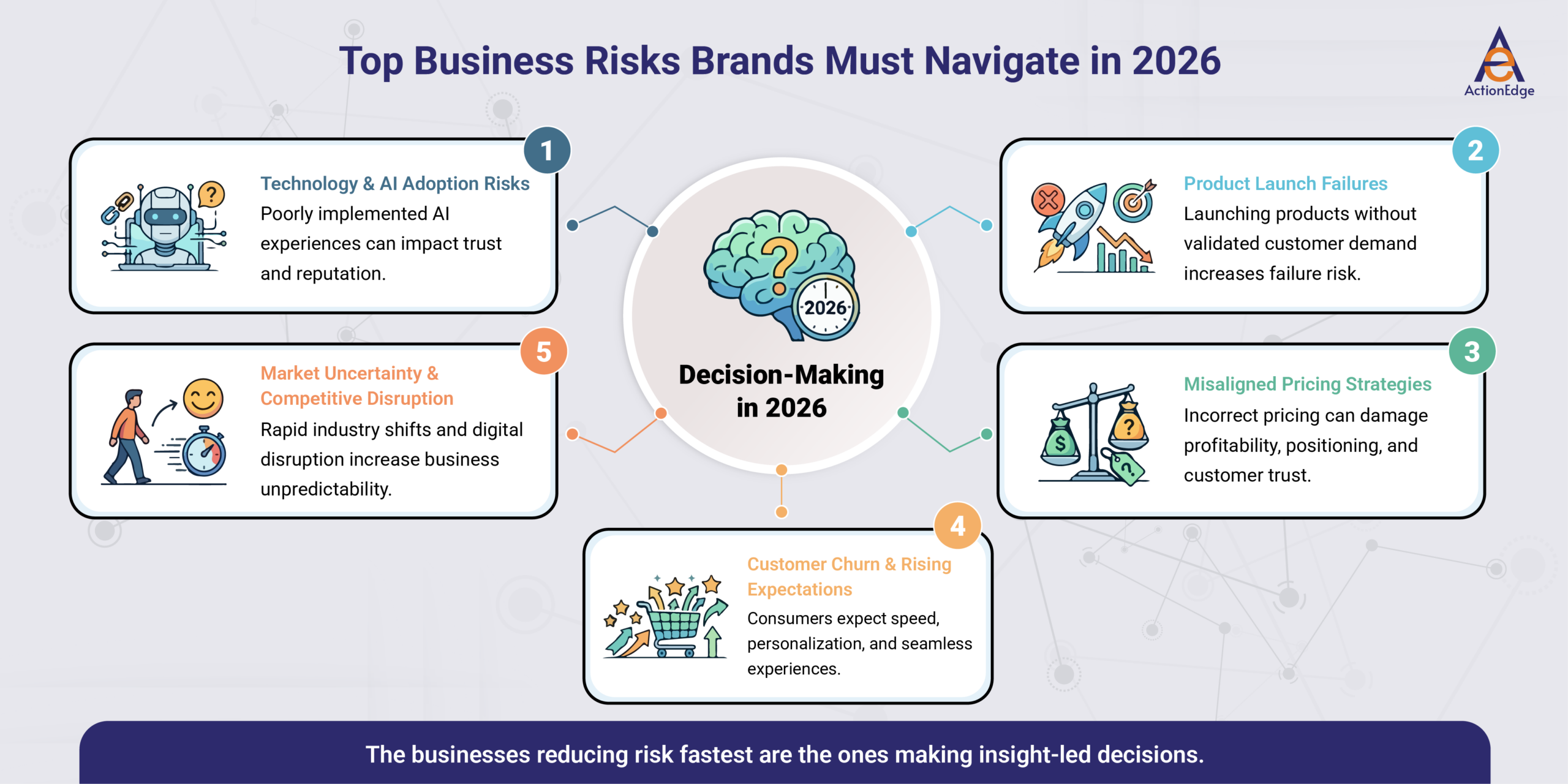
Key Risks Businesses Face in 2026
Business leaders today are navigating multiple layers of risk simultaneously.
Product Launch Failures:
Even innovative products can fail if they do not align with customer expectations or solve a meaningful problem. Many businesses still launch products based on internal assumptions rather than validated market demand.
Misaligned Pricing Strategies:
Pricing has become increasingly complex in a competitive and inflation-sensitive environment. Pricing a product too high risks losing customers, while underpricing can hurt profitability and brand positioning.
Customer Churn and Changing Expectations:
Consumers today expect speed, personalization, convenience, and transparency. Brands that fail to evolve with these expectations often struggle with retention and loyalty.
Market Uncertainty and Competitive Disruption:
New entrants, changing regulations, global events, and digital transformation continue to disrupt industries. Companies that lack visibility into shifting market conditions are more vulnerable to sudden changes.
Technology and AI Adoption Risks:
AI adoption is accelerating across sectors, but businesses are still learning how customers truly perceive automation, personalization, and AI-driven experiences. Misjudging this balance can create both operational and reputational risks.
How Research Helps Reduce Business Risk
Research helps organizations make informed decisions before risks become costly mistakes.
Understanding Customer Behavior
Businesses can no longer rely on assumptions about what customers want. Research provides direct insight into consumer expectations, frustrations, motivations, and decision-making patterns.
For example, a company may assume customers prioritize price, while research reveals that trust and convenience are stronger drivers of purchase decisions.
Validating Concepts Before Launch
Testing products, services, campaigns, or pricing strategies before launch allows businesses to identify weaknesses early. This reduces the likelihood of expensive failures.
Identifying Market Opportunities
Research also uncovers gaps that competitors may have overlooked. These opportunities often become growth areas for brands willing to act quickly.
Supporting Strategic Planning
Leadership teams increasingly use research to guide long-term investments, customer experience improvements, digital transformation, and innovation planning.
Reliable insights reduce guesswork and improve confidence in strategic decisions.
Research Methods Decision-Makers Are Prioritizing
As business challenges become more complex, research approaches are evolving as well.
Quantitative Research for Scale
Quantitative market research helps organizations gather large-scale data, identify patterns, and measure trends across broader audiences. Surveys, analytics, and tracking studies provide measurable insights that support strategic planning.
Qualitative Research for Context
While quantitative data explains what is happening, qualitative market research helps uncover why it is happening. Conversations, interviews, and exploratory discussions reveal emotions, perceptions, and hidden motivations.
In-Depth Interviews for Strategic Insights
IDI in market research has become increasingly valuable for leadership decision-making. In-Depth Interviews allow businesses to explore complex topics, customer pain points, and strategic concerns in detail.
For example, an interview with a customer may uncover operational frustrations or trust issues that a standard survey would never reveal.
Hybrid Research Approaches
Businesses are increasingly adopting hybrid research methods that combine multiple methodologies to improve both depth and scalability.
This includes approaches such as:
- CATI Research for guided conversations and contextual understanding
- CAWI Research for scalable digital surveys
- Phone-to-web via screen access (P2W SA) for real-time interaction and behavioral observation
These integrated approaches provide richer and more reliable insights than single-method studies alone.
Real-Time Research
Static annual reports are no longer enough. Businesses now need continuous feedback loops to respond quickly to changing market conditions.
Real-time research helps organizations adapt faster, validate decisions quickly, and reduce response lag during periods of uncertainty.
Why Traditional Research Alone Is No Longer Enough
Traditional research methods still offer value, but relying on them alone creates limitations in today’s fast-moving business environment.
Long turnaround times often delay decision-making. By the time insights are delivered, market conditions may have already shifted.
Survey fatigue is another growing challenge. Customers are increasingly disengaging from long, repetitive questionnaires, which affects both participation rates and data quality.
Additionally, static reporting often lacks the contextual depth needed to understand modern consumer behavior.
Businesses today require agile, adaptive, and multi-mode research strategies that combine speed with human understanding.
This is why integrated research frameworks are becoming the preferred approach for forward-thinking organizations.
Best Practices for Research-Driven Decision-Making
Organizations that successfully reduce risk through research often follow a few common principles.
Combine Qualitative and Quantitative Insights:
Using both data types creates a more balanced understanding of customer behavior and market trends.
Conduct Continuous Research:
Consumer expectations evolve quickly. Ongoing research provides businesses with up-to-date insights rather than relying on outdated assumptions.
Align Research with Business Goals:
Research should directly support strategic objectives, whether related to innovation, customer experience, pricing, or market expansion.
Act Quickly on Insights:
Insights only create value when organizations act on them. Faster interpretation and implementation improve business agility and competitive response.
How ActionEdge Can Help Businesses Reduce Risk
At ActionEdge, we help organizations make smarter, insight-driven decisions through advanced research methodologies and strategic intelligence.
As an experienced market research company, we combine deep industry expertise with agile research approaches to uncover meaningful business insights.
Our capabilities include qualitative and quantitative research, CATI, CAWI, IDIs, and advanced digital methodologies designed to improve accuracy, reduce uncertainty, and accelerate decision-making.
Our market research service focuses on delivering actionable intelligence rather than just data. From concept testing and customer experience research to strategic planning and market validation, we help businesses move forward with greater confidence.
With multi-country and multi-industry expertise, ActionEdge supports organizations in identifying opportunities, minimizing risk, and adapting faster in a rapidly changing market.
Conclusion
In 2026, business risk is no longer limited to economic uncertainty or competitive pressure. The biggest risk is making decisions without clearly understanding customers, markets, and changing expectations.
This is why research has become essential for modern decision-making. Businesses that invest in quantitative market research, customer intelligence, and adaptive research strategies are far better equipped to navigate uncertainty and respond with confidence.
The future belongs to organizations that listen faster, learn continuously, and act on real insights instead of assumptions.
Ready to make more confident business decisions? Connect with ActionEdge to transform uncertainty into opportunity with smarter, insight-driven research.
Frequently Asked Questions
By providing timely customer insights, market research assists organizations in keeping up with the constantly changing needs of customers. In 2026, data-driven decision making will allow organizations to adjust their strategies according to real behavior and emerging trends.
Market research helps identify risks associated with market changes, competitive behavior, pricing, and product demand. Robust and consistent data collection services and robust market research provide organizations with early warning signals that will support them in mitigating risk before the escalation of risk occurs.
The combination of qualitative and quantitative research services provides organizations with the greatest potential to mitigate risk. This methodology provides a combination of both deeper analytical and quantifiable insights; therefore, organizations are able to make more confident data-driven decisions when developing their organization’s overall strategy.
Market research is used by organizations to test their concepts; confirm demand; refine their position in the marketplace, and increase success rates prior to launching their product or service. The combination of customer insights and data collection services will help organizations mitigate risk and improve their degree of success.
As a global market research company, ActionEdge provides complete end-to-end market research services to assist organizations in mitigating risk. ActionEdge supports organizations by providing both customer insights research and validated Data Collection Services, allowing them to make better-informed, data-driven decisions.