

Many products fail not because they are poorly built, but because they were built on assumptions. Teams believe they understand their customers, set pricing based on internal discussions, and finalize concepts without truly testing how people react. The result is familiar across industries. Poor product-market fit, confusing value propositions, pricing that feels wrong, and low adoption even after a strong launch.
In today’s competitive environment, businesses cannot afford decisions based on guesswork. Whether you are developing a new product, testing a concept, or defining a pricing strategy, you need insights that go beyond surface-level feedback. This is where in-depth interviews become a powerful tool. The IDI research methodology helps uncover real motivations, expectations, and decision triggers that structured surveys often fail to capture.
For organizations involved in B2B Market research, innovation, or high-value decision-making, IDIs provide clarity before costly mistakes happen.
Why Traditional Methods Fall Short
Surveys such as CAWI and CATI are useful for collecting large volumes of data, but they often struggle when the goal is to understand why people behave a certain way. Most questionnaires rely on predefined answers, which means respondents must choose from options even when none fully reflect their real opinion.
Another limitation is the lack of real-time probing. If a respondent gives an unexpected answer, the survey cannot ask follow-up questions. This makes it difficult to understand emotional reactions, hesitation, or hidden concerns behind decisions.
In many cases, respondents also give rational answers instead of emotional truths. They may say they prefer a lower price, but what truly influences their decision could be trust, brand perception, or usability. This gap is widely recognized in practice. According to a survey of 1,700 B2B firms, found that 85% of companies believe their pricing decisions need improvement, largely because traditional research methods fail to capture the emotional and psychological drivers of customer choices.
Traditional methods also struggle when testing complex concepts such as pricing logic, product prototypes, or technical solutions. Without explanation or discussion, respondents may misunderstand the idea, leading to misleading results.
The outcome is simple. Data without context leads to risky decisions.
What Are IDIs and Why They Matter
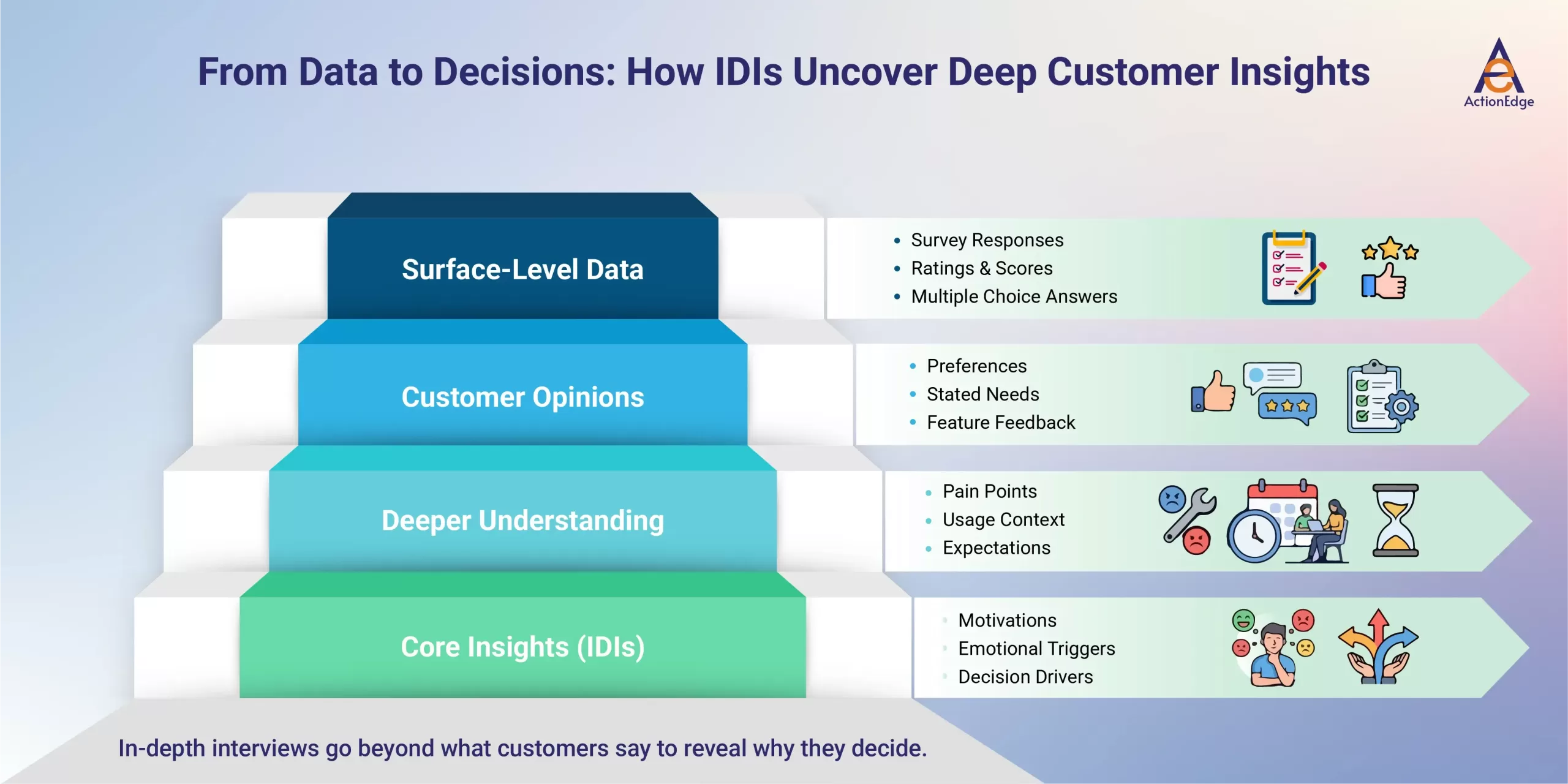
In-depth interviews, commonly known as IDIs, are one-on-one qualitative conversations between a trained interviewer and a selected participant. Unlike structured surveys, these interviews are flexible and allow researchers to explore opinions in detail.
The IDI research methodology focuses on understanding customer perceptions, buying motivations, emotional triggers, and decision journeys. Because the discussion is conversational, the interviewer can probe deeper, clarify responses, and explore unexpected insights.
This approach works especially well in B2B qualitative research, where decisions are complex and often involve multiple stakeholders. In such cases, understanding the reasoning behind choices is more important than simply counting responses.
IDIs are also ideal for niche audiences, high-involvement purchases, and situations where the topic requires explanation. Instead of collecting quick answers, researchers gain meaningful insights that can guide real business decisions.
When used correctly, in-depth interviews turn opinions into actionable insights.
Product Testing: Finding True Product-Market Fit
Problem
Many companies struggle with poor alignment between their products and market needs. Features may be added based on internal opinions rather than user demand. Sometimes products include unnecessary functionality while missing the elements that actually matter to customers.
Without proper product market fit research, these gaps usually surface only after launch, when changes become costly and time-consuming. This challenge is more common than most businesses realize. According to CB Insights, an analysis of 431 VC-backed startup failures since 2023 found that 43% cited poor product-market fit as the primary reason for failure, underscoring the importance of validating ideas early.
How IDIs Help
IDIs allow researchers to explore real user needs in detail. Instead of simply asking whether a feature is useful, the interviewer can understand how the product fits into the user’s context, what problems it should solve, and what expectations the user has.
Participants can review concepts, prototypes, or feature lists while explaining their reactions. This helps identify which features are essential and which add little value. Interviews also reveal how the product is actually used, which is often missed in structured surveys.
This depth becomes especially important when validating product-market fit. As Sean Ellis highlights, a product has strong product-market fit when over 40% of users say they would be “very disappointed” if they could no longer use it. While this benchmark is powerful, it only tells part of the story. IDIs help uncover the nuanced reasons behind that response, such as emotional connection, unmet needs, and key value drivers.
Because the discussion is flexible, researchers capture both emotional and rational responses. This is critical for building products that users not only understand but also trust and prefer.
Outcome
Products that match real user needs, clearer positioning, and stronger confidence before launch.
Concept Testing: Validating Ideas Before Launch
Problem
Many new ideas fail not because they are weak, but because they are not tested properly. Messaging may be unclear, positioning may not resonate, or the concept may be misunderstood by the target audience. When validation happens too late, the cost of change becomes significantly higher.
This challenge is widely reflected in innovation outcomes. According to NIQ BASES, 48% of innovations stall in Year 2 due to misalignment across concept, product, price, and promotion, highlighting how early-stage gaps can derail even promising ideas.
How IDIs Help
IDIs allow early-stage ideas to be tested in a flexible environment. Respondents can review concept descriptions, visuals, or messaging while explaining what they understand and how they interpret it.
Researchers can evaluate whether the idea feels relevant, unique, and valuable. They can also identify confusion, hesitation, or resistance that would not appear in a structured survey.
Another advantage is the ability to explore adoption barriers. Respondents may reveal concerns related to price, usability, trust, or compatibility that were not initially considered.
Because the conversation is open, the concept can be refined during the research process itself.
Outcome
Stronger concepts, clearer positioning, and reduced risk before market launch.
Pricing Research and Strategy: Understanding Willingness to Pay
Problem
Pricing is one of the most sensitive decisions a business makes. If the price is too high, customers hesitate. If it is too low, value perception drops, and revenue suffers. Many pricing decisions are based on internal opinions or competitor benchmarks rather than real customer insights.
How IDIs Help
Through in-depth interviews, researchers can explore how customers evaluate value and what drives willingness to pay. Instead of selecting from price ranges, respondents explain their thinking, compare alternatives, and describe what makes a price feel acceptable.
IDIs also help identify differences across customer segments. In B2B Market research, pricing decisions often involve multiple decision makers, each with different priorities. Interviews make it possible to understand these perspectives in detail.
Researchers can also test different pricing models such as subscriptions, bundles, or tiered plans. Emotional reactions to pricing, which strongly influence decisions, become visible during conversation.
Outcome
Pricing strategies that reflect real customer perception and improve acceptance in the market.
Enhancing IDIs with Hybrid Methods
Problem
IDIs provide deep insights, but the sample size is usually small. Businesses often need both a detailed understanding and large-scale validation before making final decisions.
Solution: Hybrid Research Approach
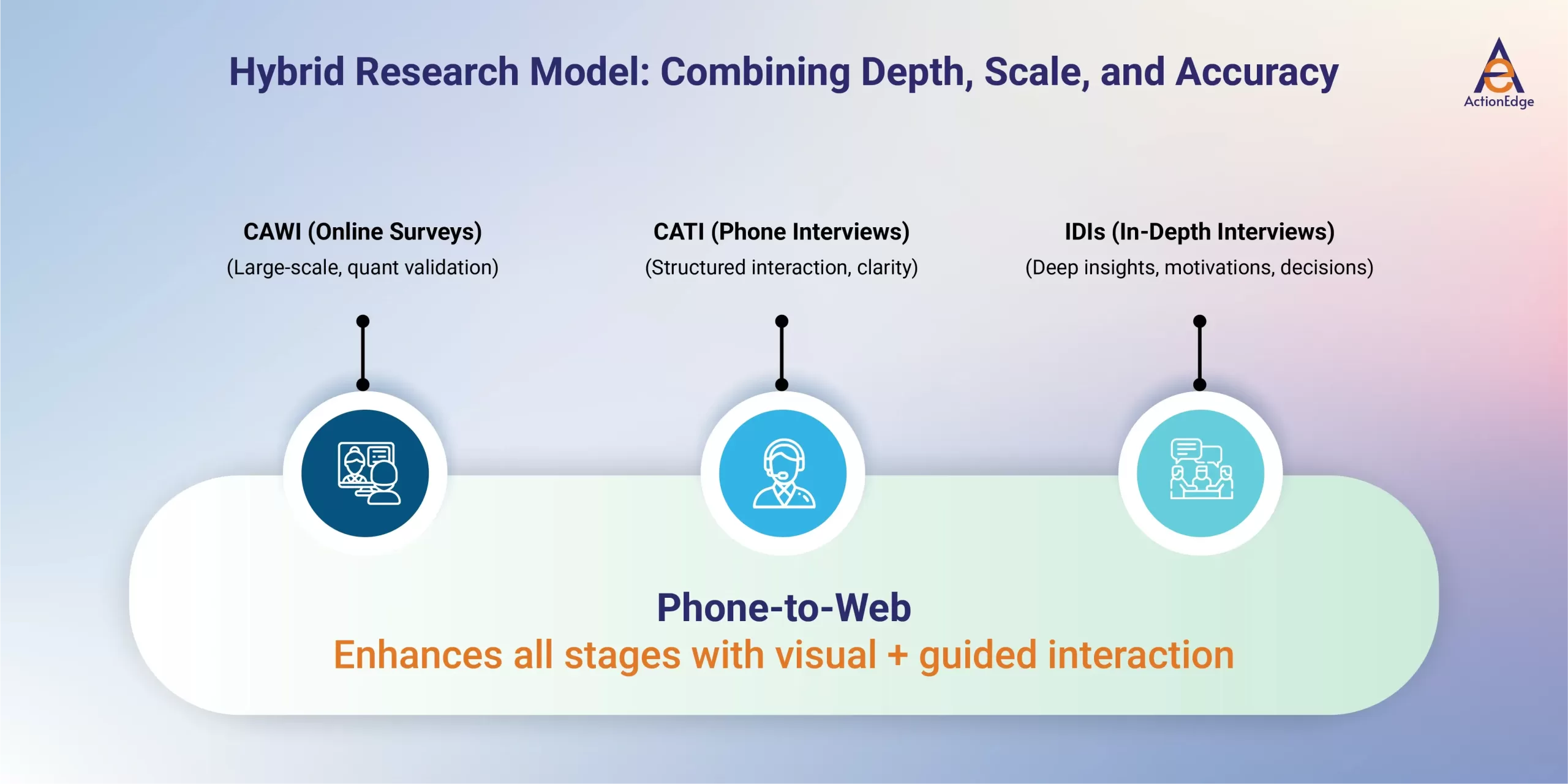
Many organizations combine IDIs with other research methods to create a balanced approach.
- CATI can be used for structured validation through guided interviews.
- CAWI allows insights to be tested with a larger audience.
- Phone-to-Web enables respondents to view concepts, pricing screens, and visuals while remaining connected to the interviewer.
For example, a study may start with IDIs to explore ideas, followed by CAWI to validate trends, and then Phone-to-Web to test concepts in real time.
This multi-mode approach is often delivered by an experienced market research company that offers advanced market research solutions.
Positioning
Multi-mode research combines depth, scale, and accuracy, making it ideal for complex product, pricing, and concept testing projects.
Business Impact
When IDIs are used at the right stage, the benefits are clear. Companies reduce product launch risks because they understand customer expectations earlier. Pricing decisions become more accurate because value perception is known. Concepts become stronger because they are validated before launch.
This becomes even more critical when you consider broader industry trends. According to McKinsey, over 40% of product launches fail to meet their targets, highlighting how common it is for businesses to misjudge market needs despite strong internal planning.
Organizations that invest in IDIs gain a deeper understanding of their customers, which improves communication, positioning, and long-term strategy. By uncovering real motivations and decision drivers early, they significantly increase the chances of market success.
In competitive markets, insight-driven decisions are not optional. They are essential for success.
Conclusion
In a world filled with data, clarity often comes from conversation. Numbers can show what people choose, but only discussion reveals why they choose it. That is why the IDI research methodology remains one of the most valuable tools in modern research.
Whether you are testing products, refining concepts, or defining pricing, in-depth interviews help uncover the real drivers behind decisions. Combined with hybrid approaches and expert execution, they allow businesses to move forward with confidence rather than on assumptions.
If you are planning product, pricing, or concept testing, work with a trusted market research company that offers the right market research service and expertise in B2B qualitative research.
The right conversation today can prevent costly mistakes tomorrow!
Frequently Asked Questions
Businesses should use in-depth interviews market research when decisions require deeper understanding beyond surface-level responses. For pricing and concept testing, the IDI research methodology helps uncover perceived value, emotional drivers, and hidden concerns that surveys often miss, making it critical for accurate product market fit research.
The cost and timeline for in-depth interviews market research vary based on audience complexity, geography, and study scope. Typically, IDI studies take 2 to 6 weeks, including recruitment, interviews, and analysis. A reliable market research service ensures efficient execution while maintaining depth and data quality.
While IDIs are inherently qualitative, they can be scaled effectively when combined with other methods. Many organizations integrate B2B qualitative research with quantitative approaches to validate insights across markets. This makes IDIs a strong foundation for large-scale B2B Market research initiatives.
As an experienced market research company, ActionEdge delivers end-to-end support for IDI-led studies, including expert recruitment, discussion guide design, moderation, and analysis. Their approach combines the IDI research methodology with broader market research service capabilities to support product, pricing, and concept validation.
Participant recruitment in in-depth interviews market research is based on precise targeting, including role, industry, and decision-making authority. For B2B Market research, this often involves senior stakeholders and domain experts. IDIs can be conducted remotely, enabling access to niche audiences across regions while supporting effective product market fit research.