

A patient skipping medication, a doctor hesitating to adopt a new treatment, or a caregiver struggling with digital healthcare platforms may seem like isolated moments. In reality, they are signals that shape critical healthcare decisions.
In 2026, healthcare organizations are operating in a landscape where patient expectations, regulatory requirements, digital transformation, and treatment innovation are evolving rapidly. Decisions can no longer rely on fragmented data or one-dimensional feedback methods. Healthcare leaders need insights that are faster, deeper, and grounded in real-world experiences.
Hybrid research is no longer experimental, according to Greenbook, 75% of researchers surveyed had already used hybrid methodologies in their projects. This shift reflects a growing industry need for research approaches that balance scalability with human understanding.
Traditional single-method research often falls short in capturing healthcare complexity. Telephone interviews may provide depth but lack scalability, while online surveys can reach larger audiences but may miss emotional nuance and contextual understanding.
This is why hybrid healthcare research is becoming increasingly important. By combining methodologies such as CATI and CAWI, organizations can generate more reliable, actionable, and patient-centric insights that support smarter healthcare decision-making.
What Is Hybrid Research in Healthcare?
In order to produce deeper, more trustworthy findings, hybrid research integrates several data collection techniques into a single study.
This strategy is particularly useful in the healthcare industry because various stakeholders, including patients, healthcare providers, carers, and legislators, have varying interactions with healthcare systems. It needs both depth and scale to comprehend these viewpoints.
Hybrid research helps organizations understand not only what people say but also why they feel or act in a particular manner by combining qualitative and quantitative methodologies. Decisions made using this integrated approach are more precise, contextual, and well-informed.
Understanding CATI and CAWI
Two of the most widely used methodologies in healthcare research today are CATI and CAWI.
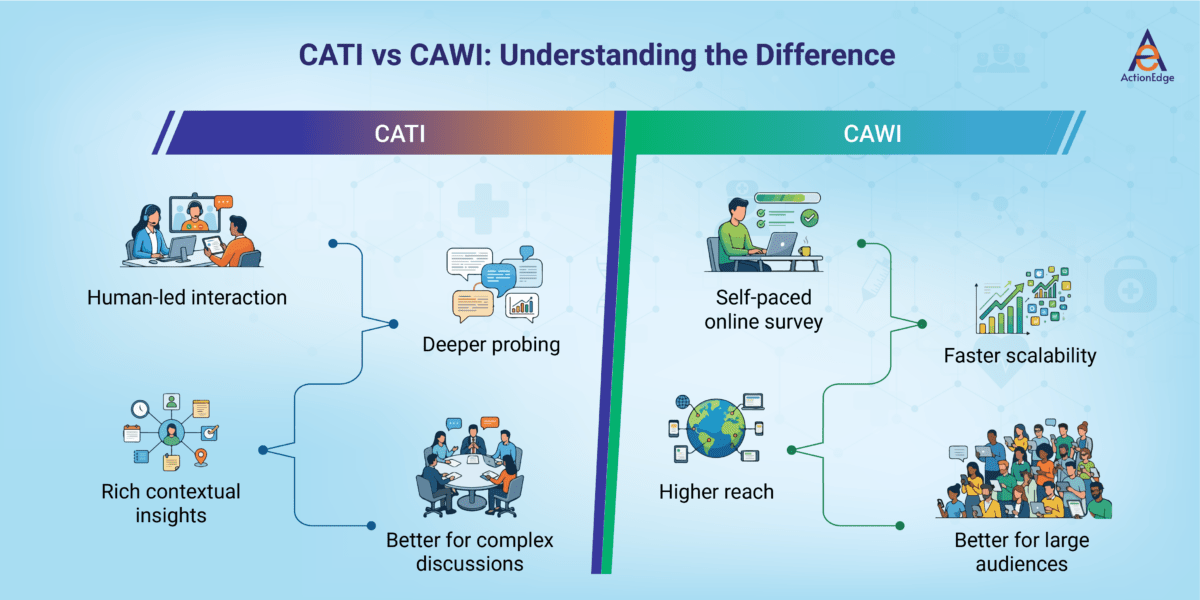
CATI Research in Healthcare
CATI research in healthcare refers to structured interviews conducted over the phone using digital survey systems. Also known as computer assisted telephone interviewing, this method allows interviewers to ask questions, probe responses, and capture detailed feedback in real time.
CATI is especially useful in healthcare as many topics require explanation, empathy, and deeper interaction. Patients discussing treatment experiences or physicians evaluating medical products often provide richer responses in guided conversations.
Common CATI use cases include:
- Patient experience studies
- Physician and HCP research
- Treatment adherence analysis
- Public health surveys
- Healthcare policy feedback
CAWI Research in Healthcare
CAWI research in healthcare includes respondents completing surveys online through digital interfaces.
This method offers scalability, flexibility, and faster turnaround times. Respondents can participate at their convenience, making it highly effective for large-scale studies.
CAWI market research is commonly used for:
- Patient satisfaction surveys
- Digital health platform evaluations
- Brand perception research
- Awareness and usage studies
- Large-scale quant tracking
Limitations of Using CATI or CAWI Alone
Relying on a single research method can create blind spots in healthcare insights.
Limitations of CATI
Telephone interviews offer depth, but they can be time-intensive and resource-heavy. They may also lack visual interaction, which can limit feedback on digital tools, packaging, or healthcare interfaces.
Additionally, some respondents may feel hesitant about discussing sensitive health topics over a live call.
Limitations of CAWI
Online surveys are efficient but often struggle with engagement and completion rates. Respondents may abandon lengthy surveys or provide rushed answers without fully engaging with the questions.
CAWI also limits the ability to probe deeper into responses. A participant may indicate dissatisfaction with a healthcare service, but the survey may not reveal the emotional or situational reasons behind it.
This creates gaps in context, nuance, and decision-making clarity.
Why Combine CATI + CAWI?
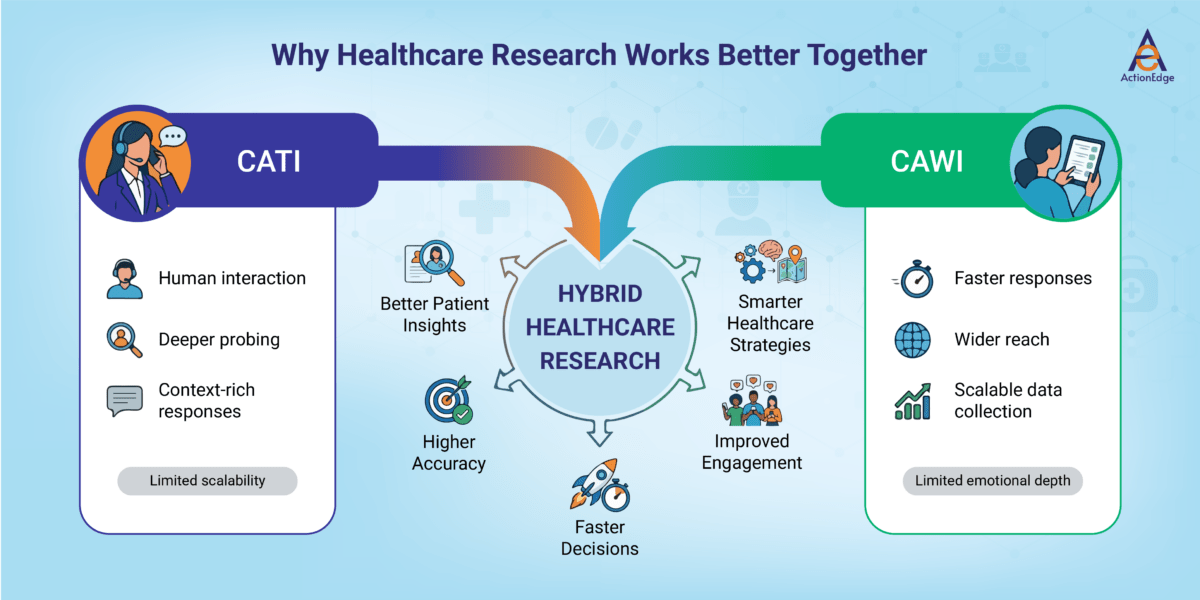
Combining CATI and CAWI allows healthcare organizations to balance scale with depth. Mixed-mode methodologies help balance the scalability of digital surveys with the contextual depth of human interaction
CATI provides the human interaction needed to explore emotions, motivations, and experiences. CAWI provides reach, speed, and data scalability.
Together, they create a more holistic research framework.
Enhanced Quality of Response:
It is frequently possible to contact respondents who might disregard online surveys via phone. In a similar vein, audiences who are at ease with technology might like self-paced online engagement.
Participation and overall response quality are enhanced by this flexibility.
Improved Validation of Data:
Researchers can cross-check and confirm results across channels by using a variety of approaches. As a result, prejudice is lessened, and trust in the outcomes is increased.
Increased Audience Reach:
A variety of responder groups, such as senior patients, doctors, carers, and tech-savvy consumers, are frequently included in healthcare research. Effectively engaging these varied populations is easier with a hybrid approach.
Key Benefits of Hybrid Research in Healthcare
Richer Insights
Combining qualitative and quantitative research provides a more complete understanding of healthcare experiences and behaviors. Surveys may reveal declining satisfaction, while interviews uncover the real reasons behind it.
Reduced Bias and Higher Accuracy
Using multiple research methods helps validate findings and reduces dependence on a single data source, leading to more reliable insights.
Faster Decision-Making
CAWI enables quick data collection, while CATI adds real-time clarification and context. Together, they speed up insight generation and strategic action.
Greater Flexibility
Hybrid research adapts to different respondent preferences, research goals, and healthcare scenarios, making participation easier and more effective.
Use Cases in Healthcare Research
Hybrid research is increasingly being used across the healthcare and life sciences sectors.
Patient Experience Studies:
Healthcare providers use hybrid methodologies to understand satisfaction, treatment journeys, and service quality across multiple touchpoints.
Healthcare Professional Insights:
Doctors and specialists often prefer structured interviews for detailed discussions, while online surveys support broader quantitative validation.
Drug and Treatment Perception Research:
Pharmaceutical companies use hybrid studies to evaluate patient trust, treatment adherence, and medication perception.
Pricing and Concept Testing:
Healthcare brands can test product concepts, pricing strategies, or healthcare solutions using a mix of online surveys and guided interviews.
Public Health Research:
Governments and healthcare organizations increasingly rely on hybrid approaches to assess awareness, policy effectiveness, and public sentiment.
Enhancing Hybrid Research with Advanced Methods
Modern healthcare research is evolving beyond traditional surveys and interviews.
Integration with IDIs
Adding In-Depth Interviews (IDIs) to hybrid studies helps uncover emotional and contextual insights that structured formats may miss.
Phone-to-Web (P2W) with Screen Access
Researchers can combine phone conversations with live digital interaction, allowing respondents to navigate apps, portals, or treatment materials while sharing feedback in real time.
Behavioral + Claimed Data
Healthcare organizations are increasingly combining behavioral analytics with survey responses to better understand actual versus stated behavior.
Real-Time Validation
Researchers can instantly clarify responses, probe deeper, and validate findings during live interactions.
Best Practices for Implementing CATI + CAWI
Successful hybrid healthcare research depends on careful planning, respondent experience, and strong data management practices. Key best practices include:
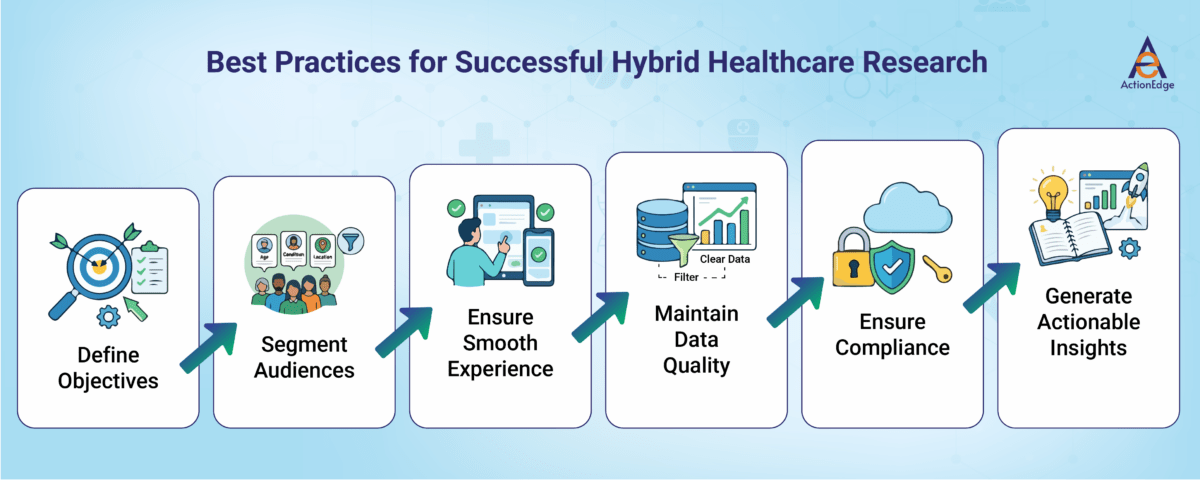
- Define Clear Objectives: Align research methods with business, clinical, or patient-focused goals for actionable insights.
- Segment Audiences Smartly: Tailor engagement approaches based on demographics, digital familiarity, and healthcare involvement.
- Ensure Smooth Transitions: Keep the shift between CATI and CAWI seamless to avoid respondent drop-offs.
- Maintain Data Quality: Use standardized questionnaires and validation checks for consistent, reliable insights.
- Prioritize Compliance: Follow HIPAA, GDPR, and other privacy regulations to protect sensitive healthcare data.
- Enhance Respondent Experience: Keep interactions simple, clear, and engaging to improve participation rates.
- Balance Qualitative and Quantitative Methods: Combine conversational depth with scalable survey data for more meaningful insights.
Challenges and Considerations
Although hybrid research has many benefits, it also has disadvantages. It can be difficult to integrate data across techniques. Consistency in question formulation, analysis, and interpretation is a prerequisite for researchers.
Another crucial factor is striking a balance between cost and value. Although hybrid approaches may require more resources, the quality and reliability of the insights often make the investment worthwhile.
To prevent fatigue or confusion across research modes, organizations must also carefully control respondents’ experience.
How Hybrid Research Improves Decision-Making in Healthcare
Healthcare researchers increasingly view technology as an enhancer to insight generation rather than a replacement for human expertise and empathy. As digital tools and AI accelerate data collection and analysis, human interaction remains essential for understanding emotions, motivations, and real-world healthcare experiences.
By combining methodologies such as CATI and CAWI, hybrid research enables organizations to gather both scalable quantitative data and deeper contextual insights. This leads to more informed healthcare decisions, improved patient engagement, stronger communication about treatment, and more patient-centric strategies.
Hybrid research also supports evidence-based policy and operational decisions by helping healthcare systems adapt more effectively to evolving patient expectations, treatment behaviors, and market dynamics.
In a rapidly changing healthcare landscape, reliable and actionable insights are no longer just a research outcome; they are a strategic advantage.
How ActionEdge Can Help Healthcare Organizations
At ActionEdge, we help healthcare and life sciences organizations uncover deeper insights through integrated research methodologies.
As an experienced market research company, we combine CATI, CAWI, IDIs, and advanced digital methodologies to deliver high-quality, actionable intelligence.
Our expertise as both a qualitative research firm and a quantitative research firm allows us to balance depth with scale, ensuring healthcare brands gain meaningful insights that support smarter decisions.
Our market research service is designed to help organizations improve their patient experience, validate strategies, optimize communication, and accelerate innovation with confidence.
Conclusion
The future of healthcare research is no longer about choosing between speed and depth. It is about combining both intelligently.
As healthcare ecosystems become more connected and patient expectations continue to evolve, organizations need research approaches that capture not just opinions, but real experiences and behaviors.
This is why hybrid research in healthcare is quickly becoming the new industry standard. By combining CATI and CAWI, organizations can generate richer insights, improve accuracy, and make more confident decisions.
Healthcare leaders who embrace flexible, insight-driven research strategies today will be better equipped to drive patient-centric innovation tomorrow.
Ready to transform healthcare insights into smarter decisions? Connect with ActionEdge to build research strategies that deliver clarity, speed, and impact.
Frequently Asked Questions
Healthcare organizations are increasingly adopting hybrid methodologies to improve respondent reach, data accuracy, and research flexibility. Combining digital and interviewer-led approaches helps strengthen healthcare market research while supporting faster and more reliable insights.
Hybrid research in healthcare combines CATI and CAWI healthcare research methodologies to collect data through both telephone interviews and online surveys. This approach improves participation rates and enables more effective hybrid healthcare surveys across diverse patient and healthcare audiences.
Hybrid research supports digital transformation by enabling flexible, technology-driven data collection methods. Integrating CATI research in healthcare with CAWI research in healthcare allows organizations to gather timely patient feedback, improve healthcare experiences, and enhance decision-making.
Leading providers of healthcare market research maintain data quality through respondent validation, survey monitoring, secure workflows, and standardized processes. Combining CAWI market research and CATI market research methodologies also helps improve consistency and research reliability.
As a global Market research company, ActionEdge Research Services delivers scalable healthcare data collection services using advanced hybrid healthcare surveys, CATI market research, and CAWI market research methodologies. The company helps healthcare organizations generate accurate, secure, and actionable research insights.