
Decisions today are no longer made in boardrooms alone. They are shaped in real time, influenced by customer behavior, digital signals, and rapidly evolving expectations. In 2026, businesses are no longer just asking “what do customers think” but “what are they actually doing right now and why.”
The growing complexity of markets means that relying on outdated, slow-moving research models is no longer viable. Consumer journeys are fragmented, attention spans are shorter, and competition is more dynamic than ever. Traditional research methods, while foundational, often struggle to keep pace with this shift.
What businesses need today are faster, sharper, and more context-rich insights. The focus has moved from static reports to continuous intelligence. From assumptions to evidence. From hindsight to foresight.
This is where market research trends 2026 come into play. They are not just shaping how research is conducted but redefining how decisions are made. As global investment in AI accelerates, the shift becomes even more evident. According to Gartner, worldwide AI spending is expected to reach $2.52 trillion in 2026, fueling the move toward predictive, real-time, and insight-driven research.
So, what should organizations adopt right now to stay ahead? Let’s explore the trends transforming decision-making in 2026.
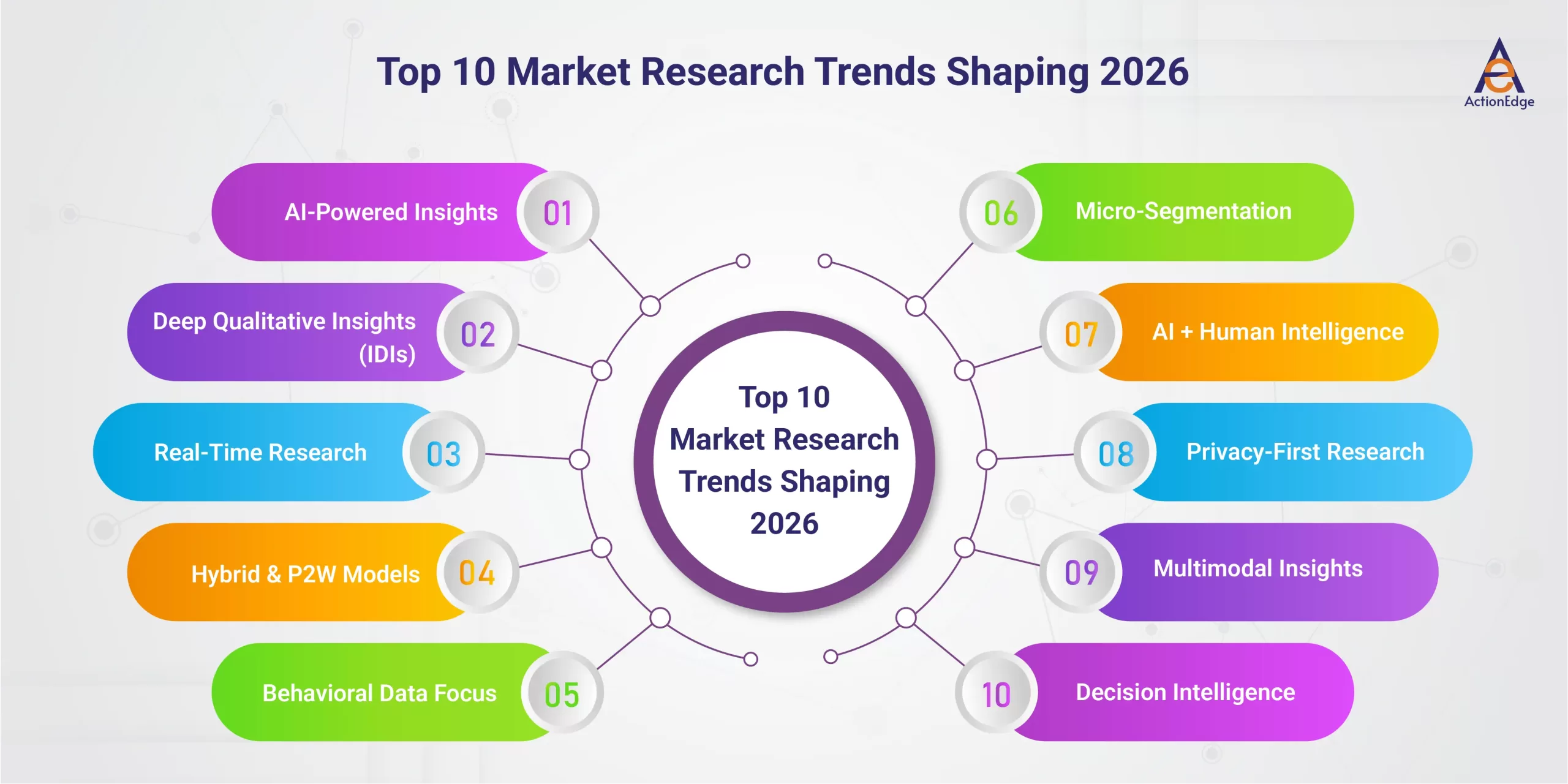
1. AI-Powered Market Research
Artificial intelligence is no longer a futuristic concept. It is at the core of modern research.
With AI in market research, data collection, processing, and analysis have become significantly faster and more efficient. Tasks that once took weeks can now be completed in hours. AI tools can scan massive datasets, identify patterns, and generate insights at scale.
More importantly, the shift from historical reporting to predictive insights is changing the game. Instead of only understanding what happened, businesses can now anticipate what might happen next.
For example, an eCommerce brand can predict churn based on browsing behavior and intervene before a customer churns. This proactive approach is becoming essential.
2. Rise of In-Depth Interviews (IDIs) and Qualitative Depth
While technology accelerates research, human understanding remains irreplaceable.
In-depth interviews (IDI) are gaining renewed importance because they uncover emotions, motivations, and decision drivers that numbers alone cannot explain.
In an era driven by data, businesses are realizing that context is everything. A spike in sales tells you what happened. An interview tells you why.
The real power lies in blending qualitative and quantitative market research. For instance, a survey may reveal that 60% of users abandon the checkout page. IDIs can uncover whether it is due to trust issues, usability concerns, or hidden costs.
This combination leads to more meaningful and actionable insights. The business impact of missing this depth is significant. An analysis by CB Insights of 431 VC-backed startup failures since 2023 found that 43% failed due to poor product-market fit, underscoring the risk of decisions made without a clear understanding of customer needs.
3. Real-Time and Agile Research
The days of waiting weeks for a research report are fading.
Businesses now operate in environments where decisions must be made quickly and confidently. Real-time and agile research enables continuous feedback loops, allowing companies to adapt strategies on the go.
For example, a brand launching a new product can track customer reactions in real time and tweak messaging within days rather than months.
This shift from static reports to dynamic insights is shortening decision cycles and improving responsiveness.
4. Phone-to-Web (P2W) and Hybrid Research Models
One of the most significant innovations in recent years is the rise of Hybrid market research approaches.
Phone-to-web research (P2W) combines the personal touch of phone interviews with the efficiency of digital interfaces. It allows respondents to interact with surveys, visuals, or prototypes while speaking with an interviewer.
Taking this further, Phone-to-web via screen access (P2W SA) enables real-time screen sharing. Respondents can navigate apps, websites, or concepts while researchers observe their behavior in real time.
This creates richer engagement, greater clarity, and deeper insights than traditional methods.
As a result, hybrid market research is becoming a preferred choice for businesses seeking both scale and depth.
5. Behavioral Data Over Claimed Data
What people say and what they do are often very different.
Modern research is increasingly shifting toward behavioral data rather than relying solely on self-reported responses. Passive data collection methods such as clickstream analysis, app usage tracking, and heatmaps provide a far more accurate picture of how users actually behave.
For instance, a user may claim they value sustainability, but their purchase history might suggest otherwise. Behavioral data helps bridge this gap, uncovering the truth behind stated preferences. This growing reliance on real-world actions is also reflected in market momentum. Industry estimates indicate that the behavioral analytics market is set to grow from around $895 million in 2024 to over $6 billion by 2032, signaling a strong shift toward action-based insights over claimed intent.
This evolution is enabling businesses to make decisions grounded in reality rather than assumptions, leading to sharper strategies and more reliable outcomes.
6. Personalization and Micro-Segmentation
Mass marketing is giving way to precision targeting.
In 2026, businesses are moving beyond traditional demographics like age and gender. Instead, they are focusing on micro-segments based on behavior, preferences, and intent.
Personalization is no longer a luxury. It is an expectation. Customers want experiences tailored to their needs, and research plays a critical role in delivering that.
For example, a streaming platform can recommend content based on viewing habits, time of day, and even mood patterns.
This level of granularity is transforming how brands engage with their audiences.
7. AI and Human Collaboration (Augmented Research)
While AI brings speed and efficiency, human expertise provides context and judgment.
The future of research lies in collaboration between machines and humans. AI can process data and identify trends, but interpreting those insights and applying them strategically requires human understanding.
Over-reliance on automation can lead to misinterpretation or loss of nuance. That is why augmented research models are gaining traction.
For example, AI might highlight a drop in customer satisfaction, but a researcher can connect it to external factors such as market shifts or cultural nuances.
This balance ensures both accuracy and relevance.
8. Privacy-First and Ethical Research
With increasing data collection comes greater responsibility.
Regulations like GDPR and other global frameworks are reshaping how data is collected, stored, and used. Businesses must prioritize transparency, consent, and ethical practices.
Building trust with respondents is becoming a competitive advantage. When people feel their data is handled responsibly, they are more likely to participate and provide honest feedback.
Privacy-first research is not just about compliance. It is about creating a sustainable relationship with consumers.
9. Multimodal Research Approaches
Text-based surveys alone are no longer sufficient.
Today’s research leverages multiple data formats, including video, voice, text, and behavioral inputs. This approach, often referred to as multi-mode market research, provides a more holistic understanding of consumers.
For example, video responses can capture facial expressions and emotions, while voice inputs can reveal tone and sentiment. Combined with behavioral data, this creates a richer and more nuanced dataset.
Multimodal approaches are particularly valuable for understanding complex decision-making processes.
10. Decision Intelligence and Data Visualization
Data is only valuable if it leads to action.
Decision intelligence focuses on transforming insights into clear, actionable strategies. This is where dashboards, storytelling, and visualization tools play a critical role.
Instead of lengthy reports, businesses are increasingly relying on interactive dashboards that deliver real-time insights. Visual storytelling enables stakeholders to quickly grasp key findings, identify patterns, and make informed decisions with confidence.
For example, a well-designed dashboard can bring together performance trends, customer segments, and potential risks in a single, unified view, making complex data easier to interpret and act upon.
This shift is making research more accessible, agile, and impactful across organizations. It also reflects a broader transformation in how insights teams operate. Industry perspectives, such as a trends report, highlight a growing emphasis on combining AI with human expertise, adopting privacy-first approaches, and leveraging multimodal research to drive stronger business outcomes.
Conclusion
The landscape of research in 2026 is defined by speed, depth, and adaptability. From AI-driven insights to human-centered approaches, the focus is on creating a balanced and future-ready strategy.
These trends highlight a clear shift. Research is no longer just about gathering data. It is about enabling smarter, faster, and more confident decisions.
Businesses that embrace these changes will not only stay competitive but also build stronger connections with their customers. Whether it is leveraging advanced analytics, adopting hybrid market research, or prioritizing ethical practices, the key lies in continuous evolution.
Partnering with the right market research company can make all the difference in navigating this transformation effectively.
As markets continue to evolve, one thing is certain. The organizations that invest in modern research approaches today will lead the decisions of tomorrow.
Want to future-proof your research strategy? Let’s connect.
Explore how hybrid research can transform your insights.
Frequently Asked Questions
Customer behavior is more important than ever because it demonstrates how customers actually behave, rather than just their opinions from surveys. As market research trends 2026 are evolving, hybrid research is becoming increasingly popular as businesses combine behavioral data with traditional survey data to get a clearer picture of their customers.
Many companies are now utilizing hybrid market research and multi-mode market research due to the number of ways customers now engage and use businesses. Now brands can obtain more detailed insights about their customers and reach them more effectively by using surveys, interviews, and digital methods in combination.
Personalization and customer experience have now become key components in the development of modern research strategies. Companies that use omnichannel customer research methods will be better able to understand customer interactions within their websites, applications, support channels, and offline experiences.
When selecting a market research company, it is critical for businesses to consider versatility, high data quality specifications, and modern research methodologies. Reliable market research services that offer hybrid market research, phone-to-web with screen access (P2W SA), and multi-mode surveys can help companies develop more effective and actionable insights.
As a global market research company, ActionEdge Research Services helps businesses stay ahead of changing market research trends 2026 through flexible and scalable research solutions. From hybrid market research and multi-mode market research to advanced methodologies like phone-to-web via screen access (P2W SA) and in-depth interviews (IDI), the company delivers customized insights that support smarter business decisions.