

Launching a Great Drug Isn’t Enough. Launching It the Right Way Is.
A breakthrough therapy can transform patient care, but commercial success is never guaranteed. Even after years of research, clinical trials, and regulatory approvals, many new therapies struggle to gain traction because they enter the market without a clear understanding of pricing expectations, competitive dynamics, or healthcare professional preferences.
This is where new drug launch market research becomes invaluable. It equips pharmaceutical companies with evidence-based insights that guide critical commercial decisions before a product reaches the market. Rather than relying on assumptions, organizations can understand how stakeholders perceive value, identify opportunities for differentiation, and evaluate adoption potential across markets.
By combining qualitative research with quantitative research, companies gain a complete view of the commercial landscape, enabling smarter pricing, stronger positioning, and more confident launch strategies.
Why Market Research Is Critical Before Launching a New Drug
Commercializing a pharmaceutical product has become increasingly complex. New therapies often enter crowded therapeutic areas where healthcare professionals have multiple treatment options to choose from. At the same time, pricing pressures, reimbursement policies, regulatory requirements, and regional healthcare systems continue to evolve.
For example, two countries may approve the same therapy, yet pricing, acceptance, and reimbursement pathways can differ significantly. Likewise, a treatment that resonates with specialists in one market may require a different communication strategy elsewhere.
This is why pharmaceutical market research plays a vital role before launch. It helps organizations answer important commercial questions such as:
- How competitive is the current treatment landscape?
- What factors influence prescribing decisions?
- Which markets offer the greatest commercial opportunity?
- How should launch priorities differ across regions?
- What risks could slow market adoption?
Instead of making high-value commercial decisions based on internal assumptions, companies rely on data-backed insights that reduce uncertainty and improve launch confidence.
Pricing Strategy: Determining the Right Market Value
Pricing is about far more than assigning a number. Successful pricing strategies begin by understanding how healthcare stakeholders perceive the value of a therapy.
Effective research helps answer questions such as:
- What clinical benefits justify premium pricing?
- How does the therapy compare with competing treatments?
- Which pricing thresholds are commercially acceptable?
- How do reimbursement requirements affect pricing strategy?
- How do pricing expectations vary across countries?
Imagine a specialty drug that demonstrates better clinical outcomes but also carries a higher acquisition cost. Without research, pricing decisions may overlook whether healthcare professionals or payers recognize sufficient value to support adoption.
Using methodologies such as Expert Interviews, CATI, quantitative research, and multi-country studies, companies can validate pricing assumptions before launch. These insights help balance commercial objectives with market expectations while supporting long-term product success.
Product Positioning: Creating a Strong Market Differentiator
Even highly effective therapies require compelling positioning to stand out in competitive markets.
Strong positioning begins with understanding what matters most to healthcare professionals and how competing therapies are perceived.
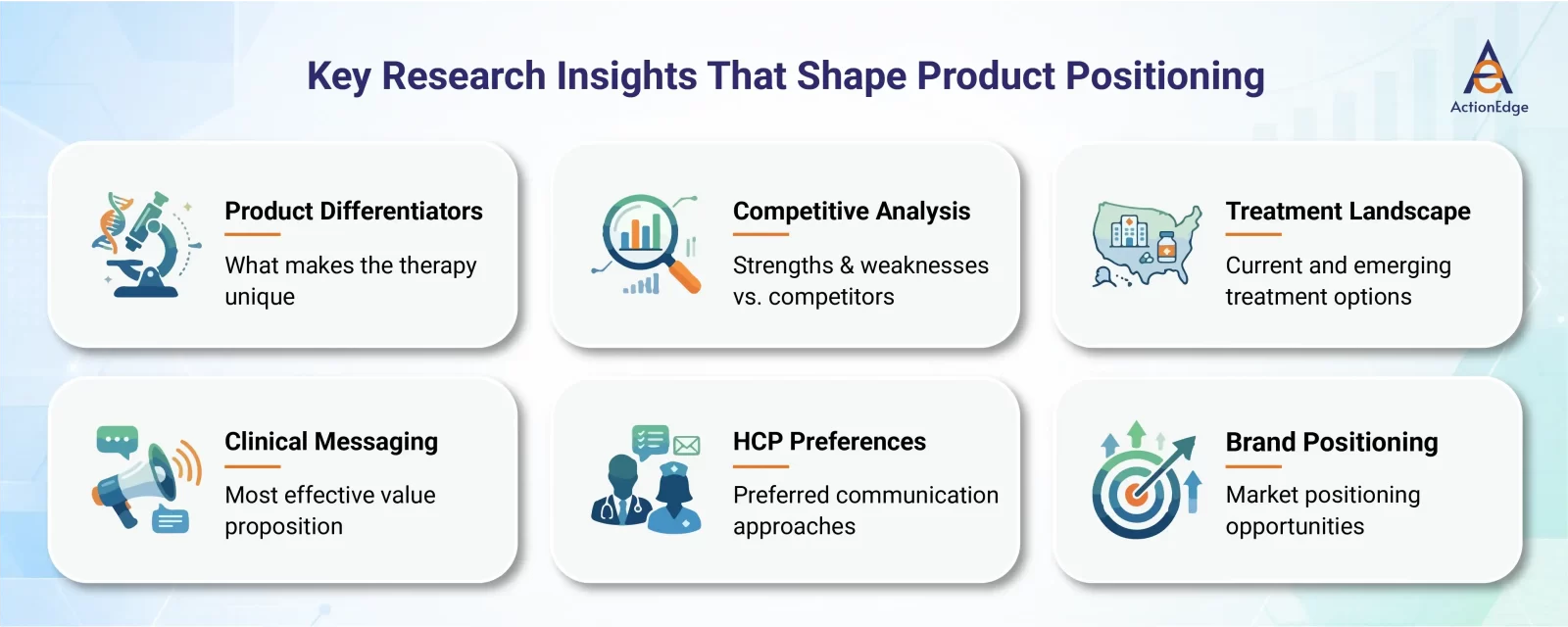
Research helps pharmaceutical companies identify:
- Key product differentiators
- Competitive strengths and weaknesses
- Treatment landscape dynamics
- Effective clinical value messaging
- Healthcare professional communication preferences
- Brand positioning opportunities
Methods such as in-depth interviews (IDIs), Expert Interviews, and qualitative research uncover insights that cannot always be measured through surveys alone. They reveal why healthcare professionals respond to certain messages, what influences prescribing confidence, and which product attributes drive differentiation.
For instance, physicians may prioritize convenience in one therapeutic area while focusing primarily on efficacy or long-term safety in another. Understanding these nuances enables more effective commercial messaging.
Measuring Launch Readiness and Market Adoption
A successful launch depends on more than awareness. Pharmaceutical companies must evaluate whether healthcare professionals are prepared to adopt a new therapy in real-world clinical practice.
Research can assess:
- HCP awareness levels
- Prescribing confidence
- Commercial adoption readiness
- Competitive switching behavior
- Market opportunity
- Regional adoption differences
- Commercial readiness across multiple countries
Opportunity Assessment studies help organizations identify markets with the highest commercial potential, while Adoption Readiness research evaluates factors that may accelerate or slow uptake.
This type of HCP research enables launch teams to prioritize resources, refine educational strategies, and anticipate market challenges before commercialization begins.
Why Competitive Intelligence Is Essential Before Launch
One of the most overlooked aspects of launch planning is understanding the competitive environment beyond currently available therapies.
Comprehensive healthcare market research includes Competitive Intelligence that helps companies monitor:
- Competitor pipelines
- Existing therapy benchmarks
- Market white space opportunities
- Competitor positioning strategies
- Commercial launch activities
For example, if several therapies targeting the same indication are expected to launch within the next two years, early intelligence allows companies to strengthen differentiation and adjust launch timing or messaging accordingly.
Benchmarking Studies provide valuable context by comparing product performance, commercial positioning, and market expectations against existing treatment options. These insights help organizations make proactive rather than reactive decisions.
Combining Qualitative and Quantitative Research for Better Launch Decisions
No single research methodology provides every answer.
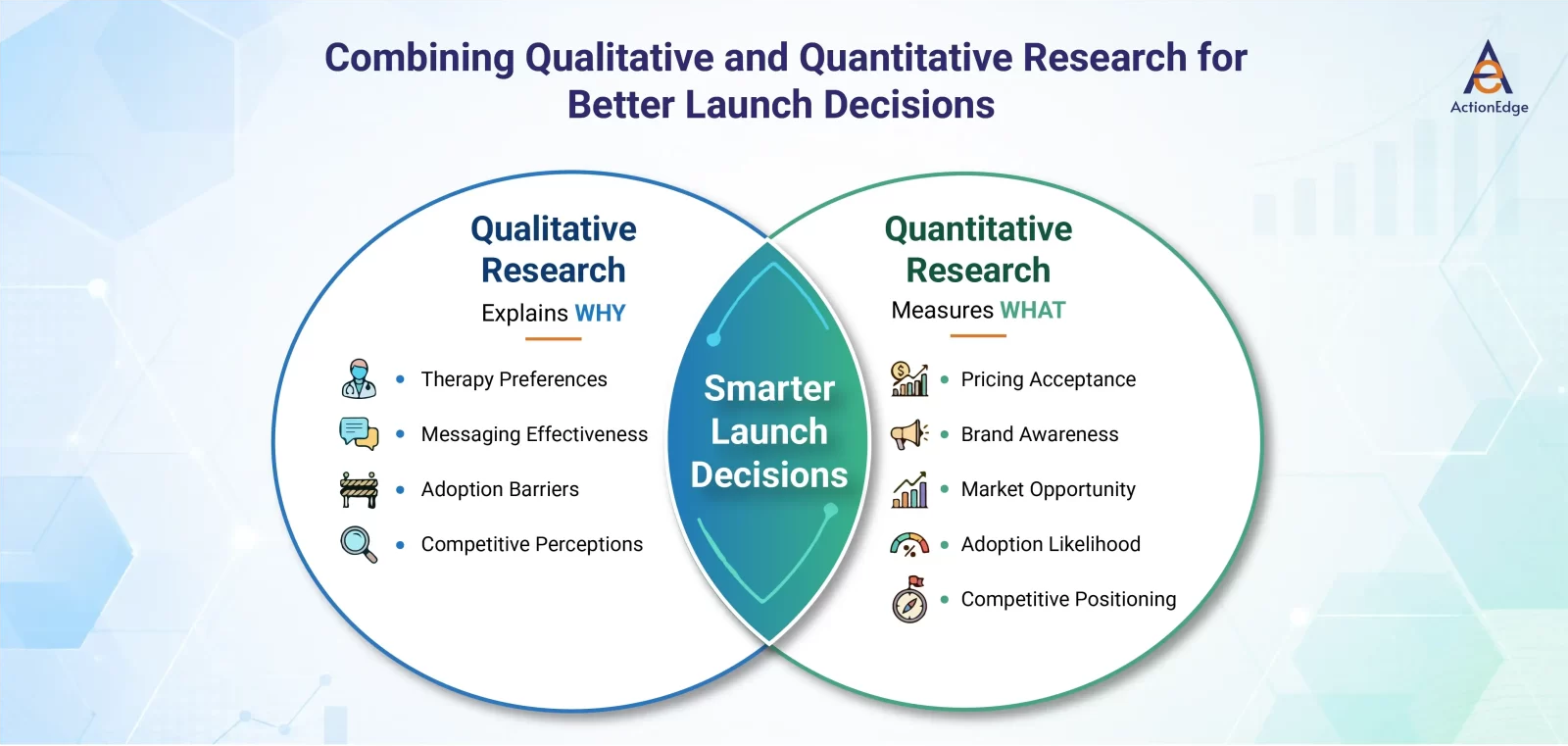
Qualitative research explains why healthcare professionals think and behave the way they do. It explores:
- Therapy preferences
- Messaging effectiveness
- Adoption barriers
- Competitive perceptions
Meanwhile, quantitative research measures:
- Pricing acceptance
- Brand awareness
- Market opportunity
- Adoption likelihood
- Competitive positioning
When both approaches are combined through Hybrid Research and Multi-Mode Research, pharmaceutical companies gain richer and more reliable commercial insights.
For example, qualitative interviews may reveal that physicians value simplified dosing schedules, while quantitative surveys measure how widespread that preference is across different markets. Together, these findings support stronger commercial decisions than either method alone.
How ActionEdge Supports Pharmaceutical Launch Research
Launching a successful therapy requires the right insights at every stage of commercialization. As a global market research company, ActionEdge delivers end-to-end market research services that help pharmaceutical companies make confident, data-driven launch decisions.
From Opportunity Assessment and Pricing Optimization Research to Product Positioning, Benchmarking Studies, and Competitive Intelligence, we provide the commercial insights needed to shape effective launch strategies before products enter the market.
Our expertise extends to recruiting HCPs across 14 therapeutic areas, with access to over 200,000 verified HCPs and healthcare decision-makers. Combined with our experience in multi-country Healthcare market research and global Pharmaceutical market research, we help clients capture reliable insights across diverse markets.
Supported by robust qualitative and quantitative research methodologies, ActionEdge transforms complex market intelligence into actionable strategies that reduce launch risk, strengthen product positioning, and accelerate commercial adoption.
Conclusion
A successful launch is built on informed commercial decisions, not assumptions. From refining pricing strategies to strengthening product positioning and evaluating adoption readiness, new drug launch market research provides the evidence pharmaceutical companies need to reduce uncertainty and maximize commercial success.
Whether your objective is market research for new drug launch, competitive benchmarking, or global commercialization planning, investing in high-quality research helps reduce launch risk, improve adoption, and create a stronger competitive advantage.
Looking to build a smarter launch strategy?
Partner with ActionEdge to access expert-driven research that supports confident pricing, impactful positioning, and successful commercialization from day one.