

Digital banking isn’t won by the best technology. It’s won by the best understanding of customers.
A sleek mobile app, instant payments, and AI-powered support may look impressive, but they do not automatically create loyal banking customers. The real difference lies in understanding what customers actually expect when they interact with a digital banking platform.
Digital banking has rapidly evolved from being a convenience to becoming a business necessity. Whether customers are opening an account, applying for a loan, transferring funds, or managing investments, they expect every interaction to be fast, secure, intuitive, and personalized. Even a small inconvenience during these digital journeys can result in frustration, lower engagement, or customers switching to competitors.
Unfortunately, many financial institutions still invest heavily in technology without fully understanding customer expectations. As a result, new digital features often experience poor adoption, low satisfaction, or unnecessary redesign costs.
This is where digital banking market research becomes invaluable. Instead of relying on assumptions, banks and financial institutions can use customer feedback to make informed decisions that improve digital experiences, reduce business risks, and build stronger customer relationships.
This blog explores how customer insights improve digital banking, the common mistakes organizations make without research, and how a trusted research partner can help collect reliable customer intelligence that drives smarter decisions.
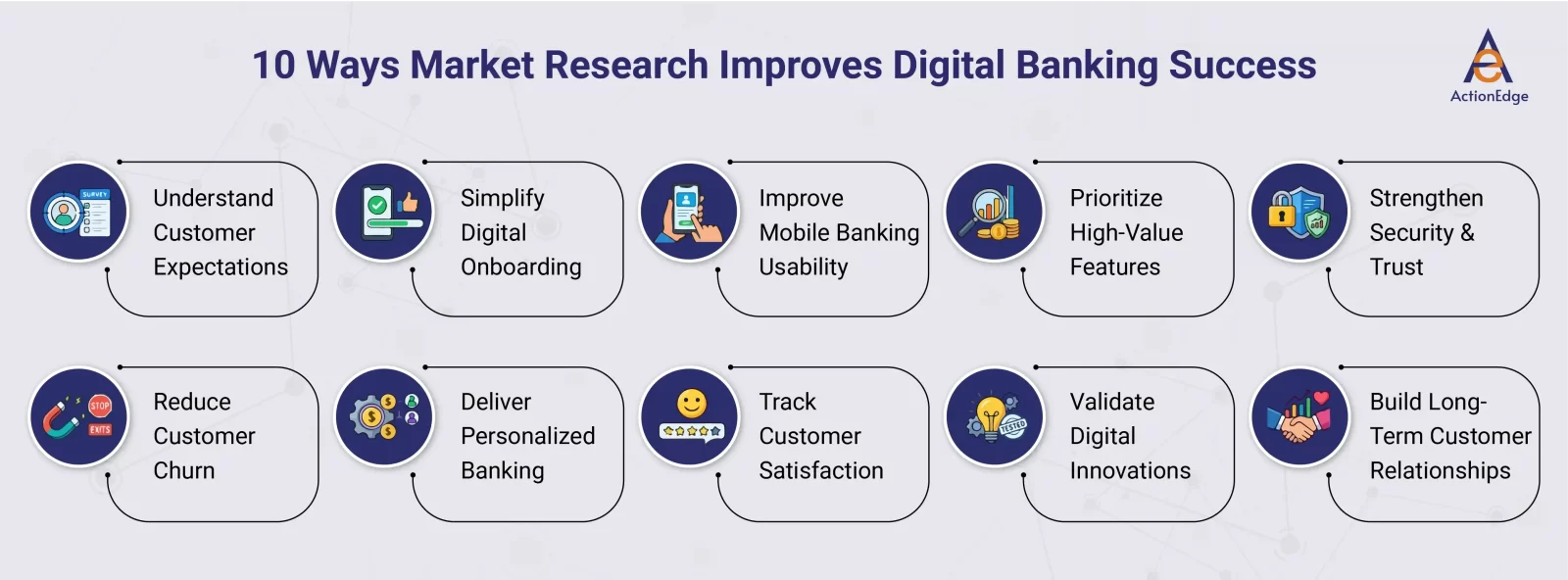
1. Understands Changing Customer Expectations
Customer expectations are constantly evolving. Today’s banking customers expect instant access, personalized services, intuitive interfaces, and consistent experiences across mobile apps, websites, and customer support channels.
Through financial services market research, institutions can monitor changing customer behaviors, emerging digital trends, and evolving service expectations before they become industry standards.
For example, research may reveal that younger customers prioritize budgeting tools and instant notifications, while business banking clients value faster approvals and secure payment workflows.
2. Improves Digital Onboarding Experiences
First impressions matter.
If customers encounter lengthy forms, confusing verification steps, or technical issues during account opening, many abandon the process before completing registration.
Research techniques such as usability testing, customer journey mapping, and surveys identify where customers struggle, allowing financial institutions to simplify onboarding and improve completion rates.
Even small improvements, such as reducing unnecessary steps or clarifying instructions, can significantly improve conversions.
3. Enhances Mobile and Online Banking Usability
A banking application may include dozens of features, but customers only benefit if they can easily find and use them.
Customer usability studies uncover issues like:
- Confusing navigation
- Slow transaction flows
- Poor feature visibility
- Difficult payment processes
- Accessibility concerns
Improving these areas leads to a better digital banking customer experience, encouraging customers to engage with digital channels more frequently.
4. Prioritizes Features That Customers Value Most
Every digital improvement requires investment.
Instead of developing features based on internal assumptions, research helps financial institutions understand what customers genuinely value.
For instance, research may reveal greater demand for:
- Card management controls
- Real-time spending insights
- Biometric authentication
- Personal finance tools
- Faster customer support
This allows development teams to prioritize enhancements that deliver the greatest customer and business impact.
5. Builds Trust Through Better Security Experiences
Security remains one of the biggest concerns in digital banking.
While customers want stronger protection, they also expect convenience.
Research helps organizations understand customer perceptions around:
- Multi-factor authentication
- Password management
- Biometric verification
- Fraud alerts
- Privacy preferences
Instead of making security more complicated, customer insights help create protection measures that customers actually trust and willingly adopt.
6. Reduces Customer Churn
Customers rarely leave without warning.
Negative experiences often build over time before customers switch banks or reduce digital engagement.
Through satisfaction studies, behavioral analysis, and banking customer research, organizations can identify recurring issues such as:
- Slow issue resolution
- Mobile app frustrations
- Hidden fees
- Poor communication
- Limited digital functionality
Addressing these concerns early helps improve retention while reducing customer acquisition costs.
7. Personalizes Digital Banking Experiences
Different customers have different financial needs.
A university student, a growing business owner, and a retiree expect completely different digital experiences.
Customer segmentation enables financial institutions to personalize:
- Product recommendations
- Financial advice
- Communication
- Promotions
- User interfaces
Rather than delivering one generic experience, institutions create more relevant interactions that improve customer satisfaction and engagement.
8. Measure Customer Satisfaction Continuously
Customer expectations never remain static.
Regular customer experience research allows organizations to monitor satisfaction across every digital touchpoint, including mobile banking, internet banking, contact centers, and self-service channels.
Tracking customer feedback over time helps identify emerging issues before they become widespread problems.
For example, a gradual decline in app satisfaction scores may indicate a recent software update introduced usability challenges that require immediate attention.
9. Supports Innovation with Customer Validation
Innovation succeeds when customers see value in it.
Before launching new digital services, research helps validate concepts through customer testing and feedback.
Banks can evaluate customer interest in innovations such as:
- AI-powered financial assistants
- Digital lending platforms
- Investment management tools
- Open banking services
- Embedded finance solutions
Testing ideas early reduces uncertainty while improving launch success.
This is where market research for digital banking becomes especially valuable by ensuring innovations solve genuine customer problems rather than perceived ones.
10. Strengthens Long-Term Customer Relationships
Successful digital banking is not achieved through one major product launch.
It requires continuous learning.
Long-term customer insight programs allow financial institutions to evolve alongside customer expectations by regularly measuring behaviors, preferences, and satisfaction.
This creates stronger relationships built on relevance, trust, and continuous improvement.
Ultimately, digital banking market research enables organizations to remain customer-focused in an increasingly competitive financial landscape.
Common Mistakes Financial Institutions Make Without Customer Research
Many digital banking initiatives fail not because the technology is weak, but because customer expectations were never properly understood.
Some of the most common mistakes include:
- Designing products based solely on internal assumptions rather than customer evidence.
- Launching digital features customers neither need nor actively use.
- Ignoring customer feedback after launch and assuming adoption equals satisfaction.
- Measuring success using downloads or registrations instead of actual customer experience.
- Treating all customer groups the same despite different financial goals and digital behaviors.
- Waiting for complaints before making improvements instead of identifying issues proactively through research.
These challenges often lead to wasted development budgets, lower customer satisfaction, and missed business opportunities.
Investing in financial services market research significantly reduces uncertainty by helping decision-makers prioritize improvements that customers genuinely value.
How ActionEdge Supports Digital Banking Research
Digital transformation requires dependable customer intelligence, and that starts with high-quality data collection.
As a trusted market research company, ActionEdge supports financial institutions, research agencies, consulting firms, and technology providers by delivering reliable respondent recruitment, fieldwork execution, and global data collection services. Rather than advising banks on strategy, ActionEdge enables customer insight studies through accurate and dependable research execution.
Our capabilities include:
- Voice of Customer Studies to understand customer expectations and experiences across digital channels.
- Brand Perception Research to evaluate how customers view financial institutions in increasingly competitive markets.
- Customer Experience Research to identify opportunities for improving digital journeys and service quality.
- CATI for reaching targeted customer groups through structured telephone interviews.
- CAWI (Online Surveys) for scalable digital feedback collection across diverse customer segments.
- In-Depth Interviews (IDIs) for exploring customer motivations, behaviors, and unmet needs in greater detail.
- Multi-country Research to support global financial institutions with consistent, high-quality fieldwork across international markets.
Backed by experienced fieldwork teams, extensive respondent access, rigorous quality control, and global research capabilities, ActionEdge delivers reliable market research services that help organizations collect trustworthy customer insights with confidence.
Better data leads to better decisions, lower research risk, and stronger digital banking strategies.
Conclusion
Technology may power digital banking, but customer understanding determines whether that technology succeeds.
Banks that continuously listen to customers are better positioned to improve digital experiences, strengthen trust, increase adoption, and retain long-term relationships. Every interaction, from onboarding to everyday banking, presents an opportunity to learn what customers truly value.
By investing in how customer insights improve digital banking, financial institutions move beyond assumptions and make evidence-based decisions that create meaningful customer experiences and measurable business outcomes.
If you’re planning your next digital banking study, ActionEdge can support your research with high-quality respondent recruitment, reliable fieldwork, and global data collection capabilities that help you generate insights you can trust.