
Think about the last time you stopped buying from a brand. Chances are, it wasn’t because the product suddenly became worse. It was probably because the experience did.
Today’s customers remember every interaction. They notice how quickly a business responds, how easy it is to navigate a website, how helpful support teams are, and whether a brand genuinely understands their needs. In fact, customers no longer compare businesses only on products or prices. They compare the overall experience.
That shift has made customer experience one of the biggest competitive advantages any organization can build. Yet many businesses still make decisions based on internal opinions, outdated assumptions, or isolated customer complaints instead of reliable evidence.
This is where customer experience research becomes invaluable. Rather than guessing what customers want, businesses can uncover real expectations, identify friction points before they become bigger problems, and make improvements backed by data.
Effective market research for customer experience enables organizations to understand what customers value most, improve every interaction, strengthen loyalty, and make smarter business decisions. Instead of reacting after customers leave, companies can anticipate needs, solve problems earlier, and continuously improve the customer journey.
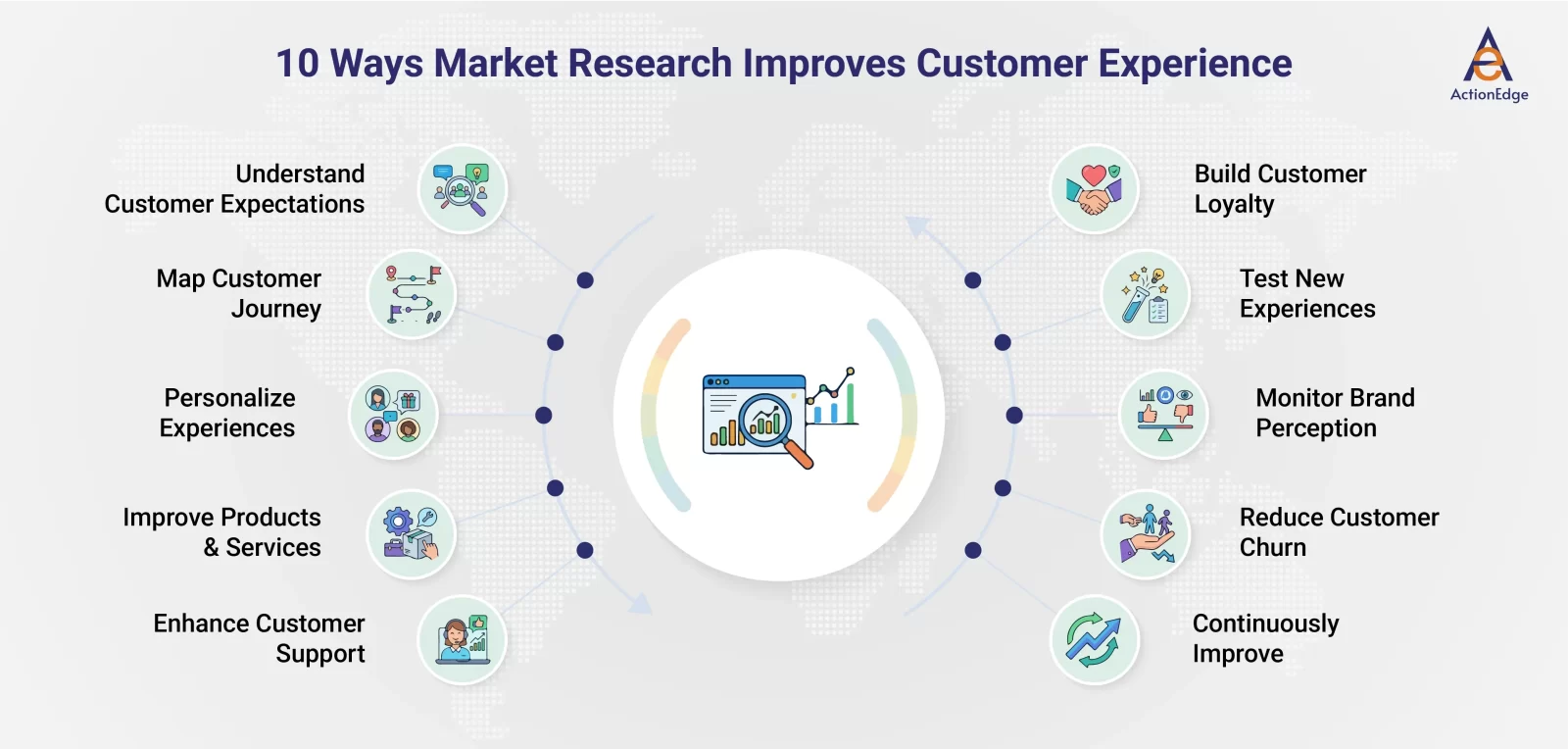
Let’s explore ten practical ways market research helps businesses deliver experiences that customers remember for the right reasons.
10 Ways Market Research Improves Customer Experience
1. Understands What Customers Actually Expect
Every business believes it knows its customers. Unfortunately, assumptions are often wrong.
Customer expectations evolve constantly. What delighted customers two years ago may now be considered the minimum standard.
Research helps organizations move beyond assumptions by uncovering genuine customer insights about:
- Service expectations
- Preferred communication channels
- Buying motivations
- Decision-making behaviour
- Desired product features
For example, a retailer may believe customers want more discounts, while research reveals they actually value faster delivery and easier returns much more.
When businesses understand expectations accurately, they can design experiences customers truly appreciate.
2. Identifies Pain Points Across the Customer Journey
Customers rarely judge a business based on one interaction.
Instead, they evaluate every touchpoint from discovering the brand to making a purchase and receiving after-sales support.
This is where customer journey research becomes essential.
Research helps identify:
- Long response times
- Confusing websites
- Complicated checkout processes
- Poor communication
- Difficult onboarding
- Weak after-sales service
Imagine a subscription business experiencing rising cancellations. Research might reveal that customers aren’t unhappy with the product itself. Instead, they become frustrated during account setup because instructions are unclear.
Fixing these hidden friction points often delivers significant improvements in customer satisfaction.
3. Creates More Personalized Experiences
No two customers have identical expectations.
Some prioritize convenience. Others value price, expert advice, sustainability, or premium service.
Market research allows businesses to segment customers based on:
- Behaviour
- Preferences
- Demographics
- Purchase habits
- Motivations
Instead of offering one generic experience, organizations can create more relevant interactions for different customer groups.
For example, an online fashion retailer may discover younger shoppers prefer mobile-first experiences while older customers appreciate detailed product descriptions and accessible customer support.
Personalization begins with understanding differences, not making assumptions.
4. Improves Products and Services
Every product or service has room for improvement.
The challenge is deciding which improvements matter most.
Research helps businesses prioritize changes that customers actually care about instead of investing resources in features that add little value.
Through customer experience research, organizations can identify:
- Missing features
- Product usability issues
- Service quality concerns
- Pricing perceptions
- Areas customers appreciate most
Many successful product innovations begin with customer feedback rather than internal brainstorming sessions.
5. Strengthens Customer Support
Customer support often shapes long-term brand perception more than advertising ever will.
Even great products can lose customers if service interactions create frustration.
Businesses use customer satisfaction research to evaluate:
- Response speed
- Agent knowledge
- Resolution quality
- Communication clarity
- Overall satisfaction
For example, research may reveal customers don’t mind waiting slightly longer if updates are communicated clearly throughout the process.
Understanding these expectations allows support teams to improve experiences where they matter most.
6. Builds Stronger Customer Loyalty
Winning a customer is only the beginning.
Long-term business growth depends on keeping customers engaged, satisfied, and willing to recommend the brand to others.
Customer loyalty research helps organizations understand:
- Why customers stay
- Why customers leave
- What builds trust
- Which experiences encourage repeat purchases
Interestingly, loyal customers are not always those who receive the biggest discounts. Many remain loyal because they consistently receive reliable service, transparent communication, and hassle-free experiences.
Research helps businesses identify these loyalty drivers and strengthen them over time.
7. Validates New Customer Experience Initiatives
Launching a new customer portal, mobile app, loyalty program, or digital support channel always carries some level of risk.
Rather than investing heavily before understanding customer reactions, businesses can test ideas first.
Research enables organizations to:
- Evaluate prototypes
- Test messaging
- Assess usability
- Gather customer opinions
- Refine experiences before launch
For example, a bank planning a new mobile onboarding process can collect feedback from potential users before introducing it nationwide.
Small adjustments made early often prevent costly redesigns later.
8. Monitors Brand Perception
Customer experience extends far beyond products.
Every interaction contributes to how customers perceive a brand.
Research helps businesses understand perceptions around:
- Trust
- Reliability
- Innovation
- Customer service
- Ease of doing business
A company may believe it is viewed as innovative, while customers actually see it as complicated or difficult to work with.
Regular monitoring helps businesses identify perception gaps and improve the overall brand experience.
9. Reduces Customer Churn
Customer churn rarely happens overnight.
Most customers give subtle warning signs before leaving.
Research helps identify:
- Declining satisfaction
- Increasing frustration
- Competitive switching reasons
- Service expectations that aren’t being met
For example, a telecommunications provider may discover customers are leaving because billing information is difficult to understand rather than because of network quality.
Addressing the real issue can significantly improve retention.
10. Supports Continuous Customer Experience Improvement
Customer expectations never stand still.
Technology changes.
Markets evolve.
Competitors innovate.
Businesses that continuously listen to customers adapt more effectively than those relying on annual surveys or outdated assumptions.
Regular research helps organizations:
- Track satisfaction over time
- Monitor changing expectations
- Evaluate improvement initiatives
- Identify emerging trends
- Stay ahead of competitors
The best customer experiences are never finished. They continuously evolve alongside customer expectations.
Turning Customer Feedback into Business Growth
Collecting feedback is relatively easy.
Turning that feedback into meaningful business decisions is much harder.
Many organizations gather thousands of survey responses every year but struggle to determine which actions deserve priority.
Effective research transforms customer feedback into actionable business intelligence by helping organizations:
- Prioritize improvements that deliver the greatest impact
- Distinguish isolated complaints from recurring patterns
- Identify hidden growth opportunities
- Measure whether implemented changes improved satisfaction
- Monitor customer experience trends over time
- Make customer-centric decisions supported by evidence
Both qualitative market research and quantitative market research play important roles here.
Qualitative research explains why customers think and behave the way they do through conversations and deeper exploration.
Quantitative research measures how widespread those behaviors and opinions are across larger customer groups.
When combined, they provide a complete picture that supports confident decision-making.
How ActionEdge Helps Businesses Deliver Better Customer Experiences
Delivering outstanding customer experiences begins with understanding customers at every stage of their journey.
As a global market research company, ActionEdge supports organizations by helping them uncover customer expectations, measure satisfaction, and identify opportunities to improve every interaction.
Our focus is always on helping businesses achieve meaningful outcomes, including:
- Understanding customer expectations before problems escalate
- Capturing feedback across the entire customer journey
- Supporting Voice of Customer (VoC) initiatives
- Measuring customer satisfaction and loyalty
- Identifying opportunities to enhance customer experiences
- Enabling customer-centric business decisions with reliable evidence
To support these goals, ActionEdge offers solutions including CATI Research, CAWI Research, In-Depth Interviews (IDIs), multi-country research, respondent recruitment, survey programming, and data processing with visual reporting.
Whether organizations are improving digital experiences, evaluating service quality, launching new initiatives, or expanding into new markets, our research helps teams make informed decisions that place customers at the center of business strategy.
Conclusion
Outstanding customer experiences don’t happen by chance. They are built by listening, learning, testing, and improving continuously.
Businesses that invest in customer experience research gain a clearer understanding of customer expectations, uncover hidden challenges, personalize experiences, strengthen loyalty, reduce churn, and make smarter decisions based on evidence rather than assumptions.
To summarise:
- Understand what customers truly expect.
- Identify friction across every stage of the customer journey.
- Personalize experiences for different customer segments.
- Improve products, services, and customer support.
- Build stronger loyalty and reduce customer churn.
- Validate new initiatives before full-scale implementation.
- Monitor brand perception consistently.
- Turn customer feedback into measurable business improvements.
At ActionEdge, we help organizations transform customer feedback into practical business decisions that create better experiences and stronger customer relationships.
Ready to improve your customer experience with research-backed insights? Connect with ActionEdge today.