

A promising medical device. A breakthrough therapy. A new market with untapped potential. Every healthcare business decision carries opportunity, but it also carries risk. Relying on assumptions, outdated information, or internal opinions alone can lead to costly mistakes that affect product launches, commercial success, and long-term growth.
Today’s healthcare landscape is shaped by evolving regulations, changing physician preferences, increasing competition, and rising patient expectations. Whether organizations are refining pricing strategies, exploring indication expansion, evaluating market opportunities, or understanding healthcare professional (HCP) perspectives, they need evidence they can trust. This is where healthcare market research becomes indispensable.
The strongest decisions rarely come from a single source of data. Qualitative research helps uncover the reasons behind behaviors, motivations, and perceptions, while quantitative research measures the size, frequency, and significance of those findings across larger audiences. Together, these complementary methodologies provide a complete picture, enabling healthcare businesses to reduce uncertainty, validate strategies, and make confident, evidence-based decisions.
Why Healthcare Organizations Need Both Qualitative and Quantitative Research
Every research question deserves the right methodology. While one approach uncovers insights, the other validates them.
Qualitative research answers the question, “Why?” It explores the opinions, experiences, and motivations that influence decision-making. Common methodologies include:
- In-depth interviews
- Expert interviews
- Focus groups
These approaches help organizations understand:
- Clinical decision drivers
- Market perceptions
- HCP opinions
- Competitive insights
- Adoption barriers
On the other hand, quantitative research answers questions such as “How many?”, “How much?”, or “How likely?” It uses structured methodologies to measure patterns and validate findings across larger respondent groups.
Common methods include:
- CATI research
- CAWI research
- Online surveys
These approaches help validate:
- Market demand
- Brand awareness
- Pricing acceptance
- Market potential
- Purchase intent
For example, interviews with specialists may reveal why physicians hesitate to adopt a new therapy. A large-scale survey can then determine whether those concerns are shared by hundreds or thousands of healthcare professionals across different markets.
10 Ways Qualitative and Quantitative Research Improve Healthcare Decision-Making
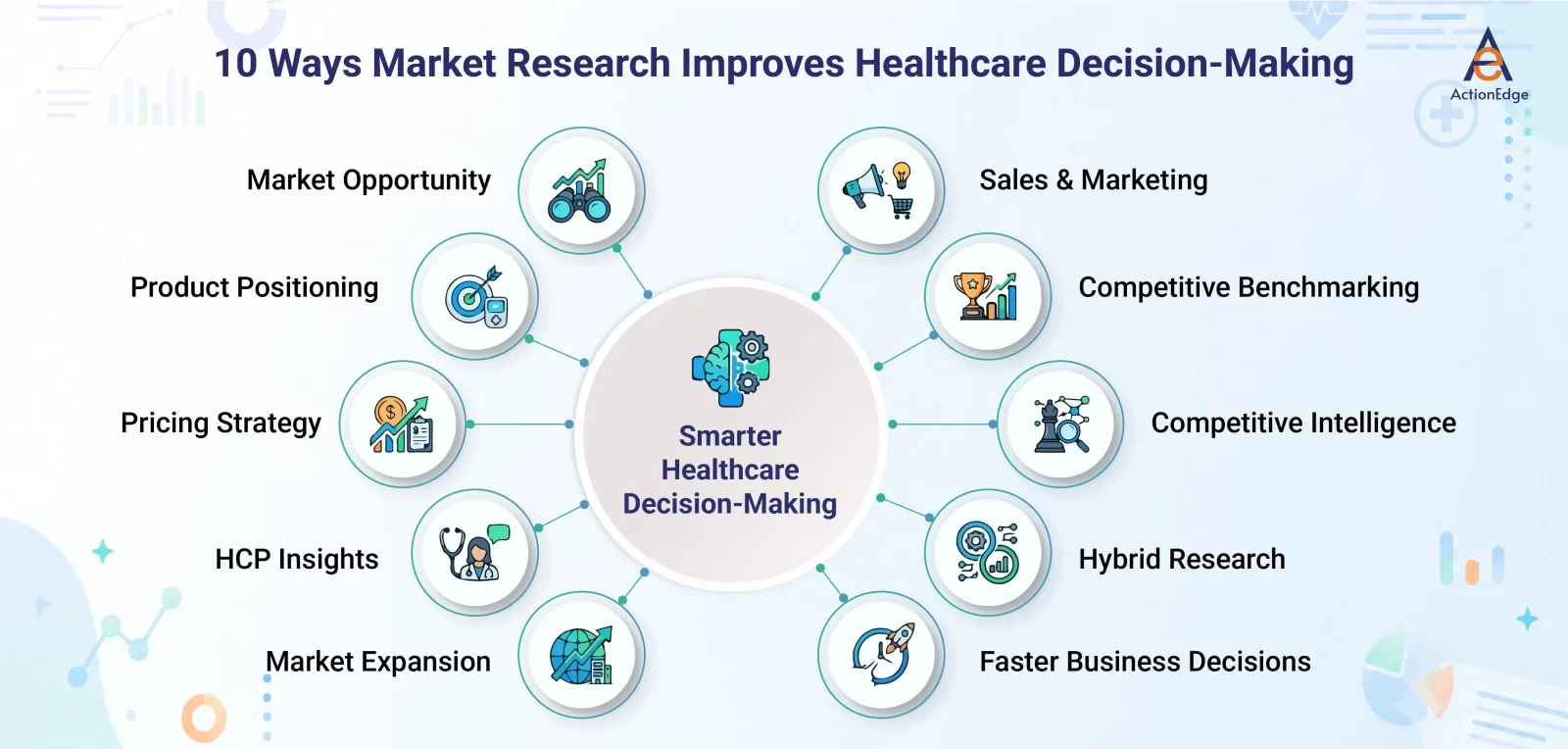
1. Evaluate Market Opportunities Before Investment
Before investing in product development or geographic expansion, organizations need confidence that the opportunity is commercially viable.
Research helps evaluate:
- Market potential
- Entry feasibility
- Indication expansion opportunities
- Product launch readiness
For instance, a company considering expansion into Southeast Asia can assess physician demand, treatment practices, and market size before committing significant resources.
2. Build Stronger Product Positioning
Even an innovative healthcare product needs clear differentiation to succeed.
Research identifies:
- Product strengths
- Competitive advantages
- Effective value messaging
- Unmet market needs
Understanding how physicians perceive competing solutions enables businesses to position their offerings more effectively and communicate meaningful clinical value.
3. Optimize Pricing Strategies
Pricing decisions directly influence product adoption and commercial performance.
Research helps determine:
- Pricing thresholds
- Perceived value
- Competitive pricing benchmarks
- Willingness to pay
Instead of relying on assumptions, organizations can align pricing with customer expectations while maintaining commercial objectives.
4. Understand Healthcare Professional Decision-Making
Clinical adoption often depends on far more than product efficacy.
Through HCP research, organizations gain valuable insights from:
- Physicians
- Specialists
- Clinical experts
- Healthcare decision-makers
Research helps uncover:
- Prescribing behavior
- Treatment preferences
- Adoption drivers
- Clinical concerns
These insights support stronger product development, communication strategies, and commercialization plans.
5. Support Market Entry and Expansion
Healthcare markets differ significantly across countries and regions.
Research validates:
- Geographic opportunities
- Regional healthcare dynamics
- Local treatment practices
- Multi-country launch strategies
Understanding these differences helps organizations tailor their approach instead of applying a one-size-fits-all strategy.
6. Strengthen Sales and Marketing Strategies
Healthcare marketing is most effective when backed by evidence.
Research improves:
- Go-to-market strategies
- Value messaging
- Communication effectiveness
- Channel selection
For example, research may reveal that specialists respond better to clinical outcome data, while procurement teams prioritize long-term economic value.
7. Benchmark Against Competitors
Healthcare organizations must continuously understand where they stand within the competitive landscape.
Research enables businesses to:
- Compare product performance
- Measure brand awareness
- Evaluate category trends
- Identify differentiation opportunities
Competitive benchmarking also highlights areas where organizations can improve positioning and messaging.
8. Generate Competitive Intelligence
Markets evolve rapidly with new technologies, therapies, and competitors entering the landscape.
Through qualitative market research, organizations can uncover:
- Competitor strategies
- Emerging market trends
- White space opportunities
- Changing customer expectations
These insights often reveal opportunities that structured surveys alone may not identify.
9. Improve Research Quality with Hybrid Methodologies
Modern healthcare studies increasingly combine multiple research methods to improve data quality and generate richer insights.
Combining methodologies such as:
- CATI
- CAWI
- Phone-to-Web via Screen Access
- In-Depth Interviews
- Expert Interviews
Creates a stronger research framework than relying on a single approach.
For example, interviews may identify important themes, while online surveys validate those findings with a much larger audience. Hybrid approaches also improve respondent engagement, reduce data gaps, and strengthen confidence in business decisions.
10. Enable Faster, Data-Driven Business Decisions
Perhaps the greatest advantage of research is reducing uncertainty.
Reliable evidence enables healthcare organizations to:
- Validate assumptions
- Prioritize investments
- Reduce commercial risk
- Make faster strategic decisions
Rather than reacting to market changes, organizations can respond proactively with greater confidence.
Why Healthcare Companies Are Moving Toward Hybrid Research
Healthcare organizations increasingly recognize that no single methodology can answer every business question.
Many studies now combine approaches such as:
- CATI + CAWI
- Expert Interviews + Online Surveys
- Phone-to-Web via Screen Access + Online Research
This integrated approach provides several advantages.
Qualitative discussions uncover the motivations behind physician behavior, while survey-based quantitative market research validates those findings across larger populations. The result is stronger evidence, improved data quality, richer insights, and greater confidence in commercial decisions.
Hybrid research is particularly valuable for product launches, pricing studies, competitive assessments, market expansion, and brand strategy because it combines depth with statistical validation.
How ActionEdge Powers Healthcare Research
High-quality healthcare research begins with high-quality data. As a trusted market research company, ActionEdge contributes to healthcare research projects by delivering reliable data collection and fieldwork across diverse study requirements. From respondent recruitment to survey execution, our focus is on helping research teams collect accurate, dependable data that forms the foundation for informed decision-making.
Our capabilities span both qualitative and quantitative fieldwork, including CATI, CAWI (Online Surveys), Phone-to-Web via Screen Access, In-Depth Interviews (IDIs), Expert Interviews, and HCP recruitment. With access to more than 200,000 verified healthcare professionals (HCPs) and healthcare decision-makers across 14 therapeutic areas, along with multi-country fieldwork capabilities, we help enable research projects across global healthcare markets.
To support end-to-end data collection, ActionEdge also provides survey programming, data processing, and visualization services that help research teams manage studies efficiently. Our healthcare market research services are built around reliable respondent access, robust fieldwork execution, and consistent data quality, making us a dependable global partner for market research services.
Conclusion
Healthcare decisions shape patient outcomes, commercial success, and long-term business growth. Making those decisions without reliable evidence increases uncertainty and risk.
By combining qualitative research to understand motivations with quantitative research to validate findings at scale, organizations gain a more complete understanding of their markets, customers, and competitive landscape. Together, these approaches support better product positioning, smarter pricing, stronger market entry strategies, and more confident business decisions.
If you’re looking for dependable data collection, expert respondent recruitment, and global fieldwork support for your next healthcare study, ActionEdge provides the expertise and operational capabilities to help research projects deliver reliable, high-quality insights.