

A new finance app can gain 100,000 downloads in a week. It can lose half of them just as quickly.
That is the reality of today’s FinTech market. Growth is explosive, but loyalty is fragile. 86% of customers will stay loyal to a business that provides a great onboarding experience, connecting seamless UX directly to retention and competitive advantage.
Digital banking platforms, payment wallets, lending apps, and wealth-tech solutions are proliferating across regions. Customers can open accounts in minutes, compare fees instantly, and switch providers without stepping into a branch.
Low switching costs, rising regulatory scrutiny, and constant security concerns make competition relentless. Startups are challenging incumbents. Traditional banks are reinventing themselves as digital-first players. In this environment, assumptions are expensive.
This is where FinTech market research becomes more than a support function. It becomes a strategic advantage.
The Reality of Today’s FinTech Market
Digital finance adoption continues to accelerate. Consumers expect:
- Instant onboarding
- Seamless mobile experiences
- Transparent pricing
- Real-time support
- Absolute data security
At the same time, regulatory compliance requirements are tightening globally. Trust is no longer optional. It is foundational.
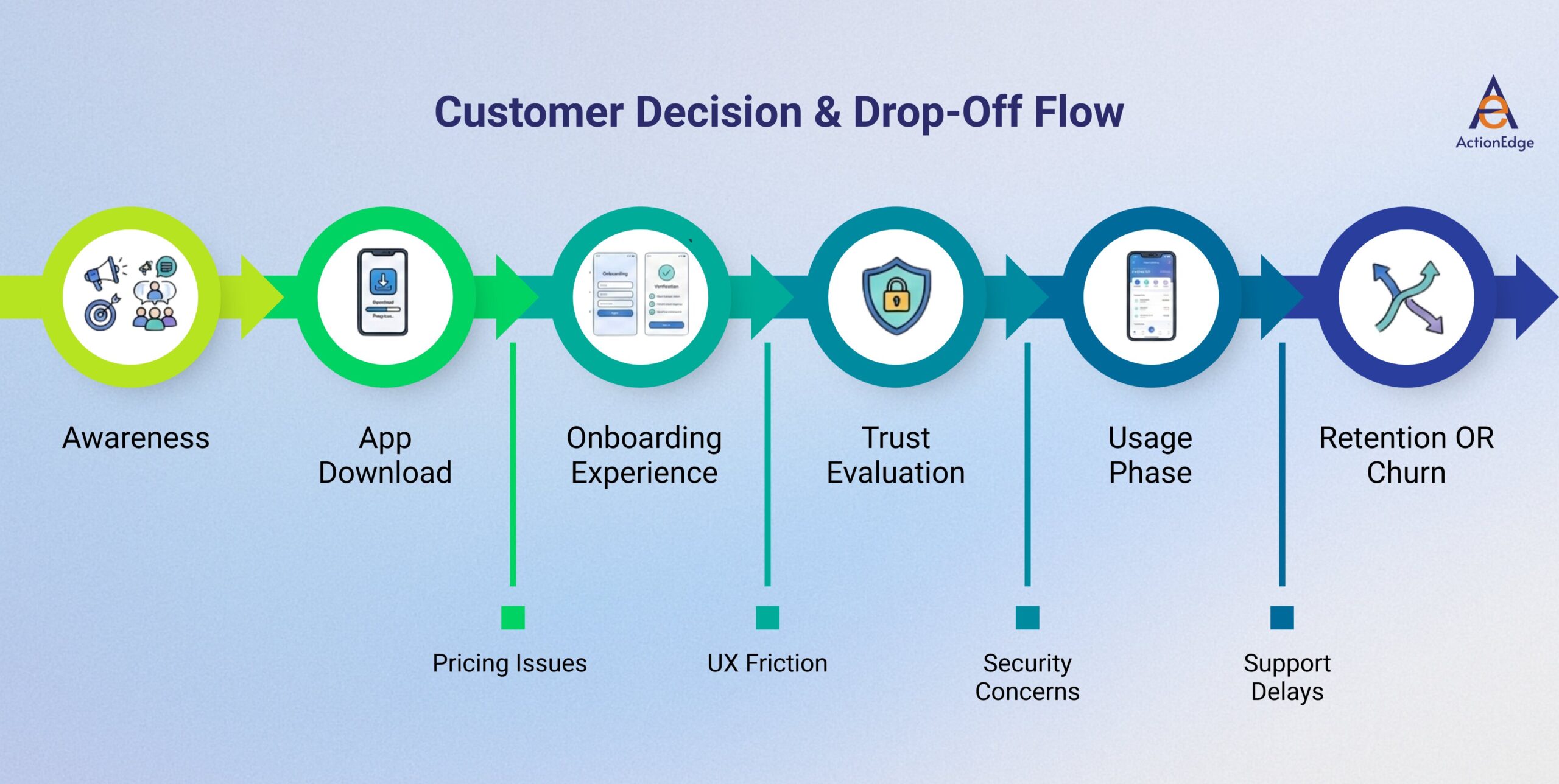
Consider this example. A digital lending startup launches with attractive interest rates and a clean interface. Initial traction is strong. But within months, reviews reveal frustration around hidden fees and delayed support responses. Downloads remain high, yet active usage declines. Without structured research, leadership may misread growth metrics and miss the warning signs.
The result? High churn, wasted acquisition budgets, and brand damage.
Why Market Research Is Critical for FinTech Success
FinTech companies operate in an ecosystem where change is constant. Consumer expectations evolve quickly, shaped by experiences with e-commerce, ride-sharing, and subscription platforms.
Here are the core challenges FinTech players face:
Rapidly Changing Expectations:
Customers expect digital finance to be as intuitive as social media apps. A confusing interface can trigger immediate abandonment.
Trust Barriers in Digital Finance:
Users are cautious with money. Concerns around fraud, privacy, and regulatory compliance influence adoption decisions.
Complex Buying Journeys:
Unlike impulse purchases, financial decisions involve comparison, consultation, and risk evaluation.
Price Sensitivity:
Even minor fee differences influence switching behavior.
App Abandonment and Churn:
FinTech apps face 45-50% uninstalls in the first month and ~80% annual churn, with retention under 20% yearly. High download numbers often mask low engagement rates.
Strategic FinTech market research reframes these challenges as opportunities. It acts as:
- A growth driver through insight-led product design
- A risk management tool by identifying dissatisfaction early
- A competitive differentiator through evidence-based positioning
Key Market Research Objectives for FinTech Companies
Clear objectives turn research into action. Leading FinTech firms focus on the following:
Customer Acquisition Insights:
Why do users choose your platform over others? What triggers initial interest? Research helps optimize messaging, channels, and onboarding flows.
Customer Experience Optimization:
88% of app users abandon apps after experiencing bugs or glitches, with 37% quitting immediately critical for FinTech trust and retention. Tracking satisfaction, trust, and usability reveals friction points that reduce engagement.
Product-Market Fit Validation:
Before scaling, companies must validate whether their offering truly addresses a defined need. This is especially important in primary market research for fintech startups, where early validation reduces costly pivots.
Churn and Retention Analysis:
Understanding why users disengage is crucial. Structured customer churn analysis research in fintech identifies the drivers behind attrition and informs retention strategies.
In mature firms, fintech churn analysis research often integrates behavioral data with survey feedback to create targeted retention campaigns.
The Role of Primary Research in FinTech
Secondary data provides industry trends. It does not explain why your specific users behave the way they do.
That is the value of Primary research in FinTech.
Primary research involves collecting first-hand data directly from customers, prospects, or stakeholders. It ensures decisions are based on current, relevant insights rather than assumptions.
Methods Include:
- Online surveys for broad user feedback
- In-depth interviews for understanding motivations
- Usability testing for app performance evaluation
- Focus groups for feature exploration
- B2B stakeholder interviews for partnership strategies
For example, a payments platform targeting SMEs may invest in b2b fintech market research services to understand procurement decision criteria among finance heads. The insights might reveal that ease of integration and compliance features matter more than transaction fees.
That insight immediately shifts product messaging and sales strategy.
Core Market Research Strategies for Competitive Digital Markets
In crowded digital ecosystems, research must be continuous and adaptive. Here are essential strategies.
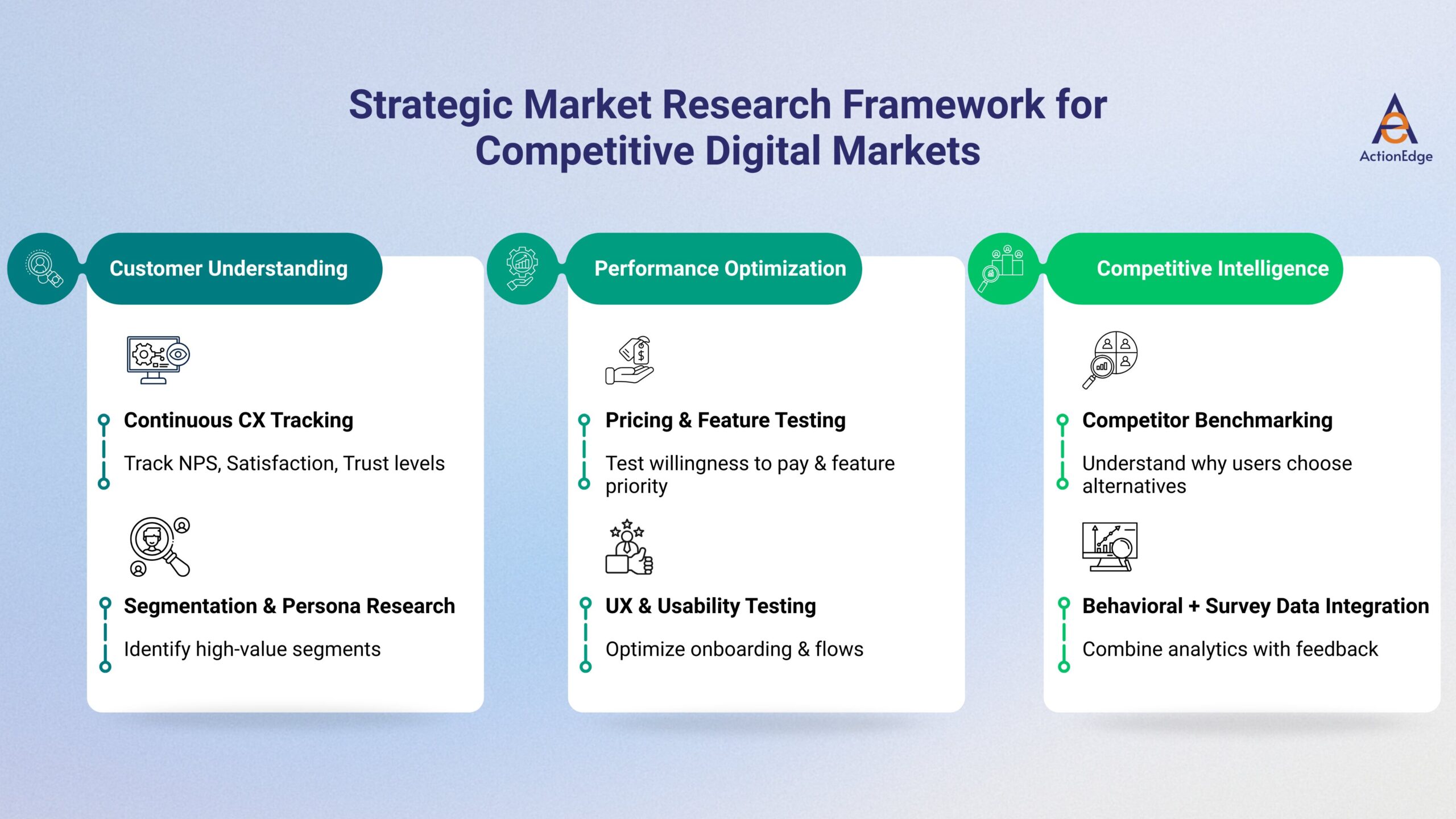
1. Continuous Customer Experience Tracking
Regularly measuring Net Promoter Score, satisfaction, and trust levels allows companies to detect early warning signals. A sudden drop in perceived security confidence could indicate a communication gap after a system update.
Continuous tracking transforms feedback into a real-time management tool rather than a post-crisis response.
2. Behavioral and Survey Data Integration
Transaction data shows what users do. Surveys explain why they do it.
Integrating analytics with feedback produces actionable fintech user behavior research and insights. For instance, if data shows declining transaction frequency, survey responses might reveal confusion about new fee structures.
This layered approach strengthens decision-making.
3. Competitor Benchmarking Research
Users compare apps constantly. Structured benchmarking reveals:
- Why customers prefer competitor platforms
- Which features drive loyalty
- Where your product falls short
Competitive insights support pricing, positioning, and differentiation strategies.
4. Segmentation and Persona Research
Not all users are equal in value or behavior. Segmenting customers by usage intensity, risk tolerance, or financial goals enables targeted engagement strategies.
For example, high-net-worth investors may prioritize advisory tools, while younger users focus on low fees and mobile convenience.
Persona-driven development improves both marketing and retention.
5. Pricing and Feature Optimization Studies
Price sensitivity testing determines willingness to pay. Feature prioritization studies help allocate development resources effectively.
A lending app may discover that flexible repayment options influence adoption more than marginal interest rate reductions.
Data prevents costly misallocation of resources.
6. Digital Usability and UX Testing
Even small interface friction can increase abandonment rates. Testing onboarding flows, navigation clarity, and transaction ease improves engagement and trust.
Apps with strong onboarding see 50% higher retention rates, while 86% of customers remain loyal when onboarding delivers clear value. In digital finance, usability is directly linked to credibility.
Choosing the Right Research Partner
Executing these strategies effectively often requires collaboration with an experienced market research company that understands financial ecosystems.
Specialized b2b fintech market research services support enterprise-focused platforms, while tailored approaches ensure startups gain clarity before scaling.
An experienced partner ensures awareness of compliance requirements, secure data handling, and interpretation of sector-specific insights.
Conclusion
The FinTech sector will continue expanding. New entrants will emerge. Traditional banks will keep digitizing. Technology will evolve.
What will remain constant is one truth: customers reward platforms that understand them.
Growth built solely on aggressive marketing is fragile. Growth built on evidence, empathy, and insight is sustainable.
Strategic FinTech market research transforms uncertainty into clarity. It reduces product risk, strengthens customer trust, and supports data-backed innovation. In competitive digital markets, that clarity is not optional. It is essential.
The winners in digital finance will not simply be the fastest innovators. They will be the smartest listeners.
Frequently Asked Questions
The cost of FinTech market research depends on scope, audience type, geography, and methodology. Primary market research for fintech startups is typically lower-cost than multi-country B2B fintech market research services involving CATI interviews or qualitative studies. Pricing scales based on complexity and sample size.
Primary research in FinTech is highly scalable across regions. Companies can combine CAWI surveys for reach, CATI for B2B stakeholders, and qualitative interviews for deeper insights. Multi-country studies are structured to maintain consistency while capturing local market dynamics.
High-quality FinTech market research relies on verified respondent recruitment, fraud-detection systems, live CATI validation, and strict data-compliance standards. In regulated environments, partnering with an experienced market research company ensures compliance with governance and data protection requirements.
Through fintech user behavior research and insights, feature testing, and customer churn analysis research in fintech, companies can identify unmet needs, refine pricing, and reduce drop-offs. Evidence-led research improves product-market alignment and reduces launch risk.
ActionEdge provides integrated B2B fintech market research services using Quant, Qual, CATI, CAWI, and Phone-to-Web screen access methodologies. This enables scalable data collection, behavioral validation, and structured fintech churn analysis research for informed decision-making.