A dropped call is not just a technical issue anymore. It is a moment of frustration that shapes how customers perceive your brand.
In 2026, telecom companies are operating in one of the most competitive environments yet. Customers expect seamless connectivity, instant support, transparent billing, and consistent experiences across every touchpoint. At the same time, switching providers has never been easier. Loyalty is fragile, and expectations are constantly evolving.
Improving customer experience has been a consistent priority for telecom leaders. In fact, PwC reported that more than half (54%) of telecom decision-makers identified CX as their top transformation initiative, highlighting the long-term focus on customer-centric strategies.
Yet, traditional feedback methods are struggling to keep up. Surveys often capture what customers say, but not what they truly feel or experience. A low satisfaction score tells you something is wrong, but it rarely explains why it happened or how to fix it.
This is where deeper, human-centric insight becomes essential. Understanding customer behavior today requires more than metrics. It requires conversations. It requires context. It requires listening beyond the surface.
Today, winning in telecom is no longer just about service delivery but about generating meaningful telecom CX insights through deeper customer experience research telecom approaches.
That is why In-depth interviews (IDI) are becoming a critical tool for telecom brands. They help uncover the real reasons behind customer dissatisfaction by capturing detailed, contextual, and emotional insights that surveys often miss.
Understanding IDIs in Telecom Customer Experience Research
In-depth interviews (IDI) are one-on-one, structured or semi-structured conversations designed to explore customer experiences, motivations, and perceptions in detail. Unlike surveys, which prioritize scale, IDIs prioritize depth.
In a complex industry like telecom, this depth matters. Customer journeys involve multiple touchpoints such as network usage, billing systems, customer support, and digital apps. Each of these interactions can shape perception in different ways.
For example, a customer may rate their experience as average in a survey. But in an interview, they might reveal frustration with inconsistent network coverage during peak hours or confusion around hidden charges in their bill.
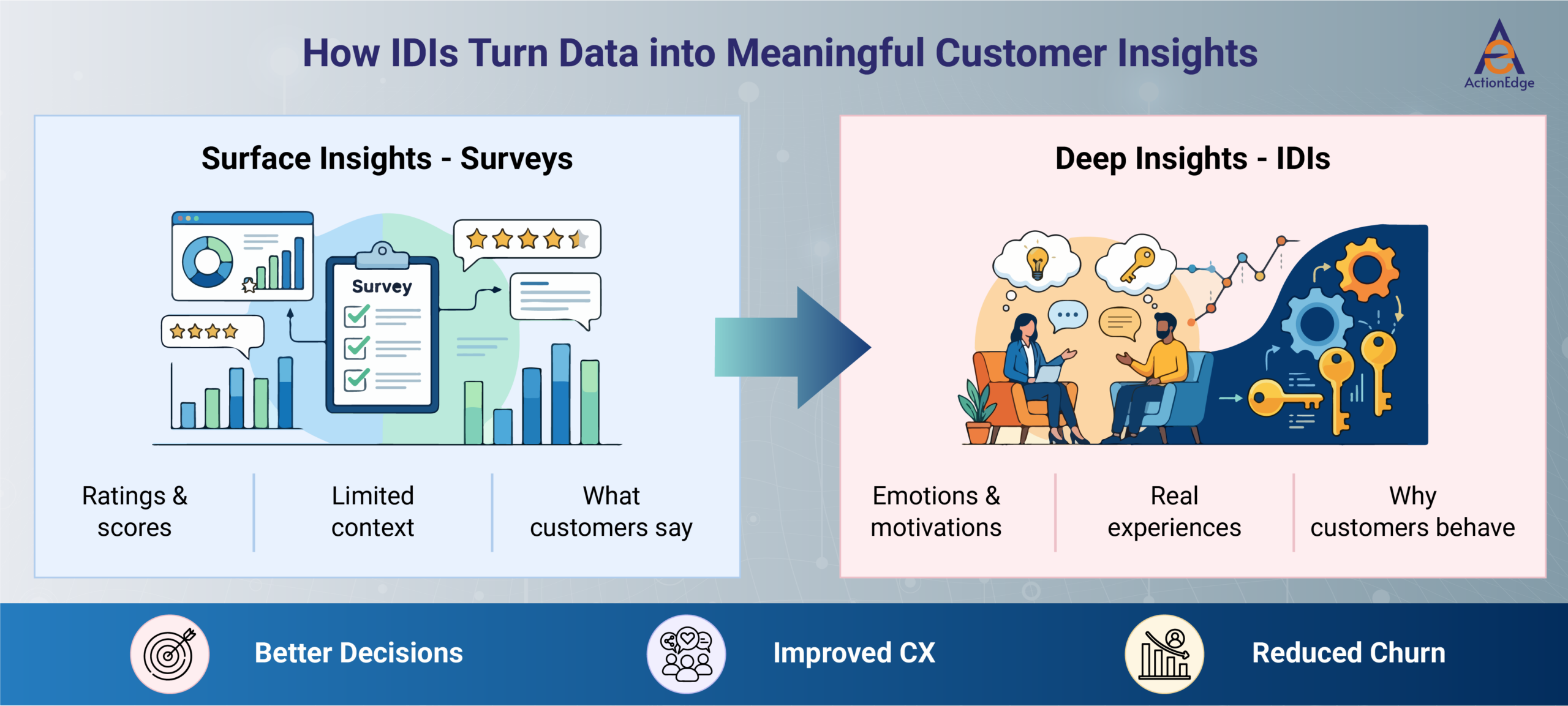
This is the key difference between IDIs and surveys. Surveys tell you what is happening. IDIs help you understand why it is happening.
Key CX Challenges Faced by Telecom Brands
Modern telecom customers expect seamless, connected digital experiences across every touchpoint. Industry insights from Oracle highlight how even minor disruptions in these journeys can significantly impact satisfaction and loyalty. Telecom brands today face several persistent customer experience challenges:
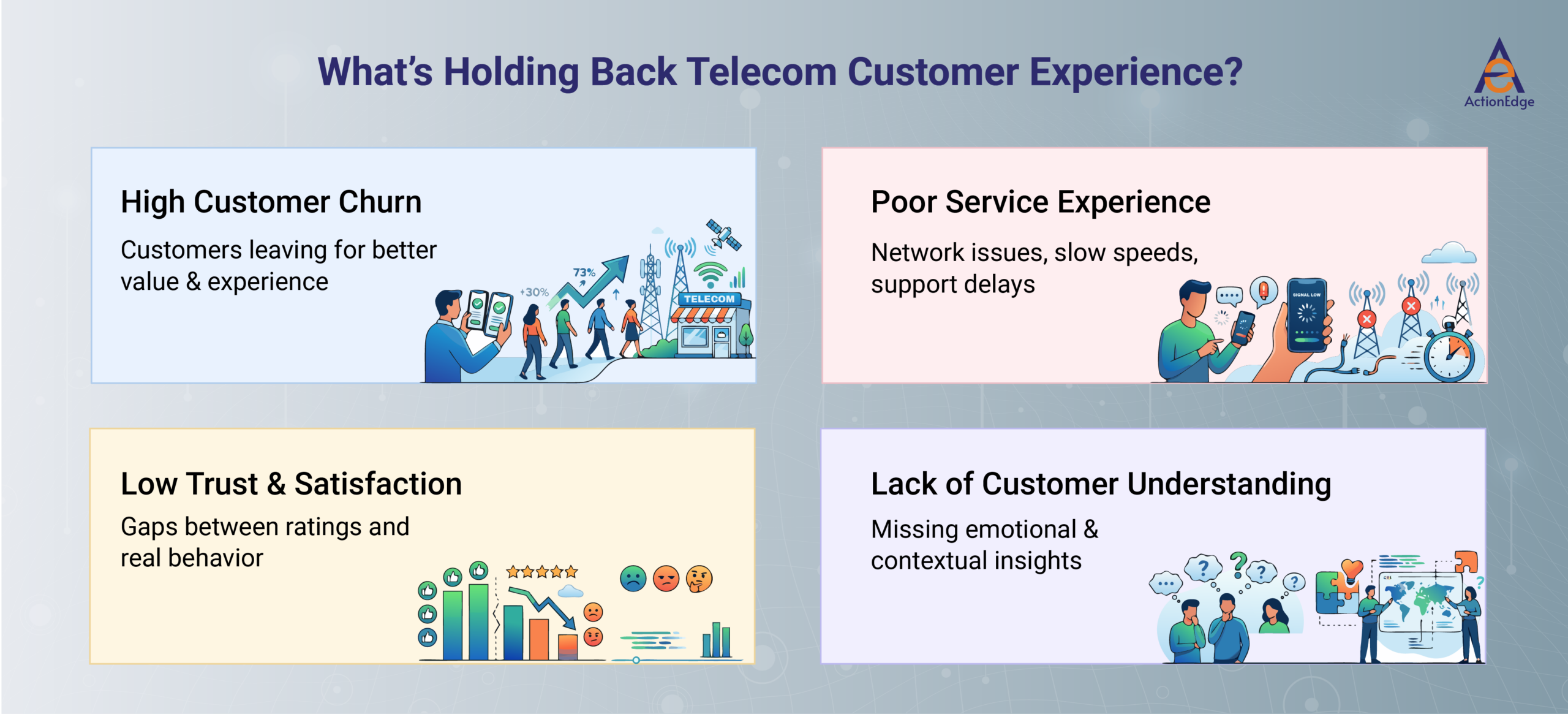
High Customer Churn
Customers frequently switch providers in search of better pricing, network quality, or service experience. Even a single poor interaction can trigger switching behavior. This makes retention a constant challenge for telecom brands.
Poor Service Experience
Issues such as network drops, slow data speeds, delayed support responses, and billing discrepancies continue to impact satisfaction. These everyday frustrations accumulate over time and significantly influence overall brand perception.
Poor Satisfaction and Trust Scores
Deeper discontent is indicated by discrepancies between real customer behaviour and NPS or CSAT scores. Consumers may give services a mediocre rating, yet they may still decide to transfer providers, indicating unspoken problems with trust.
Insufficient Emotional and Contextual Knowledge
Many brands overlook the emotional factors that influence decisions because they place a strong emphasis on quantitative measurements. It becomes challenging to determine what genuinely annoys or pleases clients in the absence of context.
These challenges cannot be solved by numbers alone. They require deeper exploration through qualitative research in telecom.
Why Surveys Alone Fall Short
Surveys remain useful, but they have limitations when it comes to understanding complex customer experiences.
Surface-Level Responses
Consumers frequently give brief, impulsive responses without giving their real experiences any thought. As a result, the feedback records what they say at the time but ignores the more nuanced context of their viewpoints.
Bias & Survey Fatigue
When consumers are requested to complete surveys on a regular basis, their involvement tends to decline, resulting in answers that may be hurried, less deliberate, or affected by what they believe to be the “correct” response. This eventually has an impact on the accuracy and dependability of the information gathered.
Limited Context
A rating does not explain the sequence of events that led to dissatisfaction. Without context, it becomes difficult to identify the root cause of issues.
Missing the “Why”
Most importantly, surveys fail to uncover the underlying reasons behind customer behavior. They show what is happening, but not why it is happening.
For telecom brands aiming to improve customer experience, this gap can lead to misinformed decisions.
How IDIs Improve Telecom Customer Experience Insights
IDIs address these challenges by bringing depth and clarity to customer insights. Leading industry perspectives from IBM highlight that telecom customer experience is increasingly shaped by real-time engagement and personalization. As platforms become more automated, understanding customer context becomes even more critical to delivering meaningful experiences.
Capture Deep Insights
They allow researchers to explore customers’ thoughts, emotions, and experiences in detail. This helps uncover hidden concerns that structured surveys often miss.
Understand Customer Journeys
By walking through real-life scenarios, brands can identify friction points across the entire journey. This provides a more holistic view of customer experience.
Reveal Unmet Needs
Customers often share expectations and frustrations that are not captured in structured formats. These insights can highlight opportunities for innovation and improvement.
Enable Better Decision-Making
With clearer context, telecom brands can make more informed and targeted improvements. Decisions become insight-led rather than assumption-driven.
For example, instead of simply knowing that customers are dissatisfied with support, IDIs can reveal whether the issue is response time, lack of empathy, or ineffective resolution.
Use Cases of IDIs in Telecom
IDIs can be applied across multiple customer experience areas:
Churn Analysis
Recognize the reasons behind customers’ departures, what influences their choices, and what could have been done to avoid them. Brands may create more effective retention strategies with the use of these insights.
Service Experience Evaluation
Examine actual encounters with call quality, network performance, and customer service. This aids in pinpointing particular areas that require work.
Pricing and Plan Testing
Determine how consumers see plan complexity, value, and pricing equity. Additionally, it shows how engaging and straightforward pricing communication is.
New Product Validation
Prior to launch, get early input on new features, apps, or services. This enhances product-market fit and lowers the chance of failure.
Mapping the Customer Journey
Determine the pivotal events that affect brand perception, loyalty, and satisfaction. Comprehending these instances aids in maximizing the total experience.
These applications make IDIs a powerful tool in telecom user experience research.
Combining IDIs with Modern Research Methods
To maximize impact, IDIs can be integrated with modern research approaches.
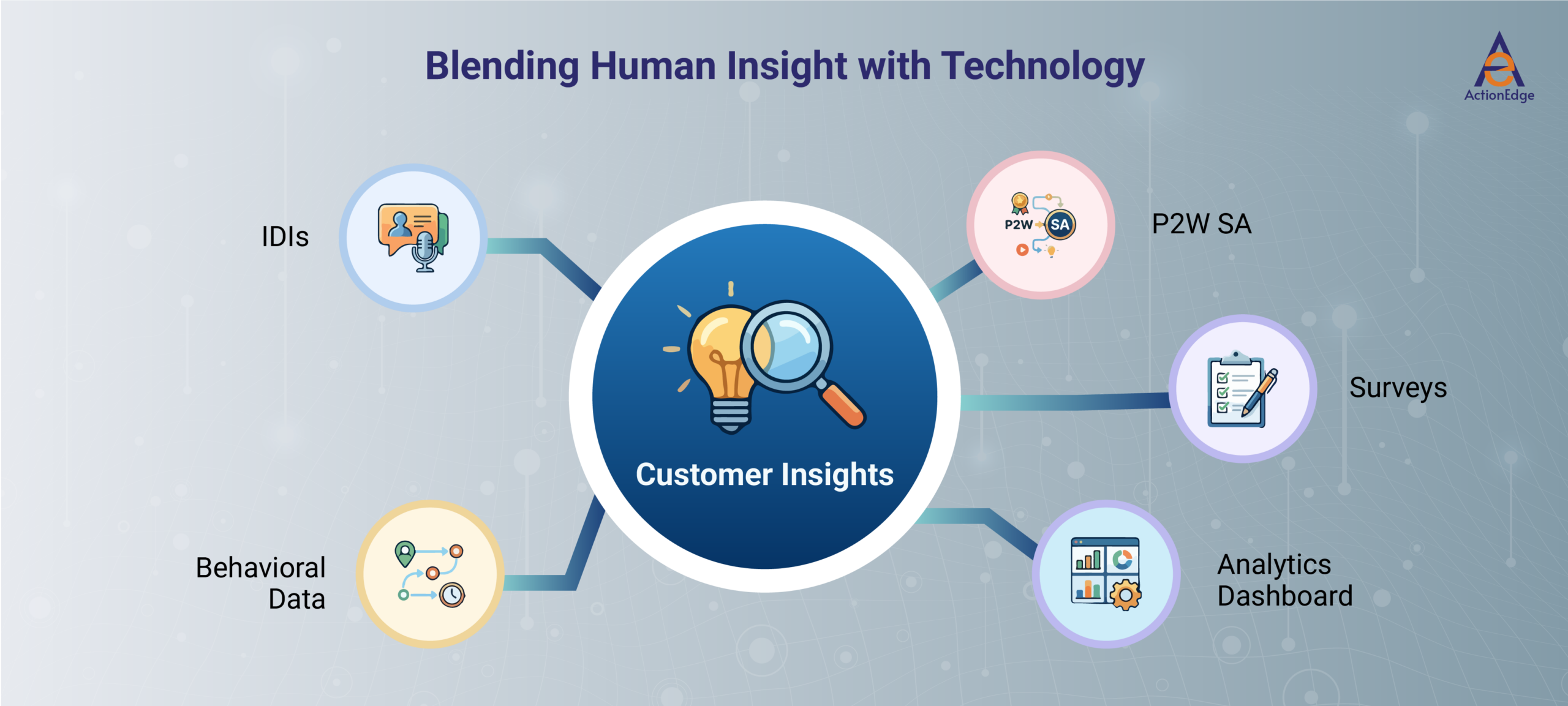
IDIs + Digital Interaction
Using phone to web via screen access research (P2W SA), respondents can share their screens while discussing experiences. This allows researchers to observe real-time behavior and interactions.
Blending Data Types
Combining IDIs with quantitative data helps validate insights and identify patterns at scale. This creates a balance between depth and breadth.
Real-Time Feedback
Live interactions enable immediate clarification, deeper probing, and richer understanding. This improves the overall quality of insights collected.
Hybrid Approach
This creates a more comprehensive framework that blends human insight with technological efficiency. It ensures both accuracy and scalability in research.
Best Practices for Conducting IDIs in Telecom
To ensure high-quality insights, telecom brands should follow key best practices:
- Select the Right Audience: Segment customers based on usage, geography, and behavior to capture diverse perspectives. This ensures the insights are relevant and representative.
- Ask the Right Questions: Focus on open-ended, exploratory questions that encourage detailed responses. Well-framed questions lead to more meaningful conversations.
- Use Skilled Moderators: Experienced interviewers can probe deeper and uncover meaningful insights. Their ability to build rapport plays a key role in extracting honest responses.
- Maintain Neutrality: Avoid leading questions to ensure unbiased responses. Neutral moderation helps capture authentic customer opinions.
- Focus on Actionability: Insights should translate into clear recommendations for improvement. The goal is not just understanding, but driving change.
Business Impact: From Insights to CX Improvement
Customer experience is no longer just a support function but a key growth driver. Industry perspectives from Bain & Company show that telecom brands that deliver superior customer experiences are more likely to improve retention and long-term profitability. When used effectively, IDIs can drive tangible business outcomes:
Improved Customer Satisfaction
Understanding real pain points allows brands to address them proactively. This leads to better experiences and stronger customer relationships.
Reduced Churn
By identifying early warning signs, companies can take steps to retain customers. Proactive action helps reduce customer loss.
Better Products and Services
Insights help refine offerings to better match customer expectations. This improves relevance and market acceptance.
Stronger CX Strategies
Data-driven decisions lead to more effective and sustainable improvements. Strategies become aligned with real customer needs.
This is where strong voice of customer telecom strategies, powered by deeper insights, help brands move from reactive fixes to proactive experience design.
How ActionEdge Can Help Telecom Brands
At ActionEdge, we specialize in delivering deep, actionable insights through advanced research methodologies. As a trusted market research company, we understand the complexities of telecom customer journeys and the importance of getting insights right.
Our approach combines IDIs with modern tools and techniques to uncover what truly drives customer behavior. We leverage methods such as P2W SA to enhance interaction, improve engagement, and capture real-world experiences.
Our market research service is designed to go beyond data collection. We help telecom brands translate insights into clear strategies that improve customer experience, reduce churn, and drive long-term growth.
Conclusion: The Future of Telecom CX is Insight-Driven
Improving customer experience in telecom is no longer about collecting more data. It is about understanding customers more deeply.
In-depth interviews (IDI) play a critical role in uncovering the real experiences, emotions, and expectations that shape customer decisions. They go beyond surface-level feedback and provide the clarity needed to drive meaningful change.
As competition intensifies and customer expectations rise, moving beyond surveys is no longer optional. It is essential. The combination of human insight and advanced methodologies is what will define successful CX strategies in 2026 and beyond.
Ready to uncover what your customers truly think and feel? Connect with ActionEdge to transform your customer experience with smarter, insight-driven research.
Frequently Asked Questions
Telecom brands use In-depth interviews (IDI) to understand customer expectations, pain points, and digital behavior in greater detail. These insights support stronger telecom user experience research and help businesses improve personalization, service quality, and overall customer satisfaction.
Qualitative research in telecom helps brands explore customer emotions, preferences, and decision-making patterns beyond survey data. Methods such as In-depth interviews (IDI) and customer discussions support more effective personalization and targeted telecom CX consulting strategies.
Telecom providers often face challenges related to service personalization, digital onboarding, customer support consistency, and changing user expectations. Strong Telecom market research and telecom user experience research help brands identify these gaps and improve digital customer journeys.
Telecom companies can improve retention by combining qualitative and quantitative insights through Hybrid market research approaches. Using In-depth interviews (IDI), surveys, and phone to web via screen access research (P2W SA) helps brands better understand customer needs and deliver more personalized experiences.
As a global Market research company, ActionEdge Research Services provides specialized Market research service solutions for telecom brands, including In-depth interviews (IDI), fieldwork support, and phone to web via screen access research (P2W SA). The company helps businesses conduct reliable Telecom market research and generate actionable customer insights.