
The automotive industry is undergoing one of the biggest transformations in its history. Electric vehicles (EVs), connected cars, autonomous driving technologies, digital retail models, and changing customer expectations are reshaping how vehicles are designed, sold, and experienced. As competition intensifies, innovation alone is no longer enough to guarantee success.
A vehicle may feature cutting-edge technology, advanced safety systems, or competitive pricing, but it can still fall short if it doesn’t align with what customers truly value. Understanding the needs of buyers, dealers, fleet operators, and regional markets has become essential for making informed business decisions.
This is where automotive market research becomes a competitive advantage. By combining customer insights with data-driven evidence, manufacturers, suppliers, and mobility companies can reduce uncertainty, validate strategic decisions, and develop products that resonate with the market. Whether launching a new EV, improving dealership experiences, or evaluating connected vehicle technologies, research helps businesses move forward with confidence.
10 Automotive Industry Challenges and How Market Research Solves Them
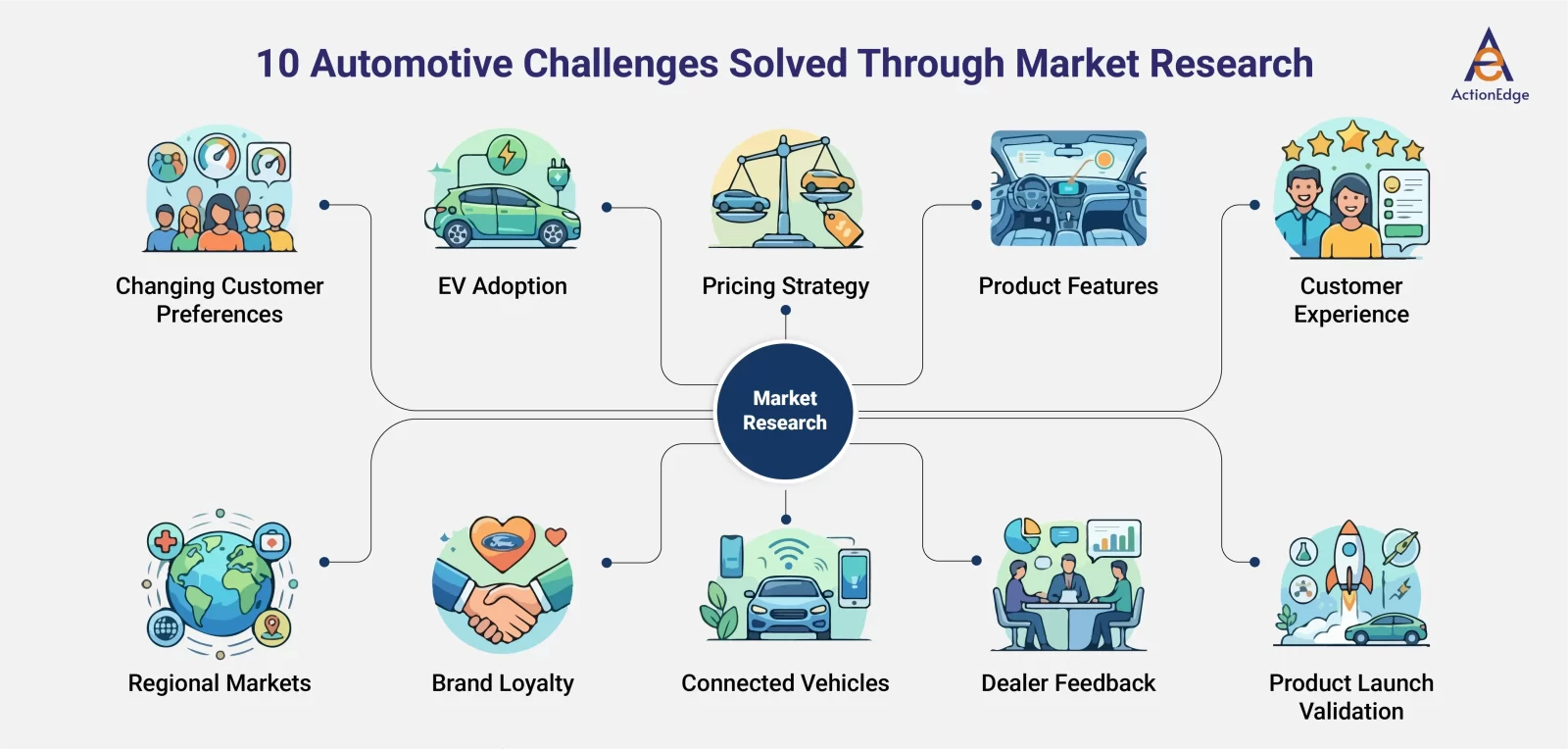
1. Rapidly Changing Customer Preferences
Customer expectations are constantly evolving. Today’s buyers look beyond performance and fuel efficiency. They expect sustainability, digital connectivity, advanced safety, personalized experiences, and flexible ownership models.
For example, younger consumers may prioritize smartphone integration and subscription-based mobility, while commercial fleet operators often focus on operating costs and vehicle reliability.
Through automotive surveys, customer segmentation studies, trend analysis, and in-depth interviews, companies can identify changing preferences early and adapt their products and marketing strategies accordingly.
2. Electric Vehicle (EV) Adoption Uncertainty
Although EV adoption continues to grow worldwide, many customers remain uncertain due to concerns about charging infrastructure, battery range, upfront costs, and long-term ownership.
Market research helps organizations understand what motivates EV buyers and what barriers still exist.
Concept testing, awareness studies, pricing research, and perception surveys provide valuable insights that help businesses refine EV strategies before investing heavily in product development or market expansion.
3. Pricing Sensitivity
Setting the right price has become increasingly challenging. Customers expect value for money, while manufacturers must protect profitability in a competitive market.
Research methods such as willingness-to-pay studies, pricing simulations, and conjoint analysis help businesses understand how different customer segments perceive value and which features justify premium pricing.
Instead of relying on assumptions, companies can develop pricing strategies supported by customer evidence.
4. Product Feature Prioritization
Modern vehicles can include hundreds of potential features, but not every innovation influences purchase decisions.
Some customers may value fast charging capabilities over autonomous driving features, while others may prioritize advanced driver assistance systems or connected infotainment.
Feature prioritization surveys, usability testing, and customer interviews help manufacturers focus investments on the features customers value most.
5. Customer Experience Across Sales and Service
The customer journey doesn’t end when a vehicle is purchased. Dealership interactions, financing, servicing, maintenance, and after-sales support all influence customer satisfaction and loyalty.
A poor dealership experience can negatively affect future purchases, regardless of vehicle quality.
This is why customer experience research is critical. Customer satisfaction surveys, journey mapping, and mystery shopping studies help organizations identify service gaps and improve experiences across every customer touchpoint.
6. Regional Market Differences
Customer preferences vary significantly across countries, cities, and demographic groups.
Urban customers may seek compact EVs with connected features, while rural buyers may prioritize durability, cargo capacity, and driving range. Regulations, infrastructure, and purchasing power also differ between markets.
Localized surveys, regional segmentation studies, and multi-country research help companies tailor products, pricing, and communication strategies for different markets.
7. Brand Perception and Customer Loyalty
Customers today have more automotive choices than ever before. Building trust and maintaining brand loyalty requires continuous monitoring of customer perceptions.
Brand tracking studies measure awareness, consideration, satisfaction, and loyalty over time.
Perception research also helps manufacturers understand how customers compare competing brands and what factors influence long-term loyalty, enabling better marketing and brand positioning decisions.
8. Connected and Smart Vehicle Adoption
Connected vehicles offer features such as predictive maintenance, remote diagnostics, over-the-air software updates, and enhanced navigation.
However, concerns about data privacy, cybersecurity, and usability often influence customer acceptance.
UX research, usability testing, and qualitative interviews help manufacturers understand these concerns and improve the design and communication of connected technologies.
9. Dealer and Channel Partner Feedback Gaps
Dealers and channel partners interact with customers every day, giving them valuable insight into purchasing decisions, customer objections, and competitive activity.
Unfortunately, these insights are not always incorporated into strategic planning.
Dealer satisfaction surveys, CATI interviews, and qualitative discussions provide manufacturers with practical feedback that supports better product planning, inventory management, and sales strategies.
10. Product Launch Risks
Launching a new vehicle or mobility solution without validating customer demand can result in costly failures.
Successful product launches require a clear understanding of customer expectations before significant investments are made.
Concept testing, pilot studies, product clinics, and purchase intent research help companies validate product concepts, pricing, messaging, and positioning before entering the market.
Why a Qualitative and Quantitative Approach Delivers Better Automotive Insights
Many automotive business challenges cannot be solved with numbers alone, and customer opinions from a handful of interviews cannot represent an entire market. The most reliable decisions come from combining Qualitative market research with Quantitative market research.
Qualitative research uncovers the reasons behind customer behavior through:
- In-depth Interviews (IDIs)
- Focus Group Discussions (FGDs)
- Customer Journey Mapping
- Concept and Usability Testing
Quantitative research validates those insights using larger sample sizes through:
- CATI Surveys
- CAWI (Online Surveys)
- Brand Tracking
- Customer Satisfaction (CSAT) Studies
- Pricing and Market Segmentation Studies
For example, interviews may reveal that prospective EV buyers are concerned about charging accessibility. Large-scale surveys can then measure how widespread those concerns are across different markets and customer segments. Combining qualitative depth with quantitative evidence enables businesses to reduce uncertainty, improve customer experiences, and make more confident strategic decisions.
How ActionEdge Supports Automotive Market Research Projects
The automotive industry spans a wide range of segments, from vehicle manufacturing and engineering to electric mobility, connected technologies, commercial vehicles, components, and aftermarket services. At ActionEdge, we have supported market research projects across these diverse automotive sub-sectors, helping clients access niche industry professionals and collect reliable insights for strategic decision-making.
Here are a couple of examples of our work:
OEM Strategy & Product Planning
ActionEdge supported a global research initiative focused on understanding how automotive OEMs assess external factors influencing product development and future technology roadmaps. The study required recruiting highly experienced professionals involved in strategic planning, R&D, product planning, technology strategy, and regulatory affairs. By providing access to the right decision-makers and ensuring reliable fieldwork execution, we helped generate valuable insights into how OEMs prepare for evolving market trends and regulatory changes.
Vehicle Engineering & Product Development
For a global automotive research project, ActionEdge recruited experienced engineering professionals to explore vehicle development processes, engineering operations, testing practices, localization strategies, and global product development programs. Respondents included current and former OEM R&D engineers, engineering managers, designers, research engineers, and operational leaders. The study enabled the client to gather in-depth perspectives from professionals directly involved in bringing new vehicles from concept to production.
Whether supporting research in vehicle development, emerging mobility technologies, automotive manufacturing, or commercial transportation, ActionEdge remains committed to delivering reliable fieldwork, access to the right respondents, and high-quality data collection that helps clients make informed business decisions.
Conclusion
The future of the automotive industry will be shaped not only by technological innovation but also by how well companies understand the people they serve. From changing customer expectations and EV adoption to pricing strategies, dealership experiences, and product launches, research provides the evidence businesses need to make smarter decisions with greater confidence.
Investing in market research for automotive industry enables organizations to identify market opportunities, reduce business risks, improve customer experiences, and build products that align with evolving customer needs. Companies that consistently listen to their customers are better positioned to innovate, strengthen their competitive advantage, and achieve long-term growth.
Looking for reliable Automotive Market Research Services?
Partner with ActionEdge for trusted fieldwork, expert respondent recruitment, and high-quality data collection that powers confident business decisions.