

A new market can look promising on paper. The real test begins when you ask the people who actually live, buy, use, influence, or make decisions within that market.
When businesses evaluate a new geography, they often investigate customer demand, competition, pricing, product expectations, purchasing behavior, and market potential. Research is expected to turn these questions into evidence. But evidence is only as dependable as the people providing it.
This is why respondent quality in market research deserves attention from the very beginning. Even a carefully designed questionnaire, strong methodology, and adequate sample size can produce misleading findings when respondents are irrelevant, inattentive, fraudulent, or poorly screened.
For new market entry research, the quality of the sample can influence everything from segmentation and pricing to competitive positioning and investment decisions. Here are 10 reasons it matters.
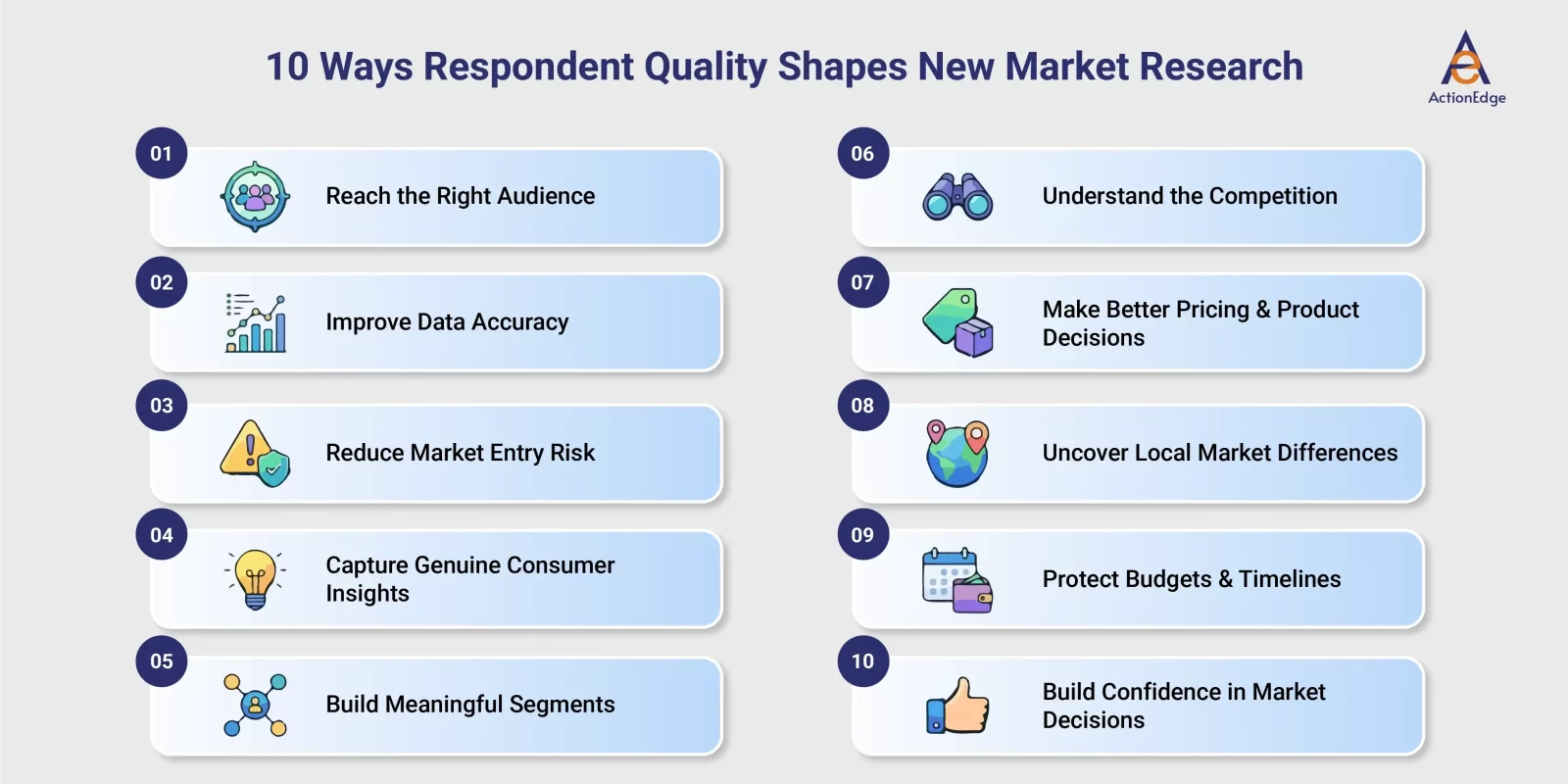
10 Ways Respondent Quality Shapes New Market Research
The quality of your respondents can influence everything from the accuracy of research findings to the confidence behind a market entry decision. Here are 10 key ways it makes a difference:
1. Ensures the Right Target Audience
A research sample needs to reflect the people the business is actually trying to understand. Depending on the study, that could mean specific age groups, professions, industries, purchasing roles, product users, decision-makers, or people with particular usage behaviors.
For example, a company assessing demand for enterprise software in a new country needs input from professionals involved in technology selection or purchasing, not simply anyone who works in an office.
Strong screening helps ensure that respondents meet the study’s specific criteria, making the resulting findings more relevant.
2. Improves Data Accuracy
Good research depends on respondents who understand the questions and provide genuine answers.
Fraudulent profiles, duplicate respondents, inattentive participants, and people who do not meet the target criteria can introduce noise into a dataset. In contrast, relevant and engaged respondents are more likely to provide thoughtful answers based on actual experiences.
That makes data quality in market research closely connected to the quality of the people recruited for the study. Better respondents create a stronger foundation for analysis and interpretation.
3. Reduces Market Entry Risk
Entering a new market involves investment. Companies may need to commit resources to distribution, hiring, marketing, partnerships, product adaptation, or local operations.
Research is often conducted before those decisions are made. If respondents incorrectly suggest that demand is high, competition is weak, or customers are willing to pay a particular price, the business could act on a false signal.
Validated respondents reduce this risk by providing evidence that is more closely connected to the actual market.
4. Provides Genuine Consumer Insights
Numbers can tell a business what is happening. The right respondents can help explain why.
People with genuine product experience, category knowledge, or purchase intent can reveal motivations, frustrations, expectations, and unmet needs that a superficial sample may miss.
For instance, a consumer survey might show low interest in a product feature. Follow-up In-depth interviews with relevant users could reveal that the feature itself is not the problem. Customers may simply find it difficult to understand or believe it does not justify the price.
5. Supports Better Market Segmentation
Not every customer in a new market thinks or behaves the same way.
Quality respondent profiling can help researchers identify differences between customer groups based on purchasing behavior, needs, product usage, attitudes, or decision-making criteria.
A company may discover, for example, that larger enterprises prioritize integration and security while smaller businesses care more about affordability and ease of implementation. These distinctions can shape targeting, messaging, and market entry strategy.
6. Strengthens Competitive Understanding
Respondents with genuine category experience can provide valuable perspectives on existing brands and competitors.
They can help researchers assess brand awareness, usage, perceptions, switching behavior, strengths, weaknesses, and reasons for choosing one provider over another.
This is particularly important in established markets where a new entrant is not competing against an empty space. Understanding what customers already value can help businesses identify where an opportunity actually exists.
7. Improves Pricing and Product Decisions
Pricing research is highly sensitive to respondent relevance.
If participants have no genuine purchasing authority or category experience, their stated willingness to pay may have limited value. The same applies to feedback about product features, packaging, service expectations, or positioning.
Relevant respondents can provide a more credible view of what customers value and what they may realistically pay for it. This supports better decisions around product-market fit and commercial positioning.
8. Helps Identify Local Market Differences
A successful strategy in one country cannot automatically be copied into another.
Customer expectations, buying habits, cultural influences, channel preferences, terminology, and decision-making processes can differ significantly between markets. Local respondents bring context that secondary research or assumptions may overlook.
For example, a purchasing process that involves one decision-maker in an existing market may involve several stakeholders in a new country. Speaking with the right local audience can uncover these differences before they become costly mistakes.
9. Protects Research Budgets and Timelines
Poor respondent quality does not only affect findings. It can also affect fieldwork efficiency.
When unsuitable respondents enter a study, researchers may need additional screening, replacements, recontacts, data cleaning, or sample replenishment. These activities can increase both costs and timelines.
A quality-focused recruitment process addresses potential issues earlier through appropriate screening, validation, monitoring, and quality checks. That helps researchers spend their fieldwork budget on usable responses rather than correcting avoidable sample problems.
10. Builds Confidence in Market Entry Decisions
Ultimately, respondent quality influences confidence in the entire research process.
The logic is straightforward:
Relevant respondents → stronger data → clearer insights → better-informed decisions
When research teams know that participants genuinely represent the intended audience, the findings become easier to defend internally and use in strategic discussions.
This is particularly important for B2B respondent quality, where a respondent’s job function, seniority, industry experience, purchasing responsibility, or involvement in business decisions can materially affect the value of their response.
How ActionEdge Can Help
For a market research company supporting studies across different audiences and geographies, respondent recruitment is an important part of the fieldwork process.
ActionEdge supports respondent screening, recruitment, validation, and data collection for B2B and consumer research, including hard-to-reach audiences and multi-country fieldwork. Its approach combines respondent qualification with structured quality checks designed to identify unsuitable, duplicate, fraudulent, or low-quality participation.
Depending on the research requirement, market research services can include CATI, CAWI, Phone-to web via screen access (P2W SA), IDIs, FGDs, and other quantitative and qualitative approaches.
For international studies, this can be particularly useful when researchers need comparable fieldwork across multiple markets while still accounting for local audience and language requirements. Quality-focused recruitment helps ensure that the data collected is relevant enough to support meaningful analysis rather than simply helping researchers reach a sample target.
Conclusion
A market entry strategy can be sophisticated, but its foundation is still human. The people answering the research questions determine how closely the findings reflect the market being evaluated.
That makes data quality in market research more than a final-stage quality-control concern. It begins with identifying the right respondents, validating their relevance, and maintaining quality throughout fieldwork. Strong market research data quality gives researchers greater confidence that the insights they are using genuinely represent the customers and decision-makers they need to understand.
For businesses planning new market entry research, ActionEdge provides quality-focused respondent recruitment and global market research data collection across B2B, consumer, quantitative, and qualitative studies.
Looking for relevant respondents for your next market? Reach us at rfp@action-edge.com