
A farmer can make a decision in January that looks completely different by June. A delayed monsoon, an unexpected heatwave, a new pest, or a shortage of irrigation water can change what gets planted, when it gets planted, and how much a farmer is willing to invest.
That is why understanding how farmers are adapting to climate change requires more than looking at crop yields or farm income. The real story lies in the decisions farmers make and the reasons behind them.
Across agricultural markets, unpredictable rainfall, changing temperatures, droughts, floods, pests, and shifting growing conditions are influencing farming decisions. Yet adaptation does not look the same everywhere. A smallholder farmer facing water scarcity may respond very differently from a large commercial producer with access to technology, financing, and crop insurance.
This is where market research in agriculture can provide a deeper perspective. By combining in-depth interviews with quantitative surveys, researchers can explore the experiences behind farmers’ decisions and then measure how widespread those behaviors are across markets and farmer segments.
In this blog, we cover 10 ways market research can reveal how farmers are adapting to climate change, from their biggest concerns and changing practices to solution adoption, investment decisions, information needs, and evolving behaviors.
What Can Market Research Reveal About Farmer Adaptation?
1. Identify Farmers’ Biggest Climate Concerns
Before understanding adaptation, it is important to know what farmers are actually worried about.
Qualitative market research, particularly In-Depth Interviews, can uncover concerns that may not appear in a predefined survey question. Farmers may talk about extreme heat, irregular rainfall, drought, flooding, water availability, or the emergence of new pests and diseases.
For example, a farmer might not describe “climate variability” as the main problem. Instead, they may say that the rainy season now starts too late to follow the traditional planting calendar.
A quantitative survey can then determine how widespread that concern is across regions, crops, and farmer segments.
2. Understand How Farming Practices Are Changing
Adaptation often shows up in everyday farming decisions.
Research can examine whether farmers are:
- Changing planting or harvesting schedules
- Switching crop varieties
- Adjusting irrigation practices
- Modifying fertilizer usage
- Introducing soil-management practices
- Diversifying crops
The distinction between the two research approaches is valuable here: IDIs explore why farmers changed, while quantitative research reveals how many farmers are changing.
That difference can turn an interesting observation into a measurable market insight.
3. Measure Adoption of Climate-Resilient Solutions
Farmers have access to an expanding range of solutions, from drought-resistant seeds and water-efficient irrigation to weather-monitoring tools, crop protection products, and digital agriculture technologies.
But awareness does not necessarily mean adoption.
Research can map the journey from awareness to consideration, trial, adoption, and continued use. It can also reveal why farmers abandon a solution after trying it.
For an agricultural technology provider, for instance, knowing that farmers are aware of a weather-monitoring platform is useful. Knowing that they find it difficult to interpret the information or do not see sufficient value in paying for it is much more actionable.
4. Uncover Barriers to Climate Adaptation
Recognizing a climate risk does not automatically make adaptation possible.
Farmers may face barriers including cost, limited technology access, lack of information, availability issues, financing constraints, or uncertainty about return on investment.
Agricultural market research can explore these barriers from both sides. Interviews can uncover the personal and practical reasons behind resistance, while surveys can establish which barriers are most common.
This distinction matters because the solution may not always be a better product. Sometimes farmers need financing, training, easier access, or stronger evidence that an investment will pay off.
5. Understand How Farmers Make Risk Decisions
Climate uncertainty changes how farmers think about risk.
Research can explore how much risk farmers are willing to take, what events trigger a change in behavior, which risks they consider most serious, and how they balance immediate costs against potential future losses.
Consider a farmer deciding whether to invest in water-efficient irrigation. The decision may involve more than the price of the equipment. Expected rainfall, previous crop performance, access to credit, farm size, and confidence in future returns may all influence the decision.
Understanding that decision-making process helps organizations develop solutions around real-world farmer priorities.
6. Identify Information and Advisory Needs
Farmers do not make decisions in isolation. They often rely on weather forecasts, agricultural advisors, input suppliers, peers, cooperatives, government programs, or other trusted sources.
Research can ask:
- Where do farmers obtain climate and weather information?
- Which sources do they trust?
- How frequently do they use weather forecasts?
- Who influences major farming decisions?
- What information do they still struggle to find?
Interviews can reveal why one source is trusted over another, while surveys can measure its reach across different farmer groups.
7. Segment Farmers by Adaptation Behavior
There is no single “farmer” profile.
Qualitative and quantitative research can help identify meaningful adaptation segments, such as early adopters, cautious adopters, cost-constrained farmers, traditionalists, or highly climate-exposed farmers.
This segmentation can be especially useful when a solution performs well with one group but struggles with another.
A seed company, irrigation provider, or agricultural technology business can use these insights to identify which farmers are most ready to adopt, which need more education, and which face structural barriers.
8. Measure Willingness to Invest in Adaptation
Climate adaptation frequently requires investment, making the economics of adoption an important research question.
Quantitative market research can examine willingness to pay, investment priorities, preferred financing models, and price sensitivity. Interviews can provide the context behind those numbers by exploring how farmers assess financial risk.
For example, farmers may prefer a lower upfront cost, installment payments, seasonal financing, or outcome-based pricing rather than rejecting a solution altogether.
These insights can influence not only product development but also pricing and go-to-market strategies.
9. Track Changing Attitudes and Behaviors Over Time
Adaptation is not a one-time decision. Farmers may change their practices as climate conditions, technology, costs, and market conditions evolve.
A research program can establish benchmarks for awareness, adoption, attitudes, behaviors, barriers, and unmet needs, then track them over time.
This makes it possible to see whether farmers are gradually adopting new practices or whether a major weather event has accelerated behavioral change.
Longitudinal research can therefore reveal movement that a single survey cannot capture.
10. Turn Farmer Voices Into Actionable Insights
The ultimate value of market research service is not simply collecting responses. It is connecting those responses to decisions.
When farmer narratives are combined with measurable evidence, organizations can understand:
- What farmers are experiencing
- Why they respond differently
- How widespread those responses are
- Which needs remain unmet
- Where new opportunities may exist
This turns fragmented feedback into useful market intelligence that can inform products, communication, pricing, distribution, and support programs.
Why Combine IDIs With Quantitative Research?
Neither approach tells the complete story on its own.
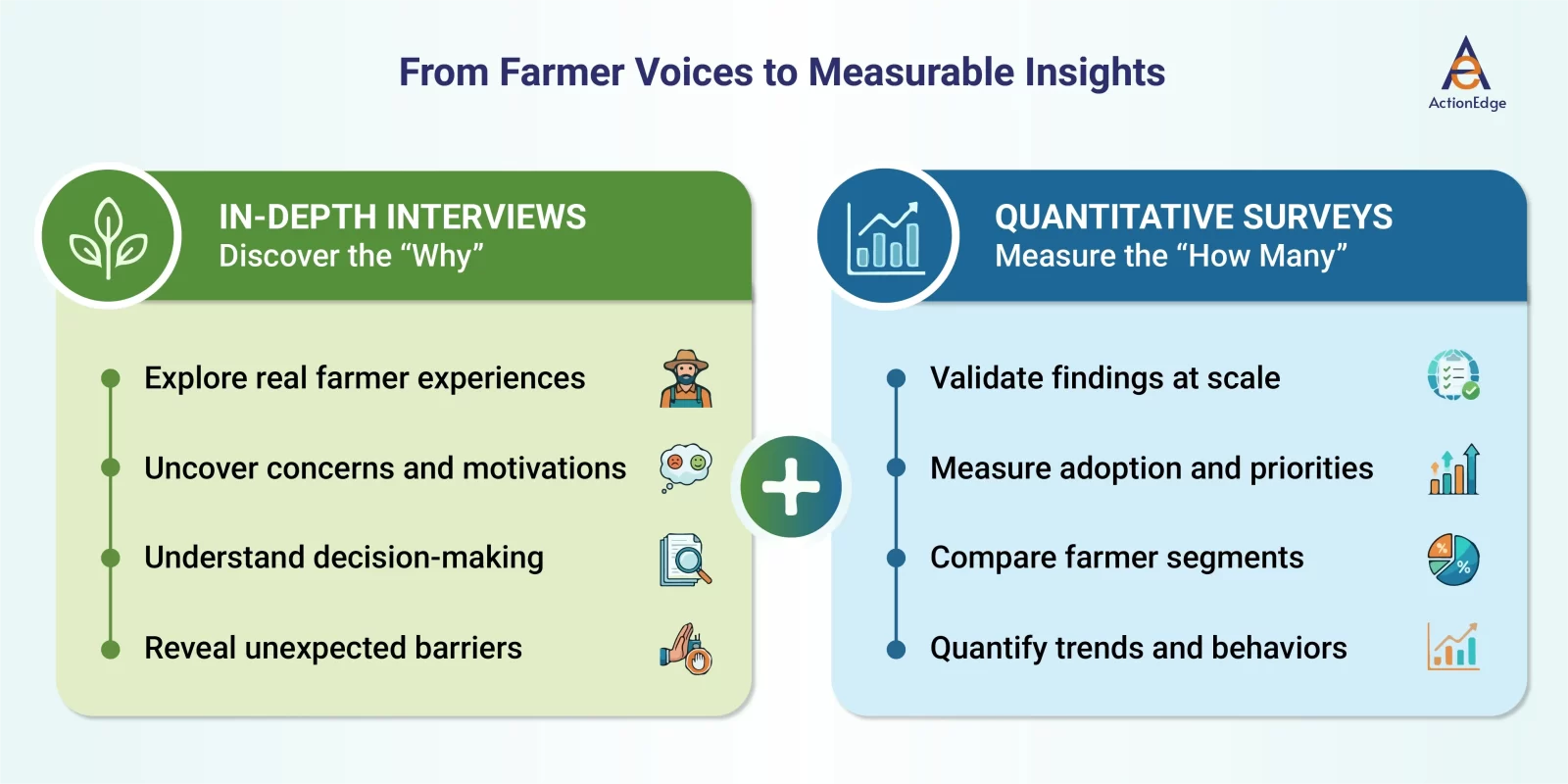
In-Depth Interviews provide the depth behind farmer behavior. Surveys provide the evidence needed to determine whether those findings represent a broader population.
Together, they create a stronger research framework for understanding climate change and agriculture. This combination is particularly valuable when farmer behavior varies significantly by geography, crop, farm size, resources, or exposure to climate risks.
Conclusion
Climate change does not produce one universal farming response. One farmer may change crops, another may invest in irrigation, while another may delay investment because the financial risk feels too high.
Those differences are not simply data points. They reveal how farmers assess risk, opportunity, cost, and confidence in an uncertain environment.
For organizations working across agriculture, understanding these choices is becoming increasingly important. A market research company with the right blend of qualitative and quantitative capabilities can bring those farmer perspectives together, identify patterns across markets, and translate them into practical decisions.
At ActionEdge, our market research service approach combines farmer voices with measurable evidence to help organizations explore changing behaviors, adoption opportunities, barriers, and evolving needs across agricultural markets. Because understanding adaptation starts with understanding the people making the decisions.