

A customer can walk into a store wanting one brand and walk out with another. Online, the switch can happen even faster: one unavailable product, a better offer, a confusing checkout page, or a single negative review can change the decision.
This is the reality of customer brand switching. Shoppers do not always make decisions based on long-term loyalty. Their choice can change in seconds depending on price, availability, convenience, promotions, recommendations, packaging, product experience, or trust.
Sales data can indicate that customers switched. It is much harder to understand why they switched.
That is where market research becomes valuable. By combining customer feedback, behavioral insights, and structured research methods, businesses can uncover the motivations behind switching and identify where they can intervene.
In this blog, we explore 10 ways market research can help businesses uncover what drives customers to switch brands and turn those insights into stronger retention strategies.
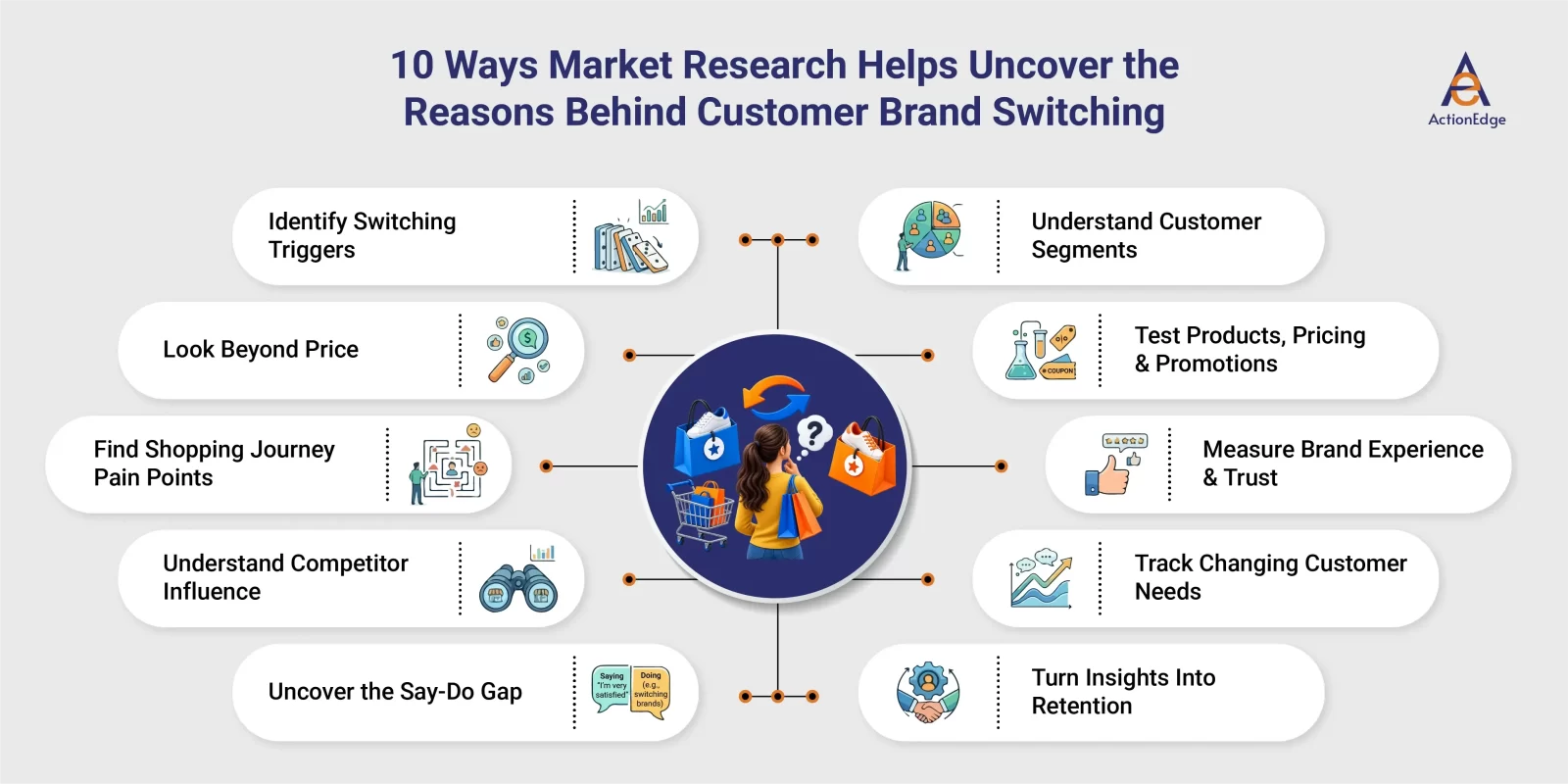
10 Ways Market Research Helps Uncover the Reasons Behind Customer Brand Switching
Here are 10 ways research can reveal what is really happening.
1. Identifies the Key Triggers Behind Brand Switching
Brand switching usually has a trigger, even when customers cannot immediately articulate it.
A shopper may discover that their preferred product is out of stock, encounter an attractive competitor promotion, become dissatisfied with product quality, or simply find another option more convenient.
Surveys can identify how frequently these triggers occur, while interviews can explore what happened immediately before the decision. This helps distinguish an isolated incident from a recurring pattern.
For retailers, identifying the trigger is the starting point for fixing the problem.
2. Goes Beyond Price to Understand Real Purchase Motivations
“It’s cheaper” sounds like a straightforward answer, but it may not tell the whole story.
A customer choosing a lower-priced brand could actually be responding to better perceived value, easier availability, stronger product features, better reviews, or greater confidence in the purchase.
Qualitative Research can uncover this deeper reasoning by allowing customers to explain how they evaluate alternatives and what makes one option feel more worthwhile.
This distinction matters. If the real issue is perceived value, simply cutting prices may not solve the switching problem.
3. Reveals Pain Points in the Shopping Journey
Switching can happen at almost any stage of the customer journey.
A shopper might struggle to find the right product, encounter unclear product information, discover that an item is unavailable, abandon a complicated checkout process, or become frustrated with delivery.
Retail market research can map these moments and identify where customers are most likely to reconsider their original choice.
For example, if shoppers consistently switch brands after comparing product specifications online, the issue may not be product quality. It could be that a competitor communicates its benefits more clearly.
4. Helps Understand the Role of Competitors
Customers often switch because another brand gives them a compelling reason to do so.
Competitor research can reveal differences in positioning, promotions, product innovation, customer experience, packaging, availability, and brand perception.
The objective is not to copy competitors. It is to understand what customers find attractive about the alternative.
A retailer may discover, for instance, that customers are not necessarily choosing a competitor because its product is better. They may simply find its website easier to navigate or its returns policy more reassuring.
5. Uncovers the Gap Between What Customers Say and What They Do
Customers may describe themselves as highly loyal, yet switch brands when circumstances change.
This is the classic say-do gap. Direct questioning can tell you what customers believe about their behavior, while observation and behavioral research can reveal what happens during an actual purchase decision.
Using Quantitative Research alongside interviews, observation, and purchase journey analysis can make this picture more complete.
For example, a shopper may claim that brand familiarity drives their choice but consistently select another brand when a promotion or better product availability appears.
6. Identifies Different Switching Behaviors Across Customer Segments
There is rarely one universal reason customers switch.
A price-sensitive shopper may move to whichever brand offers the strongest deal. A time-poor shopper may prioritize availability and convenience. A premium buyer may be less concerned about price and more influenced by quality, service or brand reputation.
Segmentation research helps businesses identify these differences and determine which customer groups are most vulnerable to switching.
This allows retention strategies to become more relevant instead of treating every customer as though they make decisions in the same way.
7. Tests Whether Products, Pricing or Promotions Influence Switching
Businesses often have assumptions about what will win customers back. Research provides a way to test those assumptions before investing heavily.
Concept testing, pricing research, shopper studies and message testing can help determine which product features, offers or communications are most likely to influence choice.
For example, a discount may generate temporary switching without creating genuine preference. Another offer, such as improved service or a better product bundle, may have a stronger effect on long-term choice.
Research helps separate short-term purchase incentives from meaningful drivers of preference.
8. Measures the Impact of Brand Experience and Trust
Customers do not judge brands only by what they buy. They judge what happens before, during, and after the purchase.
Poor customer service, inconsistent experiences, difficult returns, unmet promises, or concerns about trust can gradually weaken loyalty.
In-Depth Interviews (IDIs) can be particularly useful here because customers can describe experiences in their own words and explain how those experiences affected their perception of a brand.
Importantly, switching may not be caused by one major failure. It can be the result of several smaller disappointments accumulating over time.
9. Reveals Changing Customer Needs and Expectations
Sometimes customers switch even when a brand has done nothing obviously wrong.
Their needs may have changed. Their household circumstances may be different. They may expect greater convenience, more personalization, stronger sustainability credentials or better value than they did previously.
Ongoing research gives businesses a way to detect these changes before they become visible in declining sales.
For instance, customers who once valued a wide product range may increasingly prioritize fast delivery and easy returns. A brand that recognizes this shift early has an opportunity to adapt before customers start looking elsewhere.
10. Turns Customer Feedback Into Retention Opportunities
Understanding why customers leave is useful. Knowing what to do about it is where research creates real business value.
A structured research program can help businesses prioritize the factors that have the greatest influence on switching, whether that means improving availability, changing product communication, addressing service issues, adjusting an offer, or strengthening trust.
Different research approaches can answer different parts of the question. CATI research for retail can reach specific customer groups for structured conversations, while CAWI research for retail can efficiently capture feedback at scale. Phone-to-Web via Screen Access can also be useful when researchers need respondents to evaluate digital shopping experiences while completing a survey.
Used together, qualitative and quantitative research can connect the scale of a problem with the human reasoning behind it.
That is ultimately the role of market research services: not simply producing another set of charts, but helping businesses understand what customers are experiencing and turn those insights into decisions.
Conclusion
A customer rarely switches brands for one simple reason.
Price can matter, but so can availability. A promotion can attract attention, but convenience may close the sale. A product can meet expectations, while a poor service experience quietly damages loyalty.
The real challenge is connecting these factors to the moment when a customer decides, “I’ll choose something else.”
That is why businesses need more than transaction data. Effective research brings the customer’s perspective into the decision-making process and turns an unexplained switch into an understandable pattern.
For a market research company, the most valuable question is therefore not simply how many customers changed brands. It is what happened before they did.
Brands that consistently investigate that “why” are better positioned to improve experiences, respond to changing expectations, strengthen loyalty and compete for the next purchase.