Table of Contents
Every customer interaction leaves a signal. The brands that win are the ones that know how to read it.
A trend rarely announces itself. It appears quietly in shifting preferences, subtle behavior changes, and small signals that many brands overlook. The difference between those who lead and those who fall behind often comes down to who notices these signals first.
In today’s fast-moving markets, consumer expectations evolve constantly. What customers preferred six months ago may already feel outdated. Buying decisions are shaped by new technologies, changing lifestyles, and greater exposure to global choices. Waiting to react is no longer a safe strategy. It can cost brands relevance, market share, and long-term growth.
This is why predicting consumer trends has become a business priority. At the center of this shift is brand tracking research, a powerful approach that helps organizations stay ahead instead of catching up. By continuously monitoring how consumers think, feel, and behave, brands can anticipate change and act with confidence.
What Is Brand Tracking Research and Why Does It Matter Today?
According to Statista, the global market research industry generated nearly USD 54 billion in 2023, highlighting the growing importance of data-driven decision-making.
At its core, brand tracking research measures how a brand is perceived over time. Unlike a one-time market research survey, it captures continuous feedback, helping businesses track changes in awareness, perception, and behavior.
In fast-moving markets, customer opinions can shift quickly due to campaigns, competitors, or trends. This makes continuous tracking essential over static research.
A strong brand tracking market research approach helps businesses monitor performance, identify gaps, track competitors, and make decisions based on real-time insights rather than assumptions.
Key Metrics Measured in Brand Tracking
To predict trends effectively, brands need to track the right signals. Brand tracking focuses on several key metrics that reveal how consumers perceive and interact with a brand.
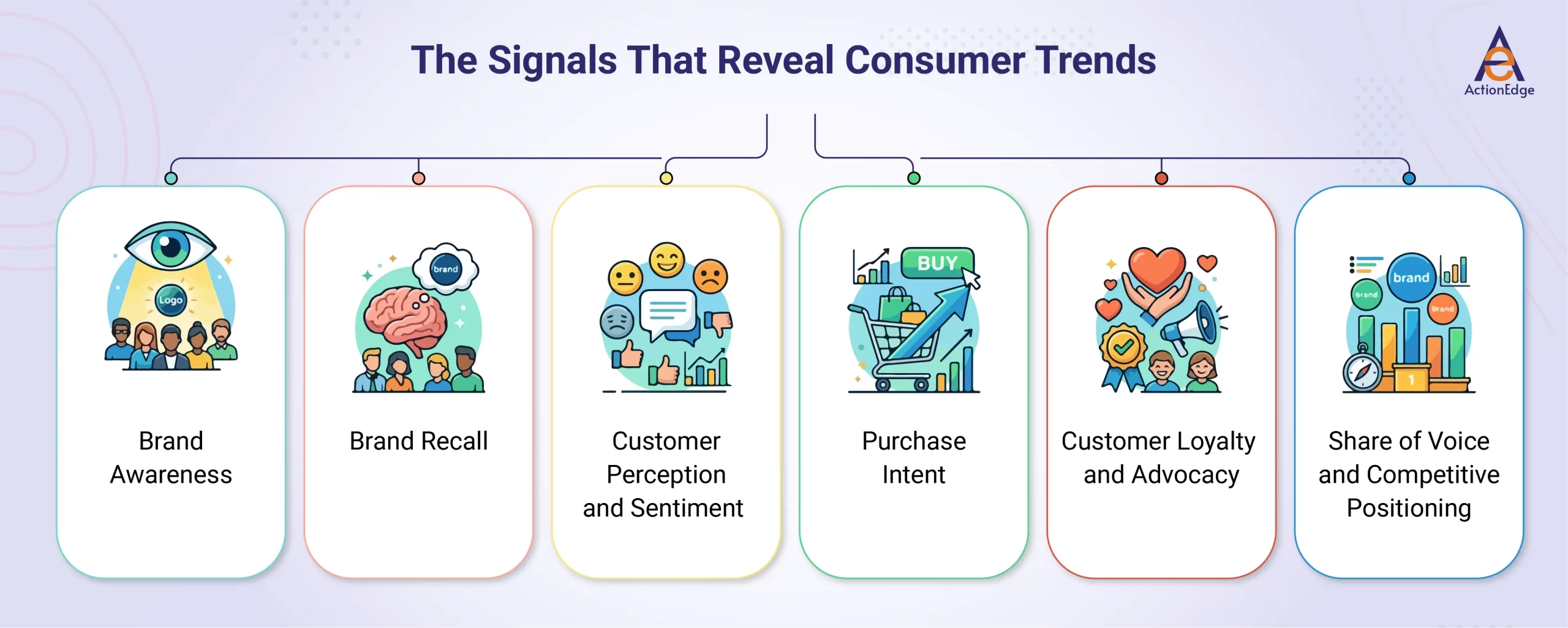
- Brand awareness represents how well consumers have come into contact with your brand and is typically where you begin to understand the impact you have on the marketplace.
- Brand recall and recognition denote whether your brand comes to mind when consumers are considering the category or type of service. Being “top of mind” indicates that your brand has relevance to the consumer.
- Customer perception and sentiment evaluate how customers view your brand. Is it positive, negative, or neutral? They also reflect a consumer’s emotional ties to your brand.
- Purchase intent indicates whether or not a consumer will purchase your brand in the future, and is a significant contributor to consumer demand.
- Customer loyalty and advocacy represent how likely a consumer is to repeat purchase and recommend your brand to others.
- Share of voice and competitive position indicate a brand’s visibility and reputation relative to its competitors.
Together, these metrics form the foundation of effective consumer behavior research, enabling brands to detect patterns before they become obvious trends.
Ad-hoc Research vs Brand Tracking Research
Not all research is designed for the same purpose. While both ad-hoc and tracking studies provide valuable insights, they serve very different roles in decision-making.
Ad-hoc research is typically conducted to answer a specific question at a specific point in time. It is useful for exploring new ideas, testing concepts, or understanding a particular issue. For example, a brand may run a one-time study to evaluate a campaign or assess product feedback after launch. While insightful, these studies offer a snapshot rather than a continuous view.
In contrast, brand tracking research is an ongoing process. It continuously monitors how consumers perceive a brand, how those perceptions shift, and what factors influence change over time. Instead of isolated insights, it provides a dynamic understanding of trends, sentiment, and behavior.
The key difference lies in continuity and purpose. Ad-hoc research helps answer “what is happening now,” while tracking research helps answer “how and why things are changing.” Without tracking, businesses may miss gradual shifts that signal emerging opportunities or risks.
In today’s fast-evolving markets, relying only on ad-hoc studies can lead to fragmented insights. A strong brand tracking market research approach ensures that businesses not only understand the present but are also prepared for what comes next.
How Brand Tracking Helps Predict Consumer Trends
Consumer preferences are evolving faster than ever, especially among younger audiences. Insights from McKinsey highlight that Gen Z consumers are reshaping purchasing behavior with new expectations around authenticity, digital engagement, and personalization. Predicting trends is not about guessing, but about identifying patterns early and acting on them with confidence.
Detecting Consumer Preference Changes Early:
Through brand tracking, you are able to determine small variations in consumer preference, such as a progressive increase in sustainability preference. Awareness of this growing preference can be an early indicator of the larger shift in purchasing patterns.
Monitoring Sentiment to Measure Changing Market Sentiment:
Monitoring consumer sentiment in relation to various market drivers (price level, innovation, and customer experience) provides an indication of how those external drivers are impacting your consumers’ perception of your brand.
Tracking Changes in Buying Patterns:
Tracking consumer purchase intent and usage patterns allows brand managers to evaluate how consumer preferences change over time.
Identifying New Opportunity Trends:
When a new need or expectation starts gaining traction, brands should take action before their competitors.
Monitoring Competitor Impact:
Brand tracking also shows how competitor actions influence your brand perception, helping you respond strategically.
For instance, a telecom brand tracking customer sentiment may notice an increase in frustration with billing transparency. Acting on this insight early can turn a potential risk into a competitive advantage.
Real Business Benefits of Brand Tracking Research
Insights highlight that consistent branding builds customer trust, improves recognition, and supports business growth. Companies that maintain strong brand consistency can even see revenue increases of 10–20%. The impact of brand tracking goes beyond insights, directly influencing measurable business outcomes.
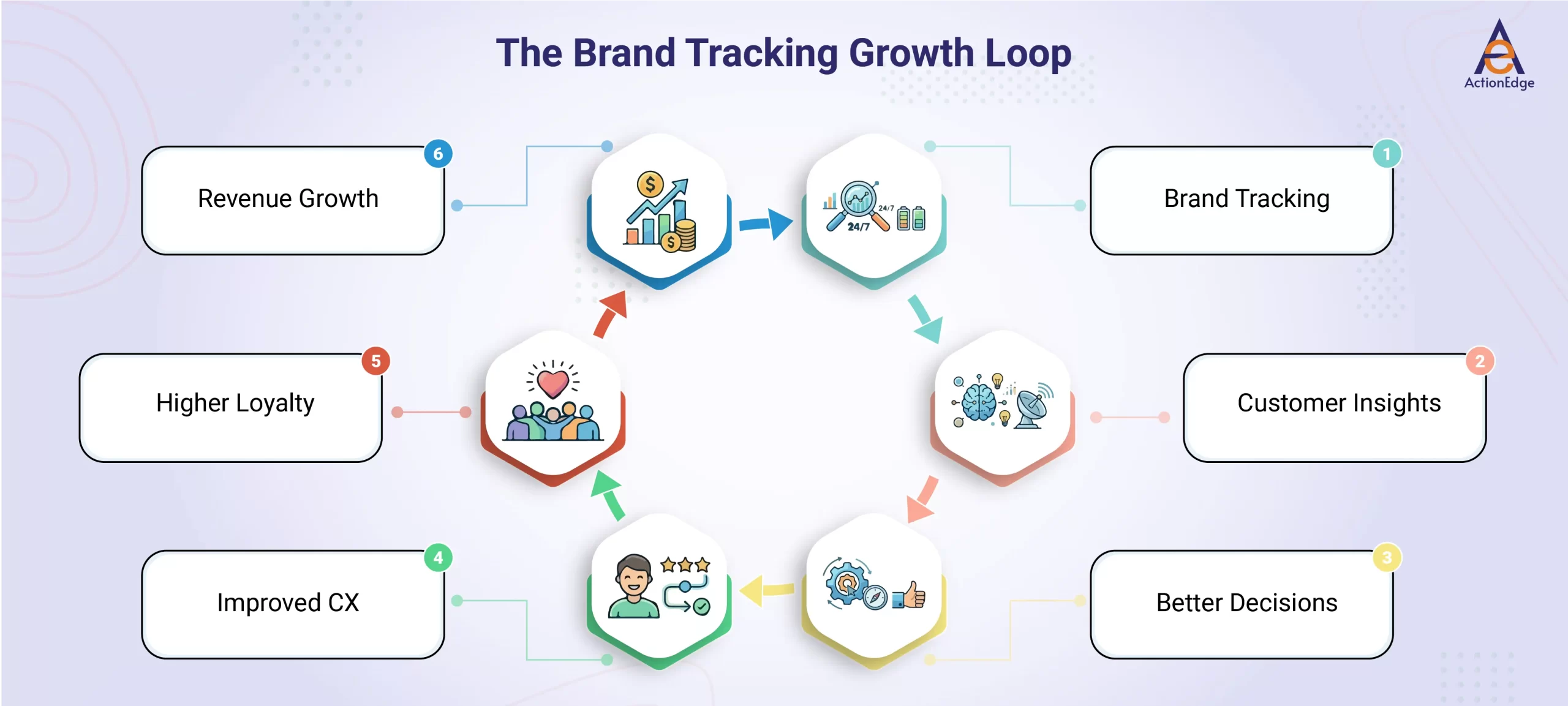
Enhanced Marketing Results:
Knowing how the audience feels enables marketers to create messages that connect with their target market.
Higher Customer Retention & Loyalty Rates:
By being able to identify early signs of customer discontent, marketers can take action to improve the customer’s experience, thereby reducing the number of customers who leave.
Improved Product & Price Decisions:
Understanding customer wants allows marketers to make better decisions regarding products and pricing via market research.
Quick Reaction Time to Change:
Continuously monitoring allows marketers to make changes quickly due to changing demands and developments within their respective markets.
Data-Driven Decisions:
The decisions made by marketers will have evidence that will support the decision, decreasing the potential of risk while increasing the likelihood of a positive result when implementing the decision.
These benefits highlight why many businesses partner with a specialized brand tracking agency to build long-term insight programs that drive growth.
How ActionEdge Supports Brand Tracking Studies
Modern brand tracking requires more than surveys. It demands advanced methodologies that uncover both patterns and the reasons behind them.
At ActionEdge, we combine qualitative and quantitative research to deliver a complete view of consumer behavior. Through in-depth interviews (IDI), we uncover deeper motivations, while Phone-to-Web via Screen Access (P2W SA) enables real-time behavioral observation.
Our multi-mode research approach integrates CATI, CAWI, and digital methods to balance scale with depth and improve insight quality.
As a trusted market research company, we provide end-to-end market research service solutions with multi-country and multilingual capabilities. More importantly, we turn insights into action, helping brands identify trends, refine positioning, and make confident decisions.
Conclusion
The role of brand tracking research is evolving. It is no longer just about measuring awareness or perception. It is about predicting what comes next.
In a world where consumer behavior changes rapidly, continuous insight is a competitive advantage. Brands that invest in tracking are better equipped to anticipate shifts, adapt strategies, and stay relevant.
The future belongs to businesses that listen closely, act quickly, and think ahead.
Ready to turn brand tracking into a powerful engine for predicting consumer trends?
Frequently Asked Questions
Brand tracking research is becoming essential in 2026 as businesses need continuous visibility into changing customer perceptions and market dynamics. It supports smarter decisions through ongoing consumer insights research and real-time brand performance tracking.
Businesses should track metrics like awareness, consideration, preference, loyalty, and sentiment through a market research survey. These insights, along with brand perception research, help measure brand health and competitive positioning.
Brand tracking research allows for the identification of new business opportunities through identifying customer preference shifts, unmet customer needs, or gaps created by competitors that will be used to allow for better/faster response times by companies to changes in the marketplace.
Brand tracking research is an ongoing research effort that is focused on the long-term view of a company’s brand performance to identify changes based on customer feedback and will use qualitative and quantitative techniques such as in-depth interviews (IDI) to gain a better understanding of consumer opinion.
ActionEdge is a global market research company providing brand tracking services using advanced market research services such as Phone-to-Web via Screen Access (P2W SA) and multi-mode research, thus allowing for consistent, actionable data for companies to identify how they are performing compared to the competition.