
Technology buying is rarely a quick or straightforward process. Whether an organization is investing in cloud infrastructure, cybersecurity software, AI platforms, or enterprise applications, every purchase involves careful evaluation, multiple stakeholders, and significant business risks. While surveys can reveal what buyers think, they often fail to explain why they think that way.
This is where in-depth interviews (IDIs) become invaluable. By engaging buyers in detailed one-on-one conversations, businesses gain rich insights into motivations, concerns, decision criteria, and purchasing behavior that structured questionnaires simply cannot uncover.
For organizations investing in B2B technology market research, understanding buyer psychology is no longer optional. It is the foundation for developing better products, stronger messaging, and more effective go-to-market strategies.
In this blog, we’ll explore ten ways in-depth interviews (IDIs) help technology companies better understand buyer decision making and how these insights translate into smarter business decisions.
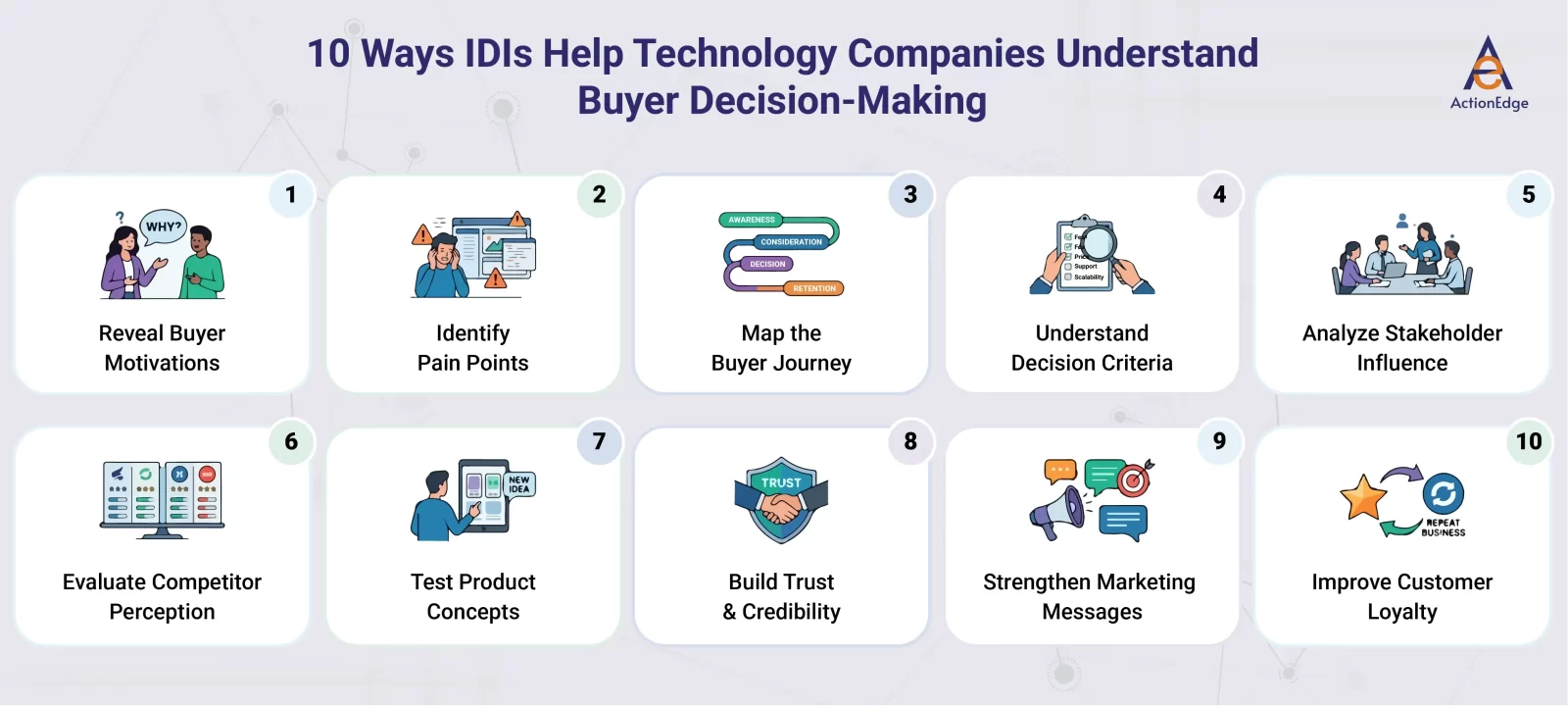
1. Reveal the Real Motivations Behind Purchases
Every technology purchase is driven by more than just product features or pricing. Buyers are often trying to solve larger business challenges, improve operational efficiency, reduce risks, or prepare their organization for future growth.
Unlike surveys that capture predefined responses, interviews encourage buyers to explain their goals, expectations, and decision-making process in their own words.
For example, a company evaluating project management software may appear to prioritize collaboration features. During an interview, however, decision makers may reveal that their real concern is improving cross-functional accountability across global teams.
Key Insight: IDIs uncover the deeper motivations that influence technology investment decisions.
2. Identify Buyer Pain Points and Challenges
Before searching for a solution, buyers typically experience operational bottlenecks, technical limitations, or organizational frustrations.
Through qualitative research, technology companies can explore:
- Existing workflow challenges
- Software limitations
- Integration issues
- Budget constraints
- Internal resistance to change
Many of these insights would never appear in a multiple-choice survey because buyers often recognize their challenges only through conversation.
Key Insight: Understanding buyer pain points enables companies to develop solutions that directly address customer needs.
3. Understand the Complete Buyer Journey
Technology purchases rarely happen overnight. Buyers move through several stages before making a final decision.
Interviews help organizations understand:
- How buyers first identify a problem
- Where they search for information
- Which content influences them
- What causes delays during evaluation
- What ultimately leads to a purchase
This detailed perspective helps businesses optimize every customer touchpoint.
Key Insight: IDIs provide a comprehensive understanding of the buyer journey from awareness through purchase.
4. Explore Decision Making Criteria
Every buyer evaluates technology vendors differently. Some prioritize security, while others focus on scalability, customer support, implementation speed, or total cost of ownership.
Interviews allow companies to understand how buyers balance factors such as:
- Price
- Features
- Security
- Customer support
- Vendor reputation
More importantly, they reveal the trade-offs buyers are willing to make when selecting a solution.
For instance, many enterprise buyers willingly pay higher prices if they believe implementation risks are significantly lower.
Key Insight: Technology companies gain clarity on the factors that truly influence purchasing decisions.
5. Understand the Role of Multiple Stakeholders
Technology purchases are rarely made by a single individual. A single buying decision may involve:
- IT teams
- Procurement departments
- Finance teams
- Business unit leaders
- Executive leadership
Each stakeholder brings different priorities and concerns.
A finance leader may focus on ROI, while an IT manager prioritizes security and compatibility. Procurement may emphasize vendor contracts, while executives consider long-term business impact.
This makes Technology Buyer Behavior significantly more complex than many companies initially assume.
Key Insight: IDIs reveal how internal stakeholders influence buying decisions and where consensus or conflict occurs.
6. Evaluate Competitive Perceptions
Understanding competitors goes beyond market share analysis. Companies also need to know how buyers perceive competing solutions.
Interviews help uncover:
- Strengths associated with competitors
- Weaknesses buyers experience
- Reasons for switching vendors
- Brand perceptions
- Differentiation opportunities
For example, buyers may consistently describe one vendor as highly innovative but difficult to implement, while another is viewed as reliable but lacking modern capabilities.
These insights strengthen positioning strategies within B2B Technology Research initiatives.
Key Insight: Competitive insights help companies sharpen differentiation and improve market positioning.
7. Test Product Concepts and Innovations
Launching new technology products without customer feedback increases business risk.
Before investing heavily in development, organizations can validate:
- New product concepts
- Feature ideas
- User experience improvements
- Pricing approaches
- Market readiness
Rather than asking buyers whether they “like” an idea, interviews explore why they find certain innovations valuable and where gaps still exist.
This is one of the strongest advantages of using IDIs in technology market research, allowing companies to refine concepts before launch.
Key Insight: Early buyer feedback reduces development risks and supports more successful product innovation.
8. Uncover Trust and Credibility Factors
Technology purchases involve significant financial investment and long-term commitments. As a result, trust often becomes a deciding factor.
Buyers frequently evaluate vendors based on:
- Security
- Data privacy
- Reliability
- Vendor stability
- Customer success capabilities
Interestingly, interviews often reveal that trust outweighs product functionality when organizations compare similar solutions.
These insights are especially valuable for companies conducting qualitative research for technology companies, where understanding emotional and organizational concerns is just as important as evaluating technical requirements.
Key Insight: Trust frequently plays a larger role in purchasing decisions than features alone.
9. Improve Marketing and Messaging Strategies
One of the biggest mistakes technology companies make is describing products using internal terminology rather than customer language.
Interviews capture:
- Words buyers naturally use
- How buyers describe their challenges
- Messages that resonate
- Content buyers find persuasive
- Misconceptions about products
This enables marketing teams to build campaigns that speak directly to customer needs instead of relying on assumptions.
Organizations conducting technology market research often discover that even small messaging changes can significantly improve engagement and lead quality.
Key Insight: Buyer language helps create authentic, customer-focused marketing strategies.
10. Understand Post Purchase Experiences and Loyalty Drivers
The buying journey doesn’t end after the contract is signed.
Interviews explore customer experiences related to:
- Onboarding
- Product implementation
- Training
- Customer support
- Product adoption
- Renewal decisions
Satisfied customers often become long-term advocates, while negative onboarding experiences can quickly lead to churn, even when the product performs well.
Organizations investing in qualitative market research gain valuable insights that improve customer retention and lifetime value.
Key Insight: Post purchase insights help strengthen customer experience and build long-term loyalty.
How ActionEdge Helps Technology Companies Generate Buyer Insights
Understanding buyer behavior requires more than asking questions. It requires asking the right questions to the right people.
As a trusted Market research company, ActionEdge combines industry expertise with proven research methodologies to help organizations make confident business decisions.
Our Market research services support technology companies by:
- Conducting interviews with technology buyers, decision makers, influencers, and stakeholders
- Delivering actionable insights for product development and innovation
- Supporting brand positioning and competitive intelligence
- Improving customer experience strategies
- Helping businesses strengthen market entry and growth plans through B2B technology market research
Every study is designed to deliver practical recommendations that organizations can confidently act upon.
Conclusion
Technology buying decisions are becoming increasingly complex, involving multiple stakeholders, evolving priorities, and higher expectations from vendors. While surveys provide valuable quantitative data, they often capture only part of the story.
In-depth interviews (IDIs) go much deeper by uncovering the motivations, challenges, trust factors, competitive perceptions, and post purchase experiences that truly shape buying decisions. From identifying buyer pain points and mapping the customer journey to testing product concepts and refining marketing messages, these ten approaches help technology companies better understand their customers and make more informed strategic decisions.
If your organization wants to strengthen products, improve customer experiences, or make smarter market decisions, investing in B2B technology market research through qualitative interviews can provide the insights needed to stay ahead of the competition.
Ready to understand what truly drives your buyers?
Partner with ActionEdge to uncover meaningful customer insights through expert qualitative research and make every business decision with greater confidence.