
The telecom market isn’t slowing down. The real challenge is keeping up with your customers.
A few years ago, offering faster connectivity was enough to stay competitive. Today, businesses expect far more from telecom providers. They want reliable networks, intelligent connectivity, cloud-enabled solutions, seamless customer support, and technologies that help them grow. At the same time, telecom companies are investing heavily in 5G, IoT, AI-powered services, and enterprise digital transformation.
The question is simple: How do you know which investments will actually deliver value?
Making business decisions based on assumptions can lead to expensive product launches, poor customer adoption, and missed market opportunities. This is where telecom market research becomes an essential part of business strategy rather than just a validation exercise.
Whether you’re introducing a new enterprise connectivity solution, improving customer retention, evaluating pricing, or expanding into new markets, research helps replace uncertainty with evidence.
A combination of qualitative market research and quantitative market research allows telecom businesses to understand customer expectations, validate new ideas, improve experiences, and reduce business risks before making major investments.
In this blog, we’ll explore eight common telecom research challenges and practical ways to solve them using the right research methodologies.
Top 8 Telecom Market Research Challenges and Their Solutions
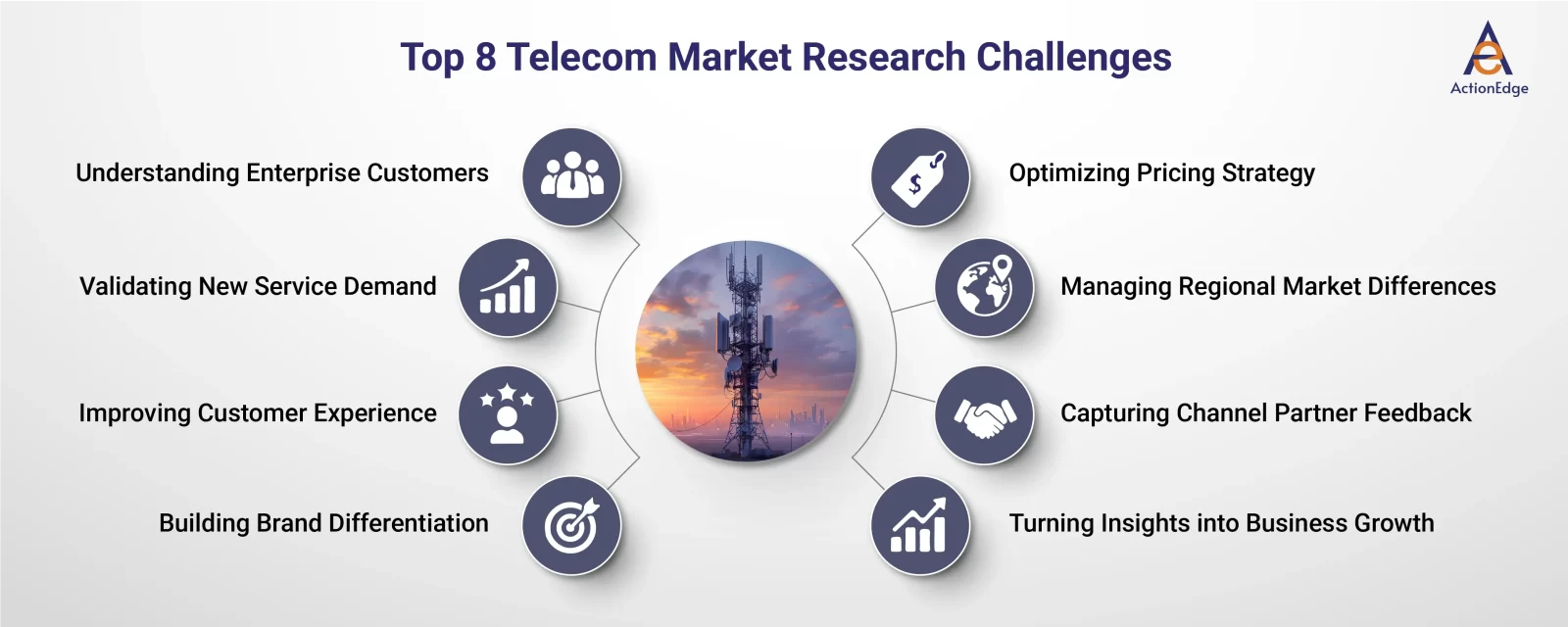
1. Understanding Evolving Enterprise Customer Needs
Enterprise customers are far from homogeneous. A manufacturing company has different connectivity priorities than a financial institution or healthcare provider. Even organizations within the same industry vary depending on company size, digital maturity, and operational goals.
Without understanding these differences, telecom providers risk developing solutions that don’t align with actual business needs.
The Solution
This is where B2B telecom research becomes invaluable.
Using in-depth interviews with decision-makers helps uncover the reasoning behind purchasing decisions, future technology plans, and operational challenges. These qualitative findings can then be validated through CATI and CAWI surveys across a larger sample of enterprise customers.
For example, an enterprise may initially request higher bandwidth but reveal during interviews that network reliability and security are actually their top priorities.
Understanding these deeper motivations enables telecom providers to design solutions that solve real business problems.
2. Measuring Demand for New Telecom Services
Every year, telecom companies introduce new services such as private 5G, IoT connectivity, cloud communications, SD-WAN, and managed network solutions.
The challenge isn’t innovation. It’s knowing whether customers are ready to adopt these services.
Launching without proper validation increases financial and operational risks.
The Solution
Concept testing, purchase intent studies, and qualitative interviews help determine whether customers understand the offering, perceive its value, and are willing to invest.
Suppose a telecom company plans to launch an IoT connectivity solution for logistics providers. Research may reveal that businesses see stronger value in fleet monitoring than predictive maintenance, allowing product teams to refine their positioning before launch.
This is where enterprise telecom research plays a critical role in reducing uncertainty.
3. Customer Experience and Retention
Acquiring customers is expensive. Losing them is even more costly.
Poor service quality, delayed support, inconsistent experiences, or unclear communication often contribute to customer churn.
Unfortunately, many providers only realize these issues after customers leave.
The Solution
Comprehensive customer experience research helps identify pain points throughout the customer journey.
Organizations commonly combine:
- Customer Satisfaction (CSAT) studies
- Net Promoter Score (NPS) surveys
- Customer journey mapping
- Service experience research
For example, research might reveal that customers are satisfied with network performance but frustrated by lengthy issue resolution processes. Addressing this single pain point could significantly improve retention without requiring major infrastructure investments.
4. Brand Differentiation in a Competitive Market
Today’s telecom providers often offer similar connectivity, pricing models, and digital services.
Standing out has become increasingly difficult.
Businesses may choose between multiple providers with nearly identical technical capabilities.
The Solution
Effective telecom industry research goes beyond measuring awareness.
Brand tracking, perception studies, competitive benchmarking, and positioning research reveal:
- How customers perceive your brand
- Which attributes influence buying decisions
- Where competitors outperform you
- What opportunities exist for differentiation
For instance, research may show that customers associate one provider with innovation while another is recognized for dependable customer support. These insights help shape stronger branding and communication strategies.
5. Pricing and Value Perception
Pricing decisions affect profitability, competitiveness, and customer acquisition.
Price services too high, and adoption may decline.
Price them too low, and long-term profitability suffers.
The Solution
Pricing research helps businesses understand what customers are truly willing to pay.
Common approaches include:
- Willingness-to-pay studies
- Value perception surveys
- Pricing optimization
- Competitive pricing analysis
Imagine introducing a premium cloud communication package. Research could reveal that customers are willing to pay more when cybersecurity features and managed support are included, allowing providers to increase perceived value rather than competing solely on price.
6. Managing Regional and Multi-Market Differences
Telecom markets differ significantly across countries.
Infrastructure maturity, regulations, technology adoption, enterprise priorities, and purchasing behavior vary from one region to another.
A strategy that succeeds in Europe may require substantial adjustments in Southeast Asia or Latin America.
The Solution
Multi-country research enables organizations to identify both global patterns and regional differences.
Market segmentation studies help telecom providers:
- Adapt service offerings
- Localize messaging
- Prioritize investments
- Improve market entry strategies
Rather than assuming one solution fits every market, research ensures strategies reflect local business realities.
7. Capturing Channel Partner and Dealer Insights
Resellers, distributors, and channel partners interact with customers every day.
They often understand market trends, competitive activity, and customer concerns before corporate teams do.
Yet this valuable intelligence frequently goes unmeasured.
The Solution
Regular partner feedback programs provide actionable insights through:
- Partner satisfaction surveys
- CATI interviews
- Qualitative discussions
- Dealer performance assessments
For example, partners may consistently report that enterprise customers struggle to understand bundled cloud offerings. This insight can lead to improved training, clearer communication materials, and increased sales effectiveness.
Strong B2B telecom research should include both customers and channel partners to provide a complete market picture.
8. Turning Data into Actionable Business Decisions
Many organizations collect large volumes of customer feedback but struggle to convert it into practical strategies.
Data alone doesn’t drive business growth.
Insights do.
The Solution
The most effective research combines qualitative exploration with quantitative validation.
Early interviews uncover motivations and emerging trends.
Larger surveys then confirm whether those findings represent the broader market.
This integrated approach allows decision-makers to:
- Prioritize investments
- Reduce product launch risks
- Improve customer engagement
- Build evidence-based business strategies
Even advanced methodologies like Phone-to-web via screen access can improve participation among busy enterprise professionals by allowing respondents to complete digital surveys while remaining connected with an interviewer, helping improve engagement and response quality for complex B2B studies.
Why Telecom Research Needs a Qual + Quant Approach
Telecom decisions rarely have simple answers.
A survey may tell you that 68% of enterprise customers want better network visibility. But it won’t explain why.
Similarly, interviews may uncover valuable customer motivations but cannot confirm whether those insights represent the broader market.
This is why combining Qualitative research in telecom with Quantitative research in telecom delivers stronger business outcomes.
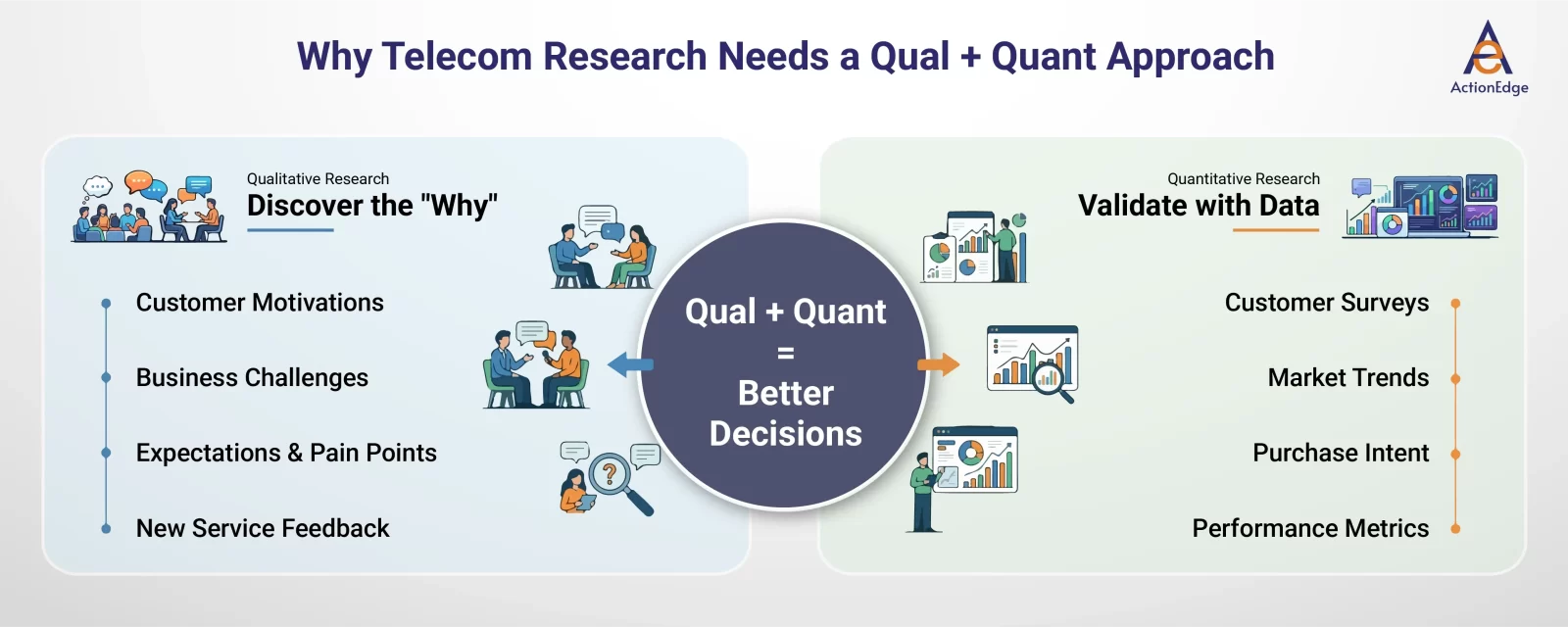
Qualitative research helps uncover:
- Customer motivations
- Decision-making processes
- Service expectations
- Unmet business needs
- Product feedback
Common methodologies include:
- In-Depth Interviews (IDIs)
- Focus Group Discussions (FGDs)
- Customer Journey Mapping
- Concept Testing
Quantitative research validates findings through:
- CATI
- CAWI (Online Surveys)
- CSAT Studies
- Brand Tracking
- Pricing Research
- Market Segmentation
- Telecom surveys
Together, these approaches help telecom providers confidently validate new services, optimize customer experiences, improve pricing strategies, and prioritize investments with measurable evidence.
The Freedom to Choose the Right Qual + Quant Research with ActionEdge
Every telecom challenge is different.
Some projects require deep conversations with enterprise decision-makers, while others need statistically reliable insights from hundreds or thousands of respondents.
The right methodology should always be guided by the research objective, not by a one-size-fits-all approach.
As a leading market research company, ActionEdge supports telecom research projects with flexible qualitative and quantitative methodologies, helping clients gather high-quality data and actionable insights across diverse markets.
Our capabilities include:
- CATI
- CAWI (Online Surveys)
- In-Depth Interviews (IDIs)
- Multi-country research
These approaches support a wide range of telecom business objectives, including:
- Enterprise customer insights
- New service validation
- Brand perception studies
- Customer experience improvement
- Pricing research
- Channel partner feedback
- Market expansion across regions
By selecting the right combination of methodologies, telecom providers can generate more reliable insights, reduce uncertainty, and make confident business decisions that support long-term growth.
Conclusion
The telecom industry continues to evolve at an extraordinary pace, creating new opportunities alongside new challenges. Success today depends on understanding customers as deeply as you understand technology. This is why telecom market research has become a strategic advantage rather than an optional exercise.
From validating innovative services and improving customer experiences to refining pricing strategies and entering new markets with confidence, the right research approach enables smarter decisions at every stage of the business journey.
At ActionEdge, we help telecom organizations transform business questions into meaningful insights through flexible qualitative and quantitative research solutions tailored to their objectives.
Looking to make your next telecom decision with greater confidence?
Connect with ActionEdge to design a research approach that delivers reliable insights, reduces risk, and helps your business stay ahead in an increasingly competitive telecom landscape.