A new medical technology can look impressive on paper and still struggle to gain traction in clinical settings. The reason is simple: HCP adoption of new medical technologies is rarely driven by one feature, one study, or one product claim.
Healthcare professionals make decisions in real-world environments where patient outcomes, clinical evidence, workflow pressures, training, budgets, peer influence, and organizational policies all intersect. Knowing that an HCP has heard of a technology or even expressed interest in it does not necessarily explain whether they will actually use it.
This is where In-depth interviews can make a difference. While structured research can measure adoption levels, one-to-one conversations give HCPs the space to explain what is behind those decisions.
In this blog, we explore 10 ways IDIs can uncover the motivations, perceptions, barriers, and real-world factors that shape healthcare technology adoption.
Why HCP Technology Adoption Is Complex
The healthcare technology landscape continues to expand, from AI-enabled clinical solutions and digital health platforms to advanced medical devices, diagnostic technologies, remote monitoring tools, and data-driven applications.
Yet awareness does not automatically lead to adoption.
An HCP may recognize the clinical value of an innovation but hesitate because it takes too long to learn. Another may appreciate its accuracy but question whether there is enough evidence to justify changing an established workflow. A third may be ready to adopt but face procurement restrictions or a lack of infrastructure.
This makes adoption a multidimensional question involving clinical value, usability, workflow fit, trust, training, cost, evidence, and organizational factors.
Quantitative market research can establish how many HCPs are using, considering, or rejecting a technology. Qualitative market research, particularly In-depth interviews, can uncover the reasoning behind those numbers.
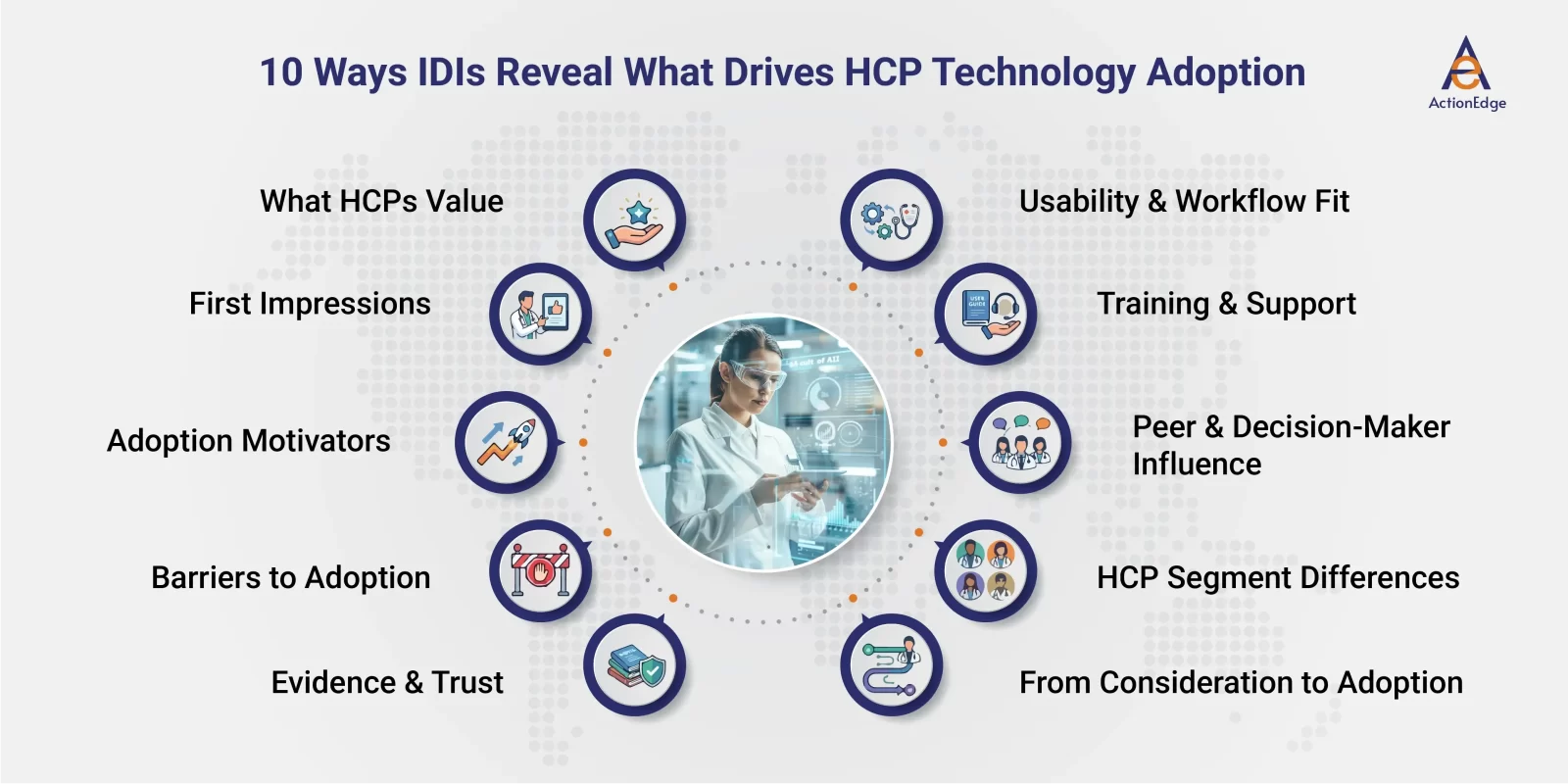
10 Ways IDIs Uncover HCP Technology Adoption Drivers
Here are 10 ways IDIs can help.
1. Reveal What HCPs Really Value in New Technology
Product specifications rarely tell the whole story.
IDIs allow researchers to explore what HCPs actually consider valuable. Is the priority better patient outcomes, faster diagnosis, reduced administrative work, greater accuracy, or simply making everyday tasks easier?
For example, an AI-supported diagnostic tool may be marketed around advanced algorithms, while physicians may care more about whether it helps them make decisions faster without disrupting their existing process.
The conversation reveals which benefits have genuine influence and which are simply attractive on paper.
2. Uncover Initial Perceptions and Attitudes
First impressions can shape how an HCP evaluates an unfamiliar technology.
During an interview, researchers can explore immediate reactions, expectations, skepticism, perceived risks, and areas of curiosity. An HCP might initially describe an AI solution as “interesting” but later reveal concerns about reliability or accountability.
These nuances are difficult to capture when respondents are limited to predefined answer options.
3. Identify Adoption Motivators
What actually persuades an HCP to try something new?
IDIs can explore the specific triggers that encourage adoption, whether that is improved clinical outcomes, greater efficiency, convenience, accuracy, innovation, or reduced workload.
They can also reveal differences between HCP groups. A specialist working in a high-volume hospital may prioritize efficiency, while a clinician in a smaller practice may place greater emphasis on simplicity and affordability.
Understanding these motivations helps researchers move beyond broad assumptions about what drives adoption.
4. Explore Barriers to Adoption
Sometimes the most valuable insight comes from understanding what stops adoption.
HCPs may hesitate because a technology is difficult to use, expensive, poorly integrated, insufficiently validated, or dependent on infrastructure they do not have.
An interview can also uncover less obvious barriers. For instance, a physician may not reject a technology because of its functionality but because introducing it would add another step to an already demanding workflow.
These details can reveal adoption challenges that a structured questionnaire may never have anticipated.
5. Understand the Role of Clinical Evidence and Trust
Healthcare decisions are built on trust.
IDIs can explore how HCPs assess the credibility of a new technology and what evidence they need before feeling comfortable using it. Clinical validation, published research, regulatory status, peer recommendations, professional associations, and real-world experience may all play a role.
Importantly, the interviews can reveal which sources of evidence actually carry weight.
For example, one group may want peer-reviewed clinical data, while another may place greater value on seeing the technology demonstrated by a trusted colleague.
6. Examine Usability and Workflow Fit
A technology can offer significant clinical benefits and still fail if it does not fit naturally into an HCP’s working day.
IDIs allow researchers to walk through current workflows and identify where a new solution could help or create friction. Discussions can cover learning curves, time requirements, system integration, accessibility, and ease of use.
Imagine a diagnostic platform that saves five minutes during analysis but requires 15 additional minutes of data entry. The headline benefit may sound compelling, but the actual workflow experience tells a different story.
7. Explore Training and Support Expectations
Adoption does not end with purchase or installation.
HCPs may need training, onboarding, technical assistance, refresher sessions, or readily available support before they feel confident using a new technology.
In-depth interviews can uncover what that support should look like. Some HCPs may prefer short online modules, while others may expect hands-on demonstrations or support from a specialist during the initial implementation.
These insights can identify gaps that could otherwise slow adoption.
8. Understand Influence From Peers and Decision-Makers
An HCP’s personal opinion is not always the final decision.
Colleagues, specialists, hospital leadership, procurement teams, IT departments, professional networks, and other stakeholders can influence whether a technology gets adopted.
IDIs help map these influences. Researchers can explore who HCPs consult, whose recommendations they trust, and how individual preferences interact with institutional policies.
This is particularly important in hospital environments, where the person who uses a technology may not be the person who approves or purchases it.
9. Discover Differences Across HCP Segments
Not every HCP approaches innovation in the same way.
IDIs can compare perspectives across specialties, years of experience, practice settings, levels of technology familiarity, and organizational environments. This can help identify early adopters, pragmatic adopters, and more cautious groups.
For example, an HCP who regularly uses digital clinical tools may have very different expectations from someone who relies primarily on established methods.
These distinctions can make HCP segmentation far more meaningful than demographic profiling alone.
10. Uncover What Could Move HCPs From Consideration to Adoption
Perhaps the most actionable question is: What would change your mind?
An HCP who is interested but hesitant may need stronger clinical evidence. Another may need better integration with existing systems. Someone else may require training, peer validation, or a more attractive cost structure.
IDIs can identify these specific conditions and translate them into potential adoption strategies. Findings can then be tested at scale through quantitative research.
Why IDIs Are Valuable for HCP Technology Research
The strength of IDIs lies in their ability to capture the reasoning behind a decision rather than simply recording the decision itself.
Open-ended conversations allow HCPs to describe experiences, frustrations, motivations, expectations, and concerns in their own words. Researchers can probe an unexpected response, ask why something matters, and follow a line of discussion that a fixed questionnaire may not have anticipated.
This makes IDIs particularly useful in healthcare market research when a technology is new, the market is evolving, or the reasons behind adoption are not yet fully understood.
A strong HCP market research program can also combine qualitative and quantitative approaches. IDI findings can inform survey questions, strengthen segmentation frameworks, identify hypotheses, and highlight themes for broader validation.
In this way, qualitative exploration and quantitative measurement complement rather than replace one another.
Conclusion
Adoption numbers tell you what is happening. The more important question for many healthcare and medtech organizations is why it is happening.
HCPs do not adopt new technologies simply because a solution is innovative. They weigh clinical value, trust, evidence, usability, workflow impact, support, cost, and the influence of their wider professional environment.
That is why In-depth interviews remain a valuable tool for understanding the human reasoning behind technology decisions. For organizations looking to strengthen their HCP market research, these conversations can reveal the motivations and barriers that numbers alone cannot explain.
At ActionEdge Research Services, our market research service combines qualitative expertise with access to B2B healthcare audiences across markets. Whether you need HCP interviews, broader qualitative healthcare research, or a study that connects IDI findings with quantitative validation, our team can help uncover insights that support better healthcare and medtech decisions.
Have a healthcare research need? Connect with ActionEdge.