

Insurance is built around trust, but trust can be difficult to measure with a single survey or a single customer interaction.
A policyholder may be satisfied with the purchase process but frustrated during a claim. A broker may value a product but struggle with the insurer’s digital tools. A prospect may abandon a policy because the coverage feels confusing, not because the price is too high.
These differences matter. For insurers, understanding what customers think is only half the job. Understanding why they think it is what turns feedback into useful insight.
This is where combining CATI and CAWI for insurance research can make a meaningful difference. By bringing together interviewer-led conversations and scalable online surveys, insurers can listen to customers in ways that match both the complexity of insurance and the diversity of its audiences.
What Are CATI and CAWI?
CATI: Computer-Assisted Telephone Interviewing
CATI for insurance research involves trained interviewers conducting structured interviews over the phone using a computer-assisted questionnaire.
The human element is particularly valuable when a topic needs explanation or further exploration. An interviewer can clarify a question, probe an unexpected response, or understand the reasoning behind a customer’s decision.
For example, if a business owner says they would not renew an insurance policy, a CATI interviewer can explore whether the issue is premium increases, coverage limitations, claims handling, service quality or something else entirely.
This makes CATI market research useful when insurers need depth, particularly among specialized or harder-to-reach audiences such as brokers, agents and business decision-makers.
CAWI: Computer-Assisted Web Interviewing
CAWI for insurance research uses online surveys that respondents complete through a web-enabled device.
It is well suited to larger samples and structured quantitative research. Insurers can use online surveys to measure satisfaction, compare customer segments, test product concepts or evaluate reactions to new propositions.
For instance, an insurer considering a new policy package could present different coverage options to a broad respondent group and measure preferences, purchase intent and perceived value.
In simple terms:
CATI + CAWI = Human depth + Digital scale.
Why CATI + CAWI Work Well for Insurance Research
Insurance is not a simple category. Customers interact with insurers at different stages, and each stage can shape their overall perception of the brand.
1. Insurance Products Can Be Complex
Policies can involve premiums, deductibles, exclusions, coverage limits, riders, and conditions that are not always easy to interpret.
If a respondent gives a negative rating, an online survey may tell an insurer what happened, but not necessarily capture the full reasoning behind it.
CATI can add that context by allowing interviewers to ask follow-up questions and understand where confusion or dissatisfaction comes from.
2. Insurance Has Diverse Audiences
An insurer’s research audience can extend far beyond policyholders.
Research may involve:
- Individual policyholders
- Prospective customers
- Brokers and agents
- Financial professionals
- Business owners
- Corporate decision-makers
- Other insurance stakeholders
A single research method may not be equally effective for every audience. B2B Market research, for example, often requires different recruitment and engagement approaches than consumer research.
3. Customer Journeys Have Multiple Touchpoints
The insurance experience does not begin and end with purchasing a policy.
Customers may interact with an insurer during:
Purchase → Onboarding → Policy servicing → Claims → Renewal → Customer support
A customer who had an excellent buying experience may still become dissatisfied because a claim took too long to resolve.
A hybrid approach can help insurers examine each stage and identify where experience gaps emerge.
4. Insurers Need Both Depth and Scale
This is perhaps the biggest advantage of combining the two methods.
Quantitative insurance research helps insurers measure patterns across a larger sample. Qualitative insurance research helps uncover the motivations, concerns and experiences behind those patterns.
Together, they provide a more complete picture.
How CATI + CAWI Help Insurers Listen Better
Understand Customer Needs and Expectations
Customers do not always articulate their expectations through ratings alone.
CATI interviews can explore why customers prefer one insurance provider, what makes them hesitate before purchasing, and what they expect from digital or human support.
These conversations can reveal issues that a predefined list of survey options might miss.
Measure Customer Experience at Scale
Once the key experience areas are understood, CAWI can help measure them across a larger audience.
For example, an insurer could survey customers about:
- Ease of purchasing a policy
- Clarity of policy information
- Digital experience
- Claims satisfaction
- Responsiveness of support
- Likelihood to renew
The resulting data can help identify differences between customer segments, products, or stages of the customer journey.
Identify Pain Points Across the Customer Journey
Suppose an insurer discovers that overall satisfaction is relatively strong, but claims satisfaction is significantly lower.
CATI can then explore what is driving that dissatisfaction. Customers may mention unclear communication, documentation requirements, waiting times, or difficulty contacting the right person.
This combination of measurement and exploration makes hybrid market research particularly useful for customer experience studies.
Test New Products, Pricing and Concepts
Insurance providers frequently need to understand how customers respond to new propositions.
CAWI can efficiently test multiple concepts, coverage options, messages, or pricing structures across a broad sample. CATI can then explore the reasoning behind preferences and objections.
For example, if respondents prefer a lower-premium policy with fewer benefits, follow-up conversations can reveal whether the decision is genuinely price-driven or whether customers simply do not understand the additional coverage offered by the alternative.
Reach Hard-to-Access Insurance Stakeholders
Some insurance research requires conversations with respondents who are not easily reached through general consumer surveys.
This is where CATI for insurance research can be especially useful. Interviewer-led research can support recruitment and engagement with brokers, agents, financial professionals and business decision-makers.
For insurers conducting B2B Market research, this can add valuable perspective from people who influence purchasing, distribution and product decisions.
CATI and CAWI: Using Each Method Where It Adds Value
The objective is not to decide whether telephone or online research is better. It is to determine where each method works best.
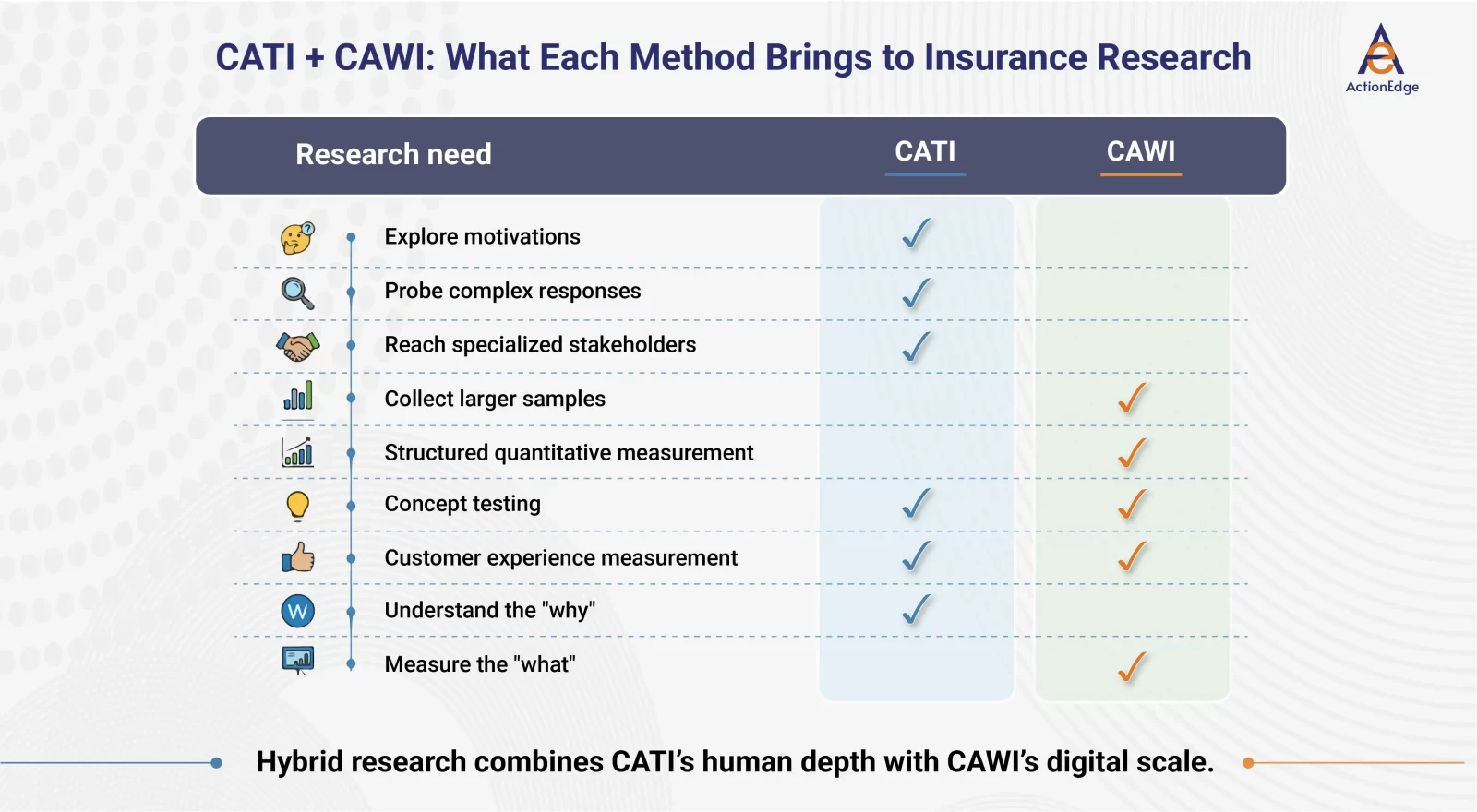
This is the foundation of hybrid market research for insurance. Instead of forcing every respondent into the same research experience, insurers can use different modes to answer different research needs.
Why Multi-Mode Research Is Becoming More Relevant
Customer behavior has changed. People expect convenience, but that does not mean every research question can be answered through a quick online questionnaire.
Some respondents prefer digital participation. Others are more comfortable discussing a complicated subject with an interviewer. Some audiences are readily available online, while niche professional groups may require a more targeted approach.
Multi-mode research recognizes this reality.
For insurers, combining human interaction, digital convenience, quantitative scale, and qualitative depth can create a stronger research design than relying on one mode alone.
The result is not simply more data. It is better context around the data.
Conclusion
Insurance customers rarely experience a company through one channel or one moment. Their perception develops through every interaction, from the first product search to renewal and, most importantly, the moments when they need support.
That is why effective insurance market research needs to look beyond isolated satisfaction scores.
Combining CATI and CAWI gives insurers the ability to hear the customer’s voice in two complementary ways. CATI can uncover the reasoning, concerns and experiences behind a response, while CAWI can show how widely those views are shared.
For insurers looking to design research around real customer behavior, the right market research service can make that combination easier to execute across audiences, markets and research objectives.
Explore how ActionEdge can support your next insurance research study with a hybrid approach that brings human conversations and scalable digital research together.