

Building a product is exciting. Building one that customers actually want is what drives success.
History is filled with products that were backed by brilliant ideas, talented teams, and significant investment, yet failed to gain traction in the market. The reason often isn’t poor execution. It’s a lack of understanding of what customers truly need.
Many businesses assume they know their customers, but assumptions can be costly. A feature customers never asked for, pricing that doesn’t match perceived value, or targeting the wrong audience can all prevent a promising product from succeeding.
This is where product-market fit market research becomes essential.
At its core, product-market fit means creating a product that solves a genuine customer problem for the right audience in a way that delivers value. It is not achieved through intuition alone. It requires listening to customers, validating ideas, testing assumptions, and continuously learning from the market.
Effective market research helps businesses identify customer needs, refine product concepts, optimize pricing, improve user experiences, and make informed decisions throughout the product lifecycle. Rather than relying on guesswork, organizations can build products based on evidence and real customer insights.
In this blog, we’ll explore ten ways market research helps businesses achieve stronger product-market fit while reducing risk and increasing the likelihood of long-term product success.
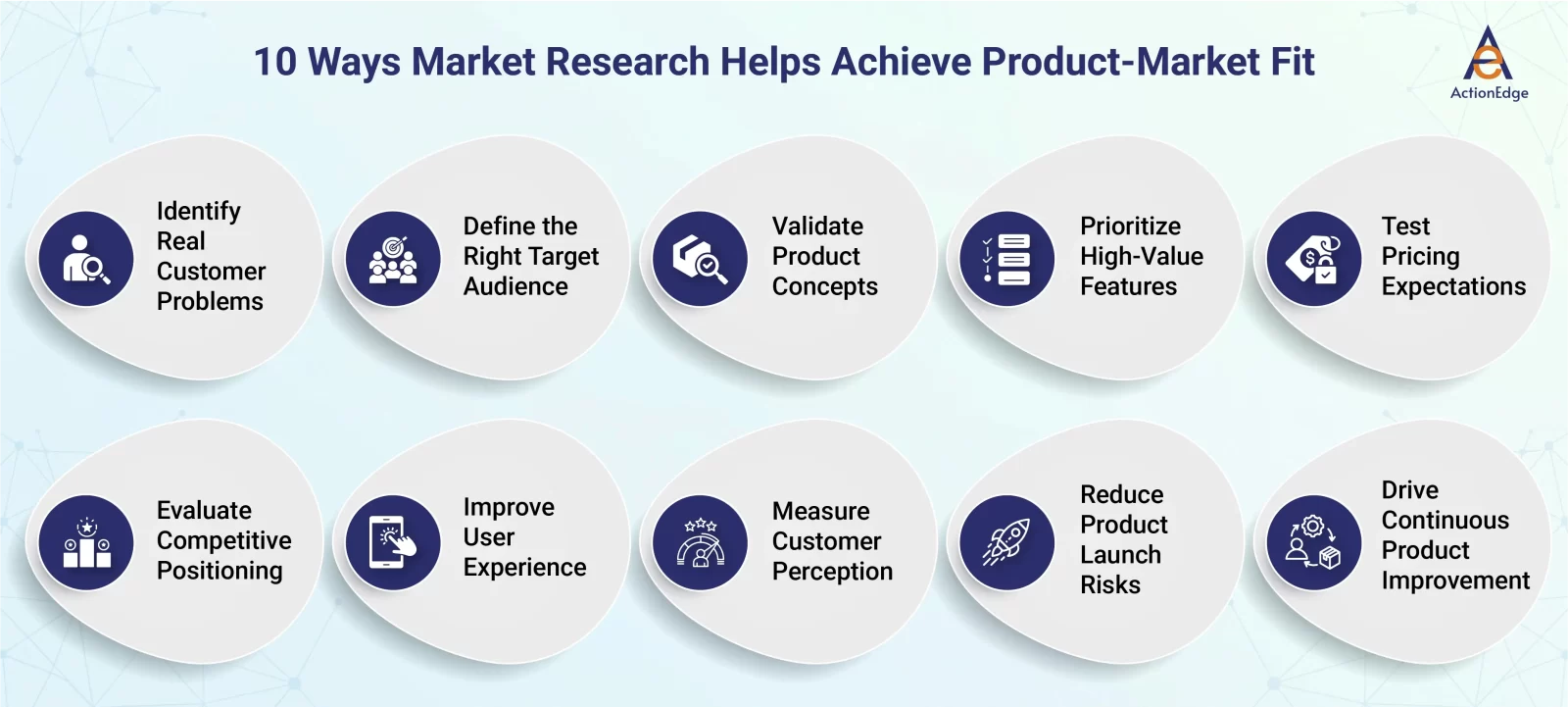
10 Ways Market Research Helps Achieve Product-Market Fit
1. Identifies Real Customer Problems
The best products solve meaningful problems.
Before investing in development, businesses need to understand the challenges customers face in their daily lives or work. Research uncovers unmet needs, frustrations, and opportunities that may not be obvious internally.
For example, a software company may assume users need more features. Customer interviews, however, may reveal that users actually want a simpler interface that saves time.
This customer-first approach is the foundation of successful product development research.
2. Defines the Right Target Audience
A product designed for everyone often appeals to no one.
Research helps businesses identify who their ideal customers are by analyzing demographics, purchasing behaviors, motivations, industries, company size, and usage patterns.
Understanding customer segments enables organizations to create products, messaging, and marketing strategies that resonate with the right audience instead of trying to satisfy every potential customer.
Insights from consumer behavior research further help businesses understand how customers evaluate products, compare alternatives, and make purchasing decisions.
3. Validates Product Concepts Before Development
Developing a product without customer validation is a significant business risk.
Concept testing allows businesses to present product ideas, prototypes, or mockups to potential customers before committing substantial resources.
Participants provide feedback on:
- Product relevance
- Perceived value
- Ease of understanding
- Purchase intent
- Suggested improvements
For instance, a technology company may discover that customers clearly understand one product concept while finding another too complex. Early validation prevents costly redesigns later.
4. Prioritizes Features That Matter Most
Product teams often have long feature wish lists.
Customers, however, usually value only a few capabilities that directly solve their problems.
Research helps prioritize features by identifying what customers consider essential versus optional.
Rather than investing equally across every enhancement, businesses can focus development resources on the features most likely to influence adoption and satisfaction.
This targeted approach improves efficiency while strengthening product-market fit.
5. Tests Pricing Expectations
Even an outstanding product may struggle if pricing doesn’t align with customer expectations.
Pricing research explores how customers perceive value and identifies acceptable price ranges before launch.
Businesses can evaluate:
- Price sensitivity
- Feature-value tradeoffs
- Competitive comparisons
- Purchase likelihood at different price points
These insights support pricing strategies that balance customer acceptance with business profitability.
6. Evaluates Competitive Positioning
Customers rarely compare a product in isolation.
They evaluate multiple alternatives before making a decision.
Competitive research helps organizations understand:
- Competitor strengths
- Market gaps
- Customer preferences
- Differentiation opportunities
For example, research may reveal that competitors emphasize technical specifications while customers place greater importance on ease of implementation and customer support.
These findings help businesses develop stronger positioning and communicate value more effectively.
7. Improves User Experience Through Customer Feedback
The user experience often determines whether customers continue using a product after the initial purchase.
Usability testing, customer interviews, and observational research identify friction points that may reduce satisfaction or adoption.
Small improvements can have a significant impact.
For example, simplifying an onboarding process or improving navigation may increase user engagement far more than introducing additional features.
Both qualitative research and quantitative research contribute to this process by combining customer feedback with measurable usage patterns.
8. Measure Customer Perception Before and After Launch
Launching a product isn’t the end of research.
Customer perceptions evolve over time as users gain experience and competitors introduce new offerings.
Brand and product perception studies help organizations understand:
- Customer satisfaction
- Brand associations
- Product strengths
- Areas needing improvement
- Market reputation
Tracking these perceptions enables businesses to make informed product improvements while strengthening long-term customer relationships.
9. Reduces Product Launch Risks
Every product launch carries uncertainty.
The difference between successful launches and costly failures often lies in preparation.
Pilot studies, beta testing, customer validation, and pre-launch research help confirm assumptions before full-scale commercialization.
For example, a consumer electronics company may conduct a pilot launch within one region before expanding nationally, allowing product improvements based on real customer feedback.
This evidence-based approach significantly improves product-market fit market research outcomes while reducing financial risk.
10. Supports Continuous Product Improvement
Customer expectations never remain static.
New technologies, changing market conditions, and evolving customer behaviors require products to adapt continuously.
Ongoing research helps organizations:
- Monitor customer satisfaction
- Identify emerging needs
- Evaluate new features
- Measure product performance
- Improve future product roadmaps
Rather than treating product-market fit as a destination, successful companies view it as an ongoing process of listening, learning, and improving.
Strong product development research ensures products continue delivering value as customer expectations evolve.
Common Mistakes That Delay Product-Market Fit
Many organizations don’t struggle because they lack great ideas. They struggle because they rely on assumptions instead of customer evidence. – If fits
One common mistake is building products without validating customer needs. Teams often become attached to ideas without confirming whether customers actually experience the problem being solved.
Another challenge is ignoring early customer feedback. Initial users frequently provide valuable insights that can significantly improve a product before wider adoption.
Trying to serve too many customer segments is another frequent obstacle. Products become overly complex when businesses attempt to satisfy every audience simultaneously instead of focusing on their ideal customers.
Some organizations also overlook competitors, assuming their product exists in isolation. Understanding alternative solutions helps businesses identify opportunities to differentiate and communicate unique value.
Many teams concentrate heavily on adding features while overlooking the actual outcomes customers seek. Customers care less about feature counts and more about whether a product solves their problems effectively.
Finally, businesses often treat product-market fit as a one-time achievement. In reality, changing customer expectations, emerging technologies, and evolving markets require continuous learning and product refinement.
How ActionEdge Enables Product-Market Fit Research Through Flexible Research Capabilities
Achieving product-market fit requires reliable customer insights collected through the right research methodology.
As a trusted market research company, ActionEdge supports product-market fit research across industries by delivering flexible market research services tailored to each project’s objectives, target audience, and geographic scope.
Depending on the research requirements, ActionEdge supports qualitative, quantitative, or blended research approaches.
For projects involving busy professionals or difficult-to-reach respondents, Phone-to-web via screen access (P2W SA) offers an effective hybrid approach by connecting respondents with an interviewer before guiding them to complete online surveys, improving participation and data quality.
Supported by reliable data collection services, these capabilities help businesses validate ideas, understand customer expectations, and generate actionable insights throughout the product lifecycle.
Conclusion
Creating a successful product isn’t about building more features or launching faster. It’s about solving the right problem for the right customers with confidence.
The organizations that consistently achieve long-term success are those that make customer insights part of every stage of product development. By investing in product-market fit market research, businesses can validate ideas before launch, improve customer experiences, refine product strategies, and respond to changing market expectations with greater confidence.
At ActionEdge, we help organizations transform customer feedback into meaningful business decisions through flexible qualitative and quantitative research solutions tailored to every stage of the product journey.
Ready to validate your next product idea with confidence?
Partner with ActionEdge to access reliable research methodologies, high-quality data collection, and actionable insights that bring you closer to achieving lasting product-market fit.