
A groundbreaking farming technology can promise higher yields, lower costs, and smarter decision-making. Yet many innovative solutions never gain widespread acceptance in the fields for which they were designed. The reason is surprisingly simple. Successful innovation depends just as much on understanding farmers as it does on developing technology.
As agriculture embraces AI, precision farming, IoT, drones, automation, and data-driven tools, the adoption of new technology in agriculture remains slower than expected. A large meta-analysis of 367 empirical models published in World Development found that technology adoption is shaped by far more than product performance. Factors such as access to credit, education, extension services, land ownership, and local farming conditions all influence whether farmers choose to adopt new solutions.
This is where AgriTech market research becomes invaluable. Every farming community has unique challenges, priorities, and decision-making processes, making assumptions a costly mistake. By uncovering the real reasons behind adoption barriers, market research helps companies develop products, pricing strategies, and communication that truly resonate with farmers.
In this article, we explore the ten biggest challenges limiting AgriTech adoption and how market research helps overcome them.
Why Farmers Don’t Adopt New AgriTech
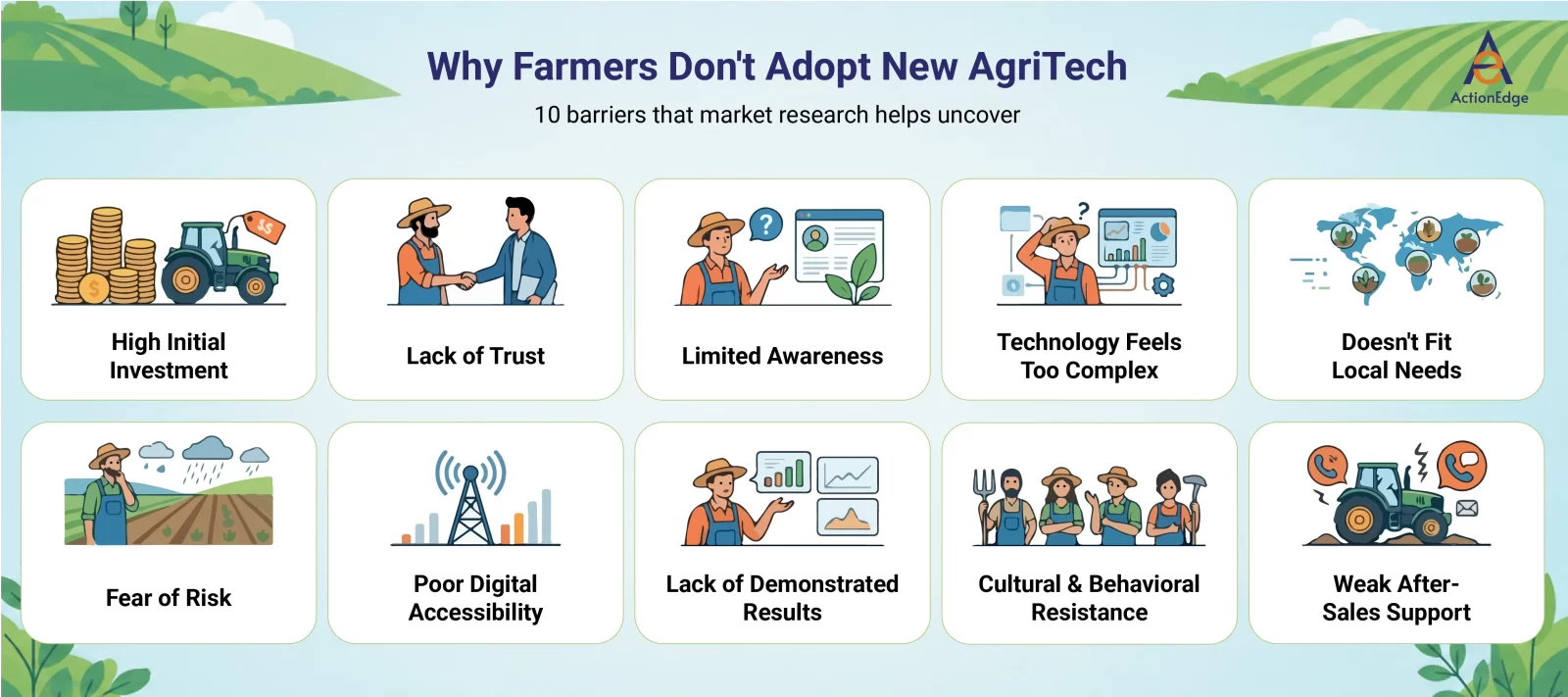
1. High Initial Investment
For most farmers, purchasing new technology is a financial decision before it is a technical one. Whether it is precision irrigation systems, autonomous tractors, or AI-based crop monitoring, the first question is often, “Will this investment pay off?”
Many farmers hesitate because they are uncertain about the return on investment or cannot justify the upfront expense.
Market research helps companies understand acceptable pricing, financing preferences, subscription models, and purchase triggers. Pricing research allows businesses to create solutions that align with farmers’ financial expectations.
2. Lack of Trust
Farmers often prefer technologies that have already been tested by people they know. Recommendations from neighboring farms, local cooperatives, and agricultural advisors carry significant weight.
Research measures trust levels, identifies credibility drivers, and evaluates which endorsements influence purchasing decisions the most. This allows companies to build stronger trust before launching products.
3. Limited Awareness
Sometimes farmers simply are not aware that a solution exists or do not fully understand how it works.
For example, a company may introduce an advanced soil monitoring platform, but if communication never reaches local farming communities, adoption remains low.
Awareness studies and agricultural surveys help identify communication gaps, preferred information sources, and opportunities to improve educational outreach.
4. Technology Feels Too Complex
An innovative solution loses value if farmers find it difficult to operate.
Complicated dashboards, confusing mobile applications, or lengthy installation processes often discourage first-time users.
Usability testing and qualitative research in agriculture allow researchers to observe how farmers interact with products, identify pain points, and recommend design improvements before commercialization.
5. It Doesn’t Match Local Farming Needs
Agriculture varies widely by geography, climate, crop type, irrigation practices, and farm size.
A precision farming solution developed for large commercial farms may not suit smallholder farmers.
Regional studies within agricultural market research uncover local farming practices, environmental conditions, and operational challenges, allowing businesses to adapt their products to regional markets.
6. Fear of Risk
Farming involves uncertainty every season. Weather, pests, labor shortages, and fluctuating market prices already create enough risk.
Adding an unfamiliar technology can feel like another gamble.
Concept testing allows companies to evaluate farmer reactions before launching products. By understanding concerns early, businesses can improve product positioning and reduce hesitation.
7. Poor Digital Accessibility
Not every farming region has reliable internet connectivity or widespread smartphone usage.
Some farmers prefer telephone conversations, while others rely on agricultural extension officers or local dealers.
Research identifies the most effective communication channels, ensuring outreach strategies match local realities instead of assuming universal digital access.
8. Lack of Demonstrated Results
Farmers often believe what they can see.
Field demonstrations, successful harvest stories, and testimonials from neighboring farmers usually carry more influence than advertising campaigns.
Research helps companies understand which proof points farmers value most, enabling them to build stronger evidence-based marketing strategies.
9. Cultural and Behavioral Resistance
Agriculture is deeply rooted in tradition.
Many farming decisions are influenced by family practices, community norms, and generations of experience. Even highly beneficial innovations may face resistance simply because “this is how we’ve always done it.”
Farmer behavior research uncovers these hidden motivations, emotional drivers, and cultural influences that affect purchasing decisions.
Understanding these behavioral patterns enables businesses to communicate benefits in ways that genuinely resonate with farming communities.
10. Weak After-Sales Support
Buying technology is only the beginning.
Farmers expect ongoing training, troubleshooting, maintenance support, and quick responses when problems occur.
Customer experience research helps companies understand service expectations, preferred support channels, and opportunities to improve long-term customer satisfaction.
Strong after-sales support often determines whether farmers become repeat customers and recommend the technology to others.
How Market Research Solves These Challenges
Successful innovation starts with evidence, not assumptions.
Rather than guessing what farmers want, AgriTech research provides reliable insights that reduce uncertainty and improve decision-making throughout the product lifecycle.
Modern market research for agriculture helps organizations:
- Understand farmer motivations and purchasing behavior
- Validate product concepts before launch
- Test pricing models and financing options
- Evaluate messaging effectiveness
- Measure brand awareness
- Identify regional differences across farming communities
- Improve product usability
- Optimize communication channels
- Build stronger adoption strategies
- Reduce product launch risks
A combination of quantitative research in agriculture and qualitative approaches provides a complete understanding of the market.
For example:
- In-Depth Interviews (IDIs) explore farmer experiences, challenges, and attitudes.
- CATI Surveys collect structured insights across large farmer populations.
- Online Surveys gather feedback from digitally connected agricultural audiences.
- Mixed-method research combines qualitative depth with quantitative validation.
- Concept testing evaluates new products before commercialization.
- Customer Experience (CX) research identifies opportunities to improve satisfaction and loyalty.
Many organizations also use specialized programs such as AGRISurvey to gather structured insights from agricultural communities, enabling better product development and market planning.
When businesses understand the people behind the purchase decisions, they build products that farmers are far more likely to adopt.
How ActionEdge Enables AgriTech Market Research Projects
Successful AgriTech research depends on collecting reliable insights from the right stakeholders. ActionEdge enables AgriTech market research projects by delivering high-quality respondent recruitment and data collection across agricultural value chains. Our capabilities cover both qualitative and quantitative fieldwork, helping research agencies, consulting firms, and organizations gather accurate, decision-ready data.
ActionEdge supports projects through CATI (Computer-Assisted Telephone Interviewing), CAWI (Online Surveys), In-Depth Interviews (IDIs), multi-country fieldwork execution, and recruitment of farmers, distributors, retailers, and other agriculture stakeholders. We also conduct fieldwork for product concept testing, innovation research, customer experience (CX) studies, and other agricultural research initiatives, ensuring every project is backed by reliable data collection and consistent fieldwork execution.
Conclusion
Technology has the potential to reshape agriculture, but innovation alone does not guarantee success. Farmers adopt solutions that address real problems, fit their budgets, earn their trust, and integrate naturally into their daily operations.
Understanding these factors requires more than assumptions. It requires listening to farmers, validating ideas with evidence, and making decisions backed by reliable research.
By combining qualitative insights with quantitative data, organizations can uncover the real reasons behind farmer adoption challenges, refine products before launch, and create strategies that drive meaningful adoption. The result is not just better technology, but solutions that farmers are confident to use, recommend, and rely on for the future of agriculture.
If you’re planning your next agricultural innovation study, ActionEdge’s global data collection and fieldwork expertise can help you gather the insights needed to make informed, research-driven decisions with confidence.