

Businesses generate more data today than at any other point in history. Dashboards track every click, surveys collect thousands of responses, and analytics platforms measure customer actions in real time. Yet, despite having access to more information than ever, many organizations still make decisions that miss the mark.
Why? Because data alone does not tell the complete story.
Numbers can reveal that customers are leaving a website, switching brands, or delaying purchases. However, they rarely explain the emotions, expectations, or frustrations driving those actions. On the other hand, conversations with customers provide rich context but may not reflect the views of the wider market.
The smartest business decisions come from connecting both perspectives. By combining qualitative and quantitative research, organizations gain a complete understanding of what customers do and why they do it. This balanced approach reduces guesswork, validates insights, and helps businesses make confident, customer-focused decisions in an increasingly competitive marketplace.
Understanding the Two Types of Research
Every business question does not require the same type of research. Some decisions demand measurable evidence, while others require a deeper understanding of human behavior. That is why successful organizations use different research methods based on their objectives.
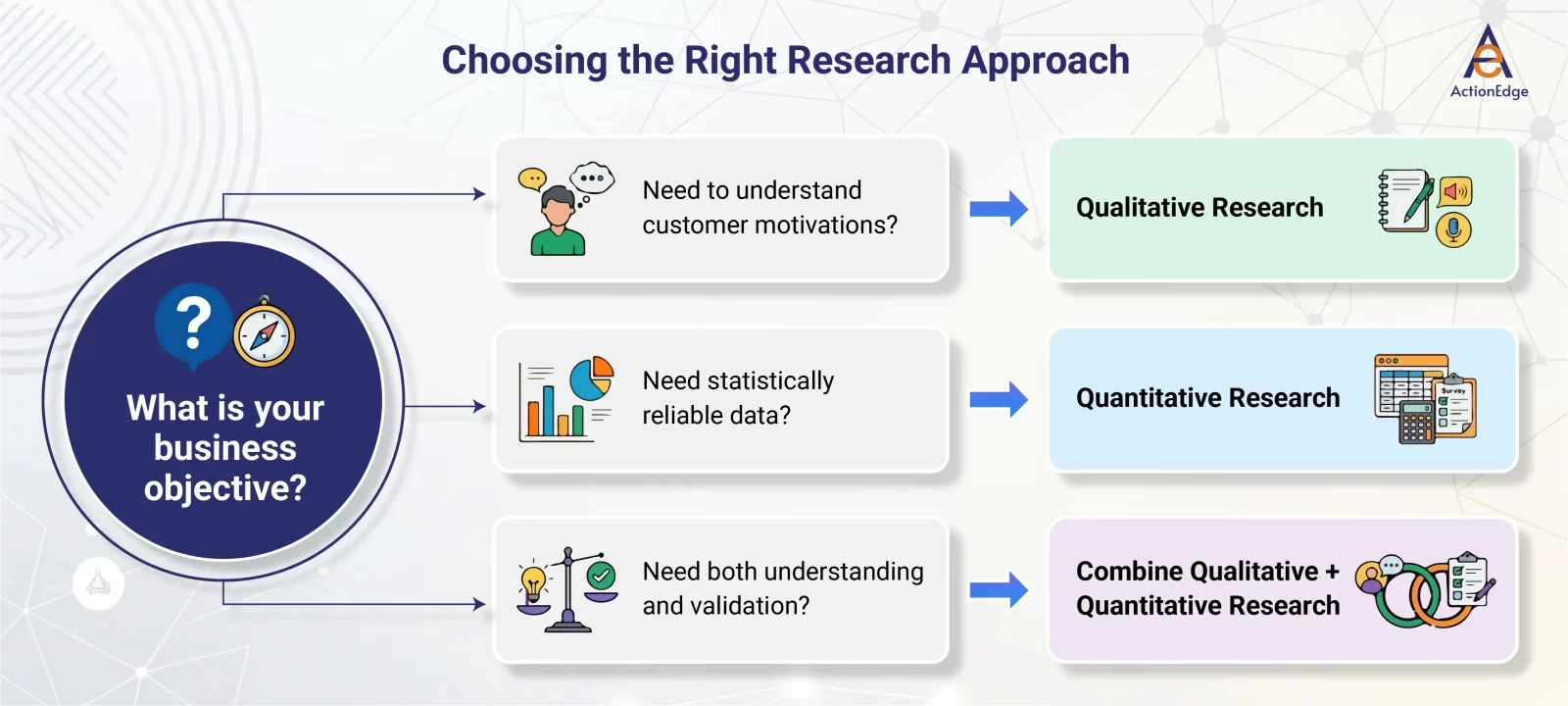
What is Qualitative Research?
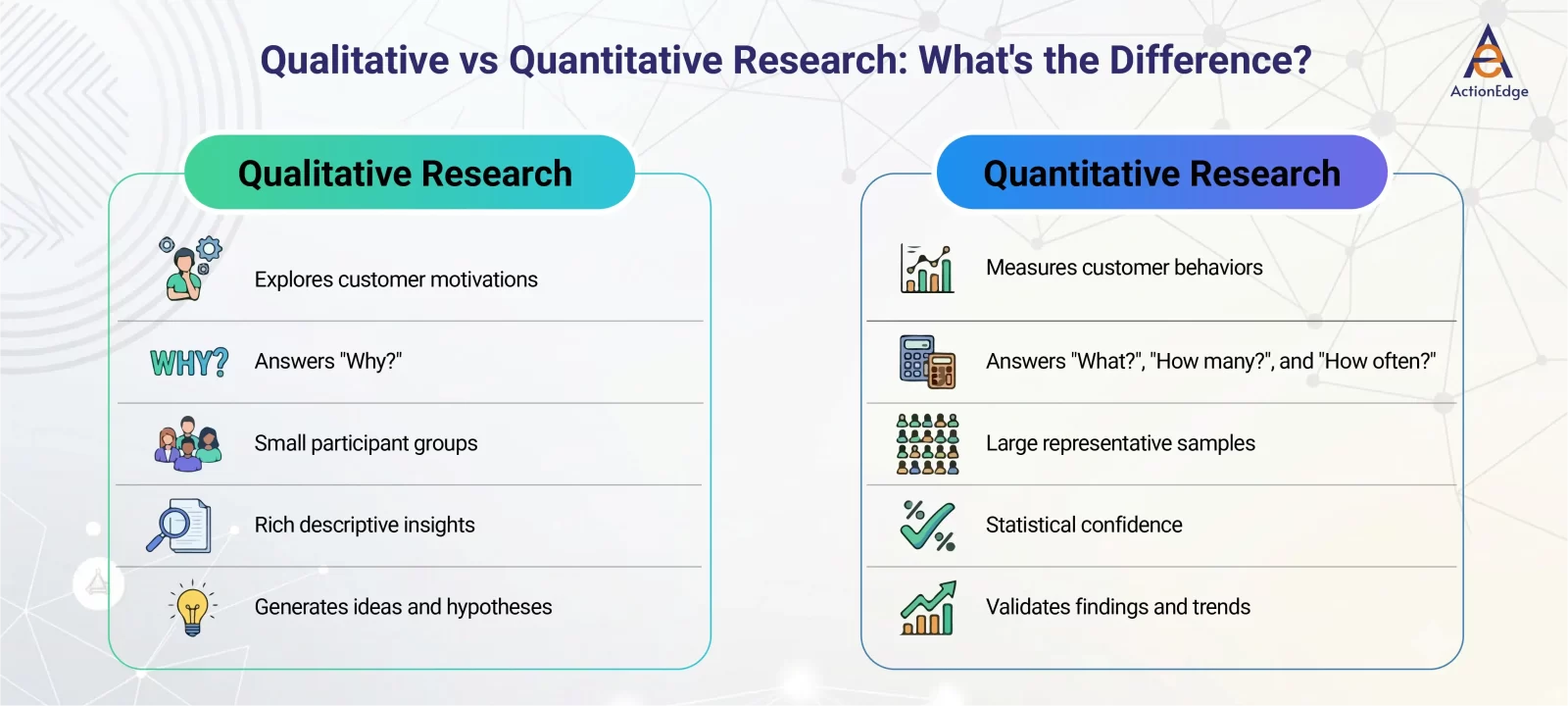
Qualitative research focuses on exploring people’s opinions, perceptions, motivations, experiences, and emotions. Instead of measuring large volumes of data, it seeks to understand the reasons behind customer decisions.
It primarily answers the question:
“Why?”
Since this approach involves smaller groups of carefully selected participants, researchers can dive deeper into individual experiences and uncover insights that structured surveys often miss.
Common qualitative research methods include:
- In-depth interview research (IDIs) for one-on-one conversations
- Focus Group Discussions (FGDs)
- Ethnographic Research, where researchers observe customers in real-life environments
For example, a software company launching a new application may interview users to understand why they find certain features confusing. These conversations often uncover usability issues that usage data alone cannot explain.
What is Quantitative Research?
Quantitative research focuses on measuring behaviors, trends, and patterns using structured data collection methods.
It answers questions such as:
- What happened?
- How many customers experienced it?
- How often does it occur?
Unlike qualitative studies, quantitative research typically involves large sample sizes, allowing businesses to identify statistically reliable patterns and make evidence-based decisions.
Popular quantitative research methods include:
- Online Surveys (CAWI)
- Telephone Surveys (CATI)
- Phone-to-web via screen access (P2W SA), which combines phone-based recruitment with online survey completion for better respondent engagement and data quality.
Imagine an online retailer surveying 10,000 shoppers after a major sale. The results might show that 68% completed their purchases on mobile devices. That insight helps prioritize mobile optimization across future campaigns.
Why Relying on Just One Method Can Lead to Incomplete Decisions
One of the biggest mistakes organizations make is depending entirely on either numbers or conversations.
Consider this example.
A customer satisfaction survey reveals that 45% of customers abandoned their purchase before checkout.
The data clearly identifies a problem.
However, it does not explain:
- Why customers left
- What frustrated them
- What they expected instead
Without these answers, businesses may spend time fixing the wrong issues.
Now imagine interviewing ten customers who abandoned their carts. Several mention confusing delivery charges, while others highlight lengthy checkout forms.
These interviews provide valuable context. However, they still leave an important question unanswered:
Do these opinions represent thousands of other customers?
Neither method provides the complete picture on its own.
This is exactly why qualitative and quantitative research are important. One uncovers the reasons behind customer decisions, while the other validates whether those reasons apply across the broader market.
Qualitative and Quantitative Research Together Lead to Better Business Decisions
When businesses combine both research approaches, they create a much stronger foundation for strategic decision-making. This approach is often referred to as mixed methods research, where qualitative insights and quantitative data work together to provide a complete understanding of customer behavior.
Together, these approaches help businesses:
- Validate assumptions before making major investments.
- Reduce decision-making risks with reliable evidence.
- Understand evolving customer needs.
- Build customer-centric strategies.
- Make informed, data-backed business decisions.
For example, before launching a new banking app, interviews may reveal that customers worry about online security. A large-scale survey can then measure how widespread those concerns are, helping product teams prioritize security features that matter most.
Real-World Applications Across Industries
Organizations across industries benefit from combining qualitative and quantitative insights.
Healthcare
Patient surveys measure satisfaction levels, appointment experiences, and treatment outcomes. Interviews with patients uncover why they prefer certain healthcare providers, telehealth services, or digital consultation platforms. Together, these insights support better patient care and service design.
Retail and E-commerce
Analytics and surveys identify where shoppers leave the purchase journey. Customer interviews explain frustrations such as unexpected shipping costs, difficult navigation, or limited payment options. These combined insights help retailers improve conversions and customer loyalty.
BFSI
Banks and financial institutions use surveys to monitor trust in digital banking services and mobile applications. Individual interviews reveal deeper concerns around cybersecurity, financial planning, and digital adoption, enabling organizations to strengthen customer confidence.
Energy and Utilities
Customer satisfaction surveys measure service quality and response times. Interviews explore public attitudes toward renewable energy, sustainability initiatives, and expectations for future energy services.
Technology
Technology companies rely on product usage data to measure feature adoption and customer engagement. User interviews uncover usability challenges, unmet needs, and feature requests that shape future product development.
These examples highlight how customer behavior research becomes significantly more valuable when businesses combine measurable trends with human experiences.
Benefits of Combining Qualitative and Quantitative Research
The benefits of qualitative and quantitative research extend well beyond better reporting. Together, they enable organizations to make smarter decisions with greater confidence.
Businesses can:
- Gain a complete understanding of customer needs and expectations.
- Validate research findings before making strategic decisions.
- Identify hidden market opportunities.
- Improve products and service experiences.
- Strengthen customer satisfaction and loyalty.
- Reduce business risk through evidence-based planning.
- Support innovation with reliable customer insights.
- Make faster, smarter decisions backed by both context and data.
Rather than relying on assumptions, organizations build strategies based on a balanced understanding of both customer stories and measurable evidence.
How ActionEdge Helps Businesses Choose the Right Research Approach
Every business challenge is unique, which means there is no universal research solution. Selecting the right methodology depends on your objectives, target audience, industry, and decision-making priorities.
As a global market research company, ActionEdge delivers comprehensive market research services designed to answer complex business questions through both qualitative and quantitative methodologies.
Many projects benefit from combining both approaches. We help organizations design customized research programs that validate findings, uncover deeper customer insights, and provide decision-makers with actionable recommendations that drive business growth.
Whether you are entering a new market, launching a product, improving customer experience, or evaluating brand performance, our experienced research teams ensure every insight supports informed business decisions.
Conclusion
Today’s business environment demands more than isolated data points or individual customer stories. Organizations that combine qualitative and quantitative research gain a richer understanding of customer needs, validate their assumptions with confidence, and make decisions backed by both evidence and human insight.
The most successful businesses do not choose between conversations and numbers. They use both to build strategies that reduce risk, strengthen customer relationships, and create lasting competitive advantage.
If you’re looking to uncover deeper insights and make smarter business decisions, ActionEdge can help you design the right research approach for your goals. Contact our team today to discover how the right combination of qualitative and quantitative research can turn data into confident business decisions.