In research, costly mistakes rarely come from wrong answers. They happen when the right questions are asked through the wrong methodology.
B2B and enterprise environments have become more demanding than ever. Decision-makers are harder to access, stakeholder ecosystems are more layered, and expectations for data accuracy are unforgiving. In 2026, research design is no longer a procedural choice. It is a strategic decision that shapes the credibility of insights and the confidence behind major investments.
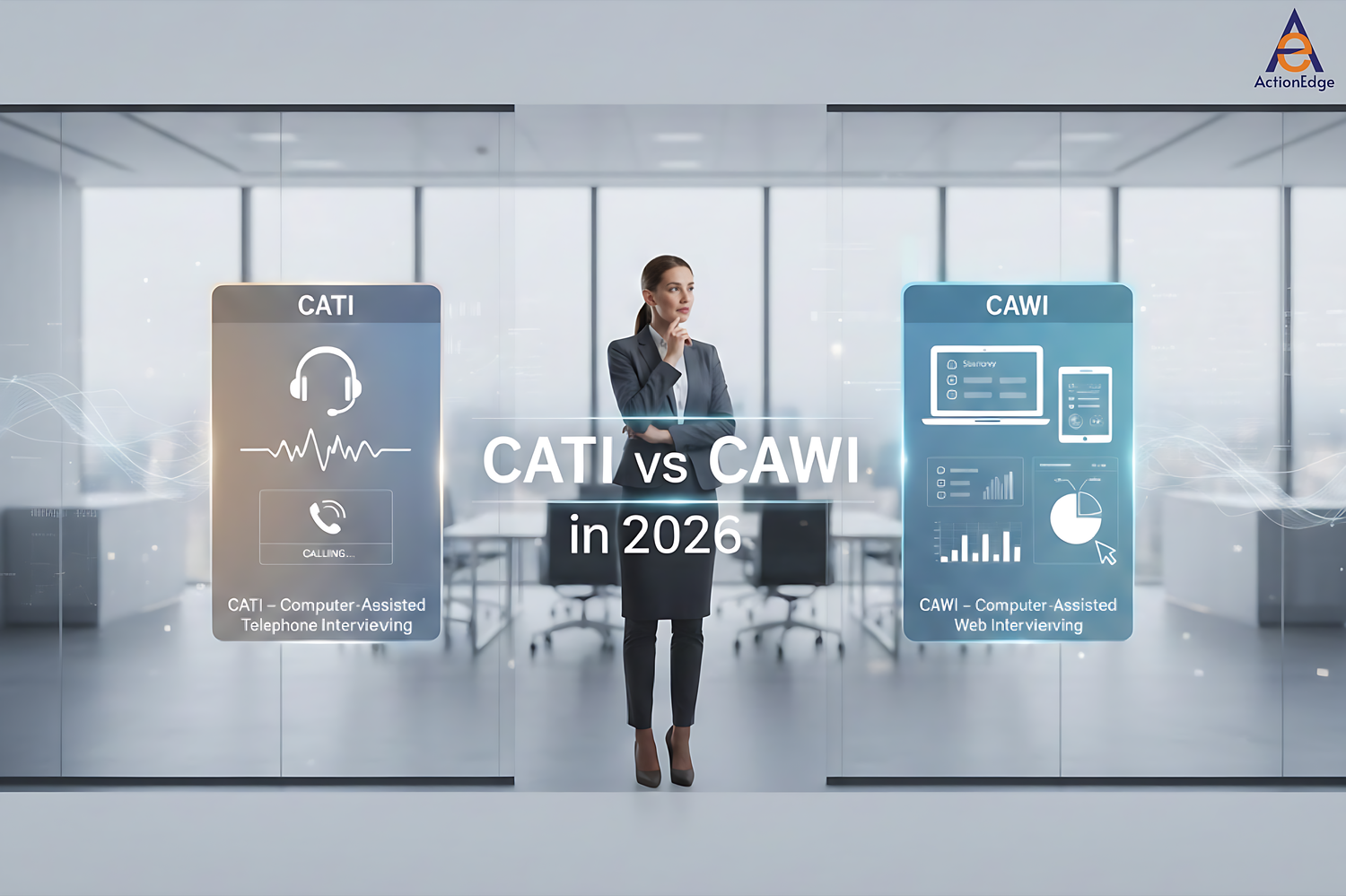
Two methodologies continue to dominate discussions of structured data collection: CATI and CAWI. While both methodologies are widely adopted and effective, they ultimately serve very different research objectives.
Understanding when to use each method can dramatically improve response quality, reliability, and the overall impact of your study.
Let’s break this down clearly.
What is CATI?
CATI, or Computer assisted telephone interviewing, is a research methodology where trained interviewers conduct surveys over the phone using specialized software platforms.
The system guides the interviewer through a structured questionnaire, applies logic checks, and captures responses in real time. According to a study, among digitally ready participants, 51% opted for CATI over CAWI, valuing guided interaction. Unlike traditional phone surveys, CATI is highly controlled, data-driven, and designed for accuracy and consistency.
Strengths of CATI
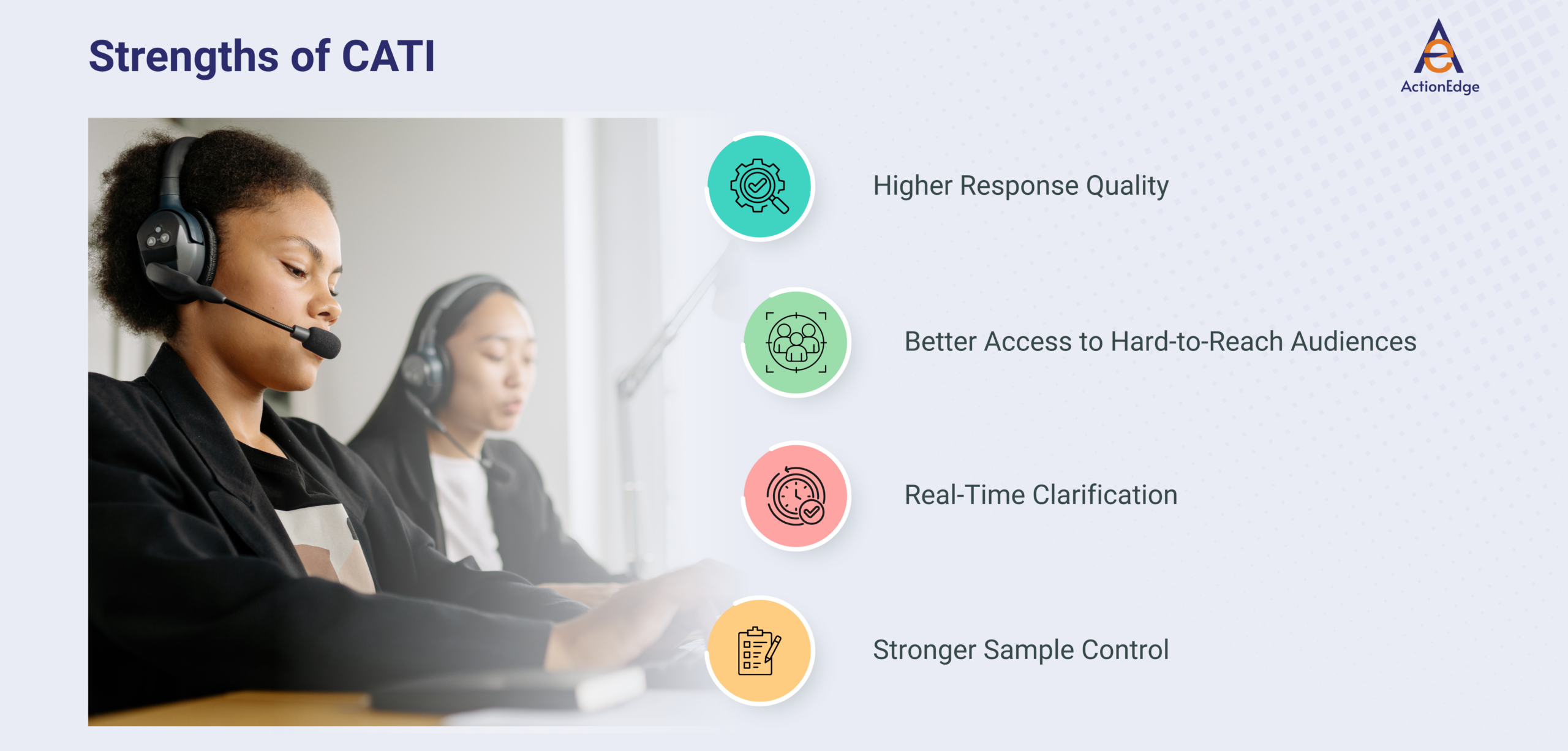
Higher Response Quality
Human interaction naturally increases engagement. Respondents are more attentive, less likely to rush through answers, and more willing to provide thoughtful feedback.
This becomes especially valuable when surveys involve complex decision-making, technical language, or nuanced business topics.
Better Access to Hard-to-Reach Audiences
Senior executives, medical professionals, procurement leaders, and niche specialists often ignore online surveys. However, they are more likely to participate in scheduled, professionally conducted phone interviews.
This makes CATI indispensable for B2B and enterprise research conducted by a specialized CATI market research company.
Real-Time Clarification
Interviewers can immediately explain complex questions, resolve misunderstandings, and probe deeper when needed. This reduces data distortion caused by misinterpretation.
For enterprise studies involving technical products or strategic investments, this clarity significantly improves data reliability.
Stronger Sample Control
A professional CATI market research company can validate respondent eligibility, confirm job roles, and ensure participants meet strict screening criteria.
This level of verification is critical when research outcomes influence high-value business decisions.
Practical Example:
Imagine surveying CIOs about cybersecurity investment priorities.
An online survey link may sit unnoticed in a crowded inbox. A scheduled CATI interview, conducted at a convenient time, results in deeper engagement and richer responses. The conversation allows clarification of technical terms and ensures answers reflect genuine decision-making perspectives.
This is why enterprises often rely on CATI market research services when targeting high-value stakeholders.
What is CAWI?
CAWI, or Computer-Assisted Web Interviewing, refers to surveys completed online via desktop, tablet, or mobile devices.
Respondents self-administer the questionnaire through a digital interface without an interviewer. Automation controls routing, logic, and data capture, making CAWI highly scalable and efficient.
Strengths of CAWI
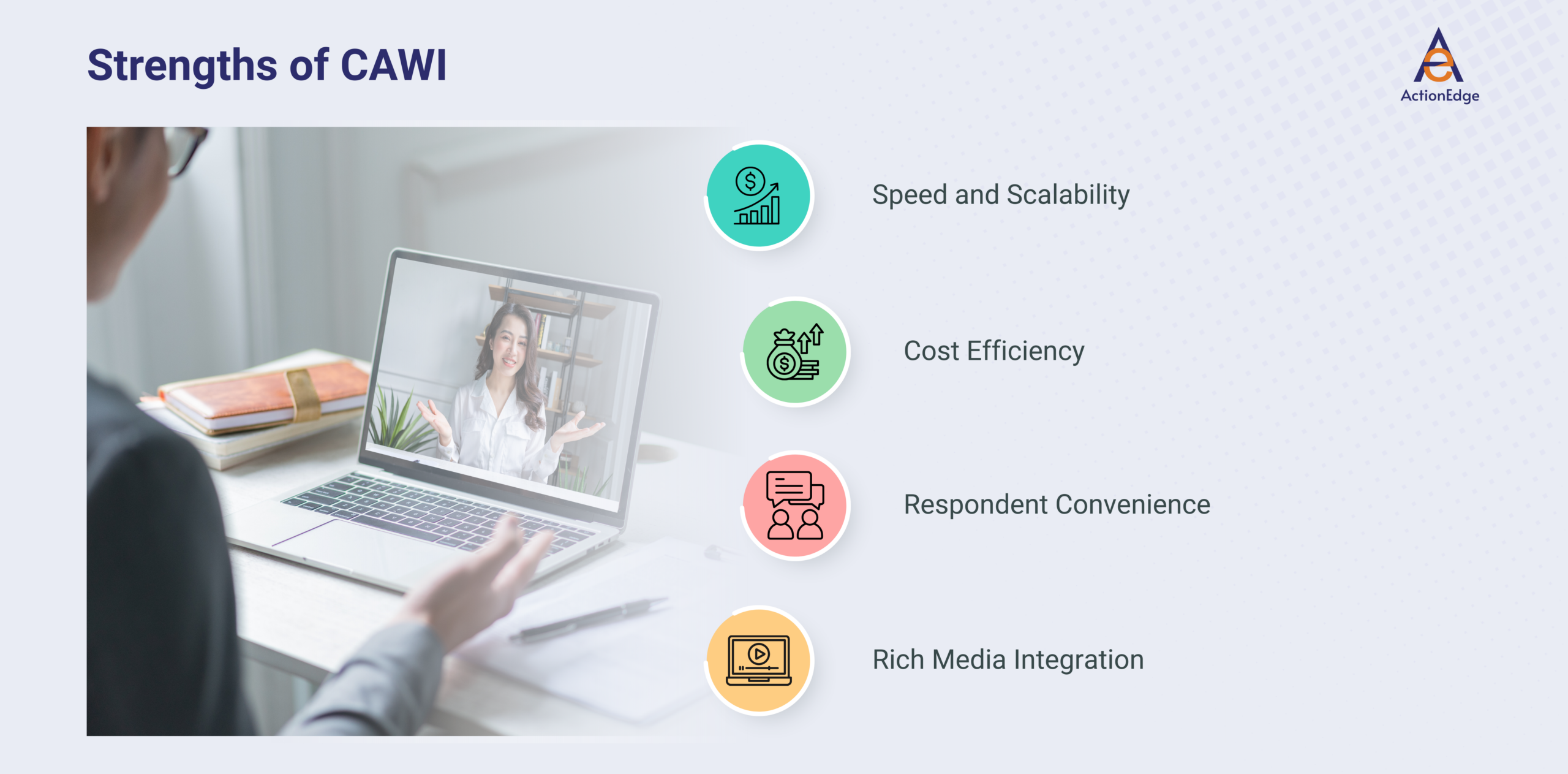
Speed and Scalability
CAWI enables researchers to collect thousands of responses across multiple markets in just days. This rapid turnaround is ideal for time-sensitive studies.
For large validation projects, this efficiency makes CAWI a preferred method for many organizations.
Cost Efficiency
With no interviewer involvement, operational costs are significantly lower compared to phone-led methodologies.
This allows businesses to achieve broader reach while maintaining budget control.
Respondent Convenience
Participants can complete surveys at their preferred time, increasing accessibility and participation rates for digitally active audiences.
This flexibility often improves completion rates in global research programs.
Rich Media Integration
CAWI supports embedded videos, product demos, images, concept boards, and interactive stimuli. This enhances respondent understanding and engagement.
These capabilities are frequently leveraged by a quantitative market research agency conducting concept tests or UX studies.
Practical Example:
Consider a SaaS provider evaluating feature prioritization among mid-level managers across five countries.
Deploying a CAWI survey allows rapid collection of statistically significant data. Respondents review visual feature mockups and provide structured feedback efficiently. This approach delivers scale and speed without the need for scheduling constraints.
This is where a quantitative market research agency typically leverages CAWI for validation-heavy studies.
CATI Vs. CAWI – Key Differences
Understanding these differences helps align methodology with research objectives rather than relying on habit or convenience.
| Aspect | CATI | CAWI |
|---|---|---|
| Mode | Phone interviews | Online surveys |
| Interaction | Interviewer-led | Self-administered |
| Response Quality | High engagement | Varies by respondent |
| Speed | Moderate | Very fast |
| Sample Control | Strong verification | Limited verification |
| Best For | Niche B2B audiences | Large-scale studies |
| Complexity Handling | Excellent | Moderate |
| Cost | Higher | Lower |
| Data Completeness | 7% skip 5+ questions | 23% skip 5+ questions |
Note: CATI 103% quota vs. web 52% in scaled studies.
When to Use CATI in B2B & Enterprise Research
CATI performs best when data precision, respondent quality, and depth of understanding outweigh speed considerations.
- Reaching Senior Decision-Makers: Executives and specialists are more responsive to professional, interviewer-led engagement.
- Addressing Complex Topics: Enterprise technology, financial solutions, and medical devices benefit from real-time clarification.
- Handling Sensitive Discussions: Topics involving budgets, vendor evaluation, or risk assessment require trust and conversational nuance.
- Low Incidence Audiences: Niche roles or specialized industries often require targeted outreach and verification.
Many organizations work with CATI market research services providers when accuracy and respondent validation are critical.
When to Use CAWI in B2B & Enterprise Research
CAWI excels when scale, speed, and efficiency are dominant priorities. For hard-to-reach executives, CATI response rates reached 43-76% for live contacts, far outpacing online alternatives
- Large Sample Requirements: Market sizing, segmentation, and tracking studies benefit from CAWI’s reach.
- Geographically Dispersed Respondents: Multi-country research becomes faster and more manageable.
- Visual or Interactive Stimuli: Product concepts, UI testing, dashboards, and advertisements integrate seamlessly.
- Shorter, Structured Surveys: Pulse checks and feedback loops are efficiently executed online.
Hybrid Approach in 2026: CATI + CAWI
Research strategies are increasingly shifting from “CATI vs CAWI” to “CATI + CAWI.”
Rather than choosing one method exclusively, organizations are blending methodologies to maximize strengths and minimize limitations.
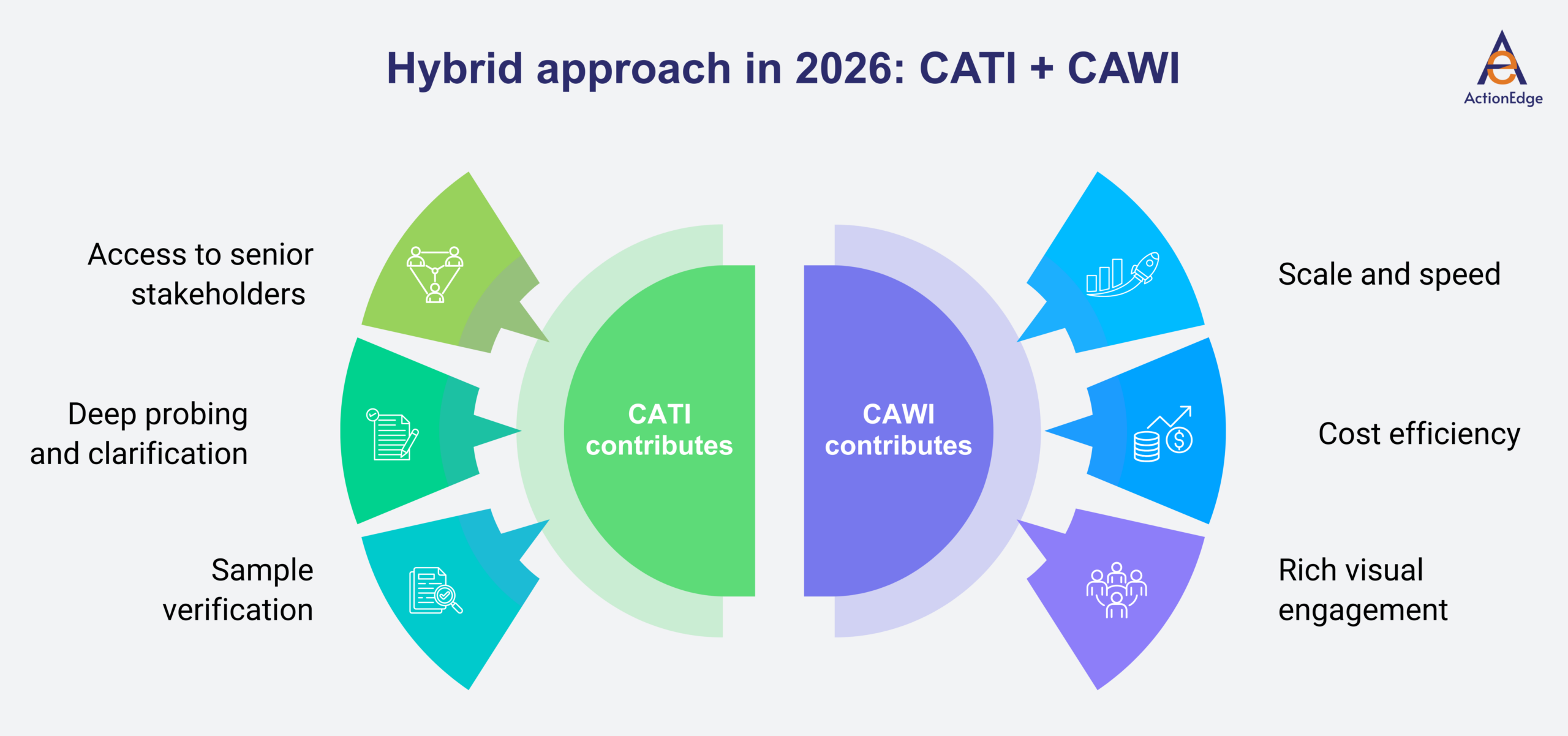
Hybrid approaches shine too: The Swiss Household Panel, FORS, found that CATI/CAWI matched pure CATI rates after three waves, with less drop-off. This combined design often delivers deeper insight and greater statistical confidence.
The 2026 Reality: Digital Meets Human
Methodologies are no longer competing channels. They are complementary tools within integrated research ecosystems.
Even phone-led studies now incorporate digital stimuli, while CAWI projects increasingly include human follow-ups to improve interpretation. A modern qualitative research firm often blends CATI, CAWI, and video interviews within a unified design.
Conclusion
Choosing between CATI and CAWI is not about preference. It is about strategic alignment.
CATI delivers when respondent quality, engagement, and complexity handling are critical. CAWI wins when speed, scale, and efficiency drive the study. In 2026, the most effective research designs are rarely binary. They are built around objectives, audience behavior, and decision risk.
If your research involves high-value stakeholders or complex enterprise decisions, working with an experienced Market research firm can significantly elevate data quality. When broader validation is required, CAWI becomes indispensable.
The smartest choice is not CATI or CAWI. It is knowing when each creates the most value.
Frequently Asked Questions
CATI (Computer Assisted Telephone Interviewing) is an interviewer-led survey method conducted via phone using software-guided questionnaires, commonly managed by a CATI market research company.
CAWI (Computer Assisted Web Interviewing) refers to online surveys completed through digital interfaces, widely used in market research and surveys for speed and scalability.
It depends on your goals: CATI works best for senior or niche professionals, while CAWI is ideal for larger samples and rapid quantitative market research.
Consider audience accessibility, topic complexity, and timeline; a professional market research service provider can recommend the most suitable approach.
CATI typically delivers better engagement and verification, which is why many organizations rely on CATI market research services.
ActionEdge is a global market research service provider. Its methods are based on the alignment of study objectives, target markets, and regional differences across markets. By using both qualitative market research and quantitative market research, including CATI market research services, Action Edge is able to produce reliable, high-quality results for complex international market research and surveys that have multiple countries involved.
An expert market research service partner ensures strong methodology design, validated samples, and reliable quantitative market research outcomes.