
The decision that quietly shapes every insight!
If you’ve ever looked at a finished research report and thought, something feels off, you’re not alone. The numbers might add up, the charts might look clean, yet the conclusions lack conviction. More often than not, the issue stems from how the research partner was chosen.
That choice sets the tone for everything that follows. Who gets surveyed? How questions are understood. Whether responses reflect real thinking or rushed answers. This is why a SWOT Analysis before choosing your research partner matters far more than most teams realize.
Why a SWOT analysis matters in research partnerships
Research partners influence more than execution. They shape the quality, credibility, and usability of insights. Strategic decisions, investments, and long-term plans often rest on the data they deliver.
Imagine a global study targeting senior technology leaders. The proposal looks solid. Fieldwork begins. Then response rates slow, interviews feel shallow, and the final output lacks depth. The issue rarely lies in the questionnaire. It lies in partner capability.
This is exactly where a SWOT analysis before choosing your research partner earns its place.
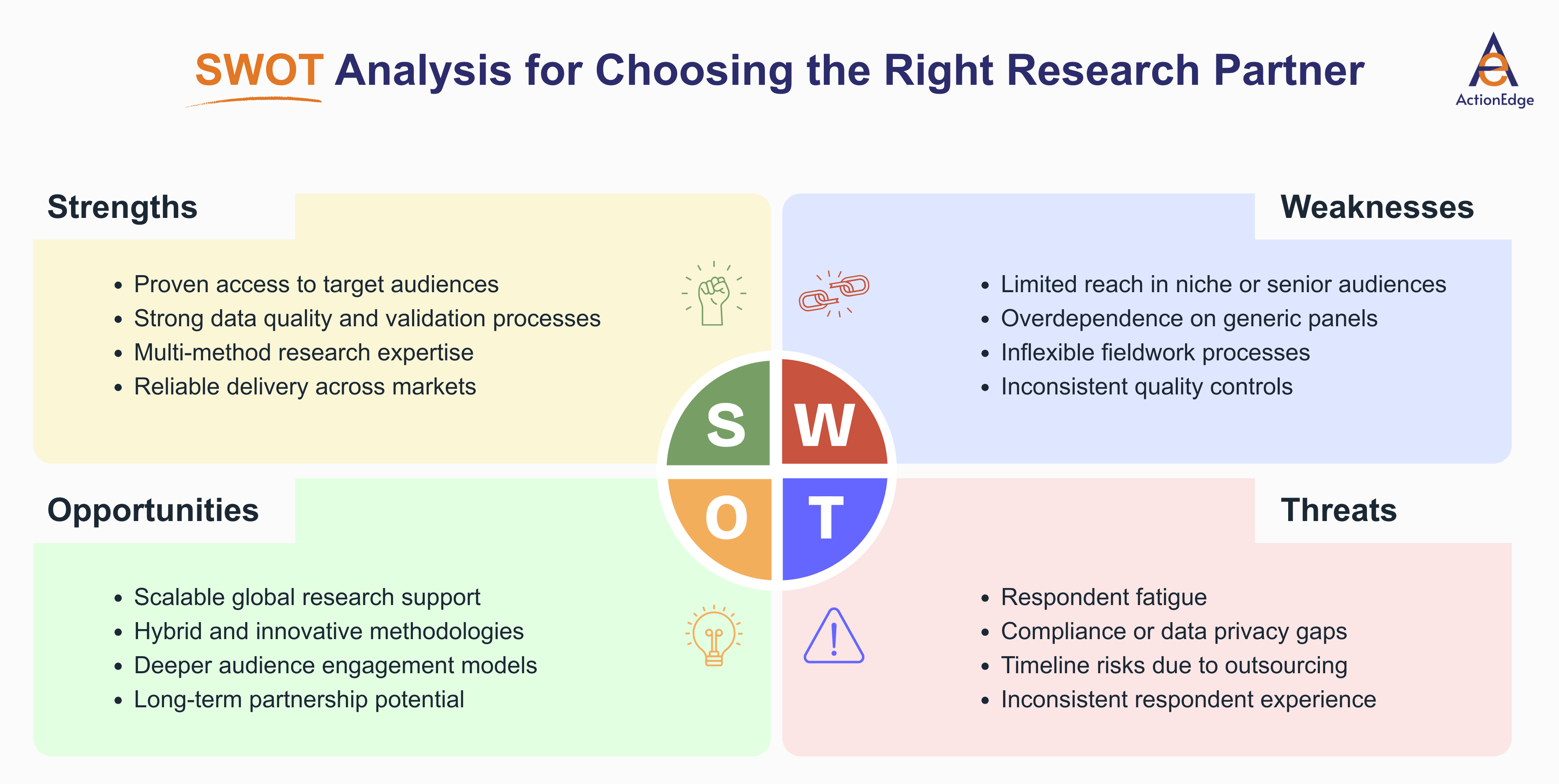
Strengths: What the partner truly does well
Strengths should be visible in outcomes, not just promises.
Look for partners with:
- Consistent access to hard-to-reach audiences such as CXOs and functional experts
- Strong respondent verification and quality control processes
- Experience across regions, industries, and methodologies
A real strength shows when recruitment stays on track despite tight criteria, short timelines, or complex markets.
Weaknesses: What could quietly derail your project
Common weaknesses include:
- Heavy reliance on generic panels
- Limited regional or language depth
- Rigid fieldwork processes
- Minimal oversight once data collection begins
For instance, a partner strong in online surveys may struggle in markets where phone-led validation is essential. A SWOT analysis before choosing your research partner helps surface these gaps before they affect quality or delivery.
Opportunities: Where the partnership creates added value
Opportunities are about future fit, not just current needs.
Consider whether the partner:
- Can scale with your research footprint
- Brings innovative or hybrid methodologies
- Acts as a thought partner, not just an executor
As research becomes more complex and audience access more challenging, partners who evolve with you become strategic assets.
Threats: Risks you should anticipate, not react to
Even capable partners carry risks.
Watch for:
- Respondent fatigue due to overused panels
- Compliance or data privacy gaps in certain regions
- High interviewer turnover impacts consistency
- Over-dependence on third parties
A well-executed SWOT analysis before choosing your research partner helps you plan around these threats instead of firefighting later.
Why ActionEdge stands out as a research partner
In a SWOT analysis, ActionEdge stands out for its ability to balance quality, reach, and control.
One of ActionEdge’s core strengths is its Phone-to-Web (P2W) methodology via Screen Access. This approach blends live phone engagement with the structure of an online survey, ensuring the right respondents participate, questions are clearly understood, and responses are captured accurately. It is especially effective when engaging senior leaders and niche experts who expect efficiency without compromising credibility.
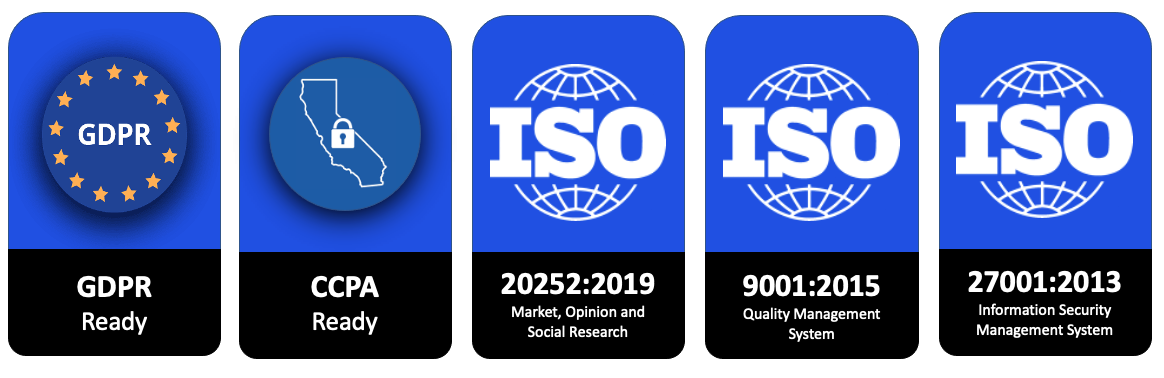
This credibility is reinforced by ISO-certified processes and strong data governance in market research, along with adherence to global data security and quality standards, giving clients confidence that every project meets strict compliance, confidentiality, and research governance requirements.
Beyond P2W-SA, ActionEdge supports qualitative and quantitative research across 65+ countries through experienced in-house teams and multilingual capabilities. Services include expert interviews, appointment setting, CATI, and online surveys, all managed with active quality checks throughout fieldwork.
What consistently sets us apart is our hands-on execution. Teams monitor data quality in real time, adjust recruitment strategies when needed, and maintain transparency with clients. This reduces common risks such as poor sample fit, rushed responses, or last-minute delays.
Choosing clarity over assumption
What this really means is simple. Choosing a research partner is not an operational decision. It is a strategic one.
A thoughtful SWOT analysis before choosing your research partner helps you move beyond assumptions and focus on what truly matters, i.e., data quality, risk management, and long-term alignment.
Because when insights drive decisions, the partner behind those insights makes all the difference.