
A telecom operator can add thousands of new subscribers in a quarter and still lose ground.
Why?
Because customers rarely leave with a warning. They drift away quietly, taking lifetime value, referrals, and brand equity with them.
In 2026, churn is no longer just a retention metric. It is a boardroom concern tied directly to profitability, network investment, and competitive positioning. Operators across regions are seeing churn pressures intensify as switching barriers fall and digital-first consumers demand frictionless experiences.
This is where predictive research and multi-mode surveys for telecom step in. Together, they transform churn from a lagging indicator into a manageable risk.
Telecom Customer Churn in 2026: The Industry Reality
The telecom landscape has evolved faster in the last five years than in the previous two decades. Industry analyses confirm that telecom churn remains alarmingly high, averaging 20–50% annually. Postpaid churn ranges between 9–43%, while prepaid segments can see churn levels reaching 80% per year. Even in mature markets, retention continues to challenge operators.
Several industry shifts are reshaping customer behavior:
- Aggressive price wars and bundled offers
- eSIM adoption simplifying provider switching
- Digital-only competitors entering niche segments
- Rising expectations for instant support and personalization
What this really means is simple: acquisition can no longer compensate for retention failures.
Why Is Telecom Customer Churn Increasing in 2026?
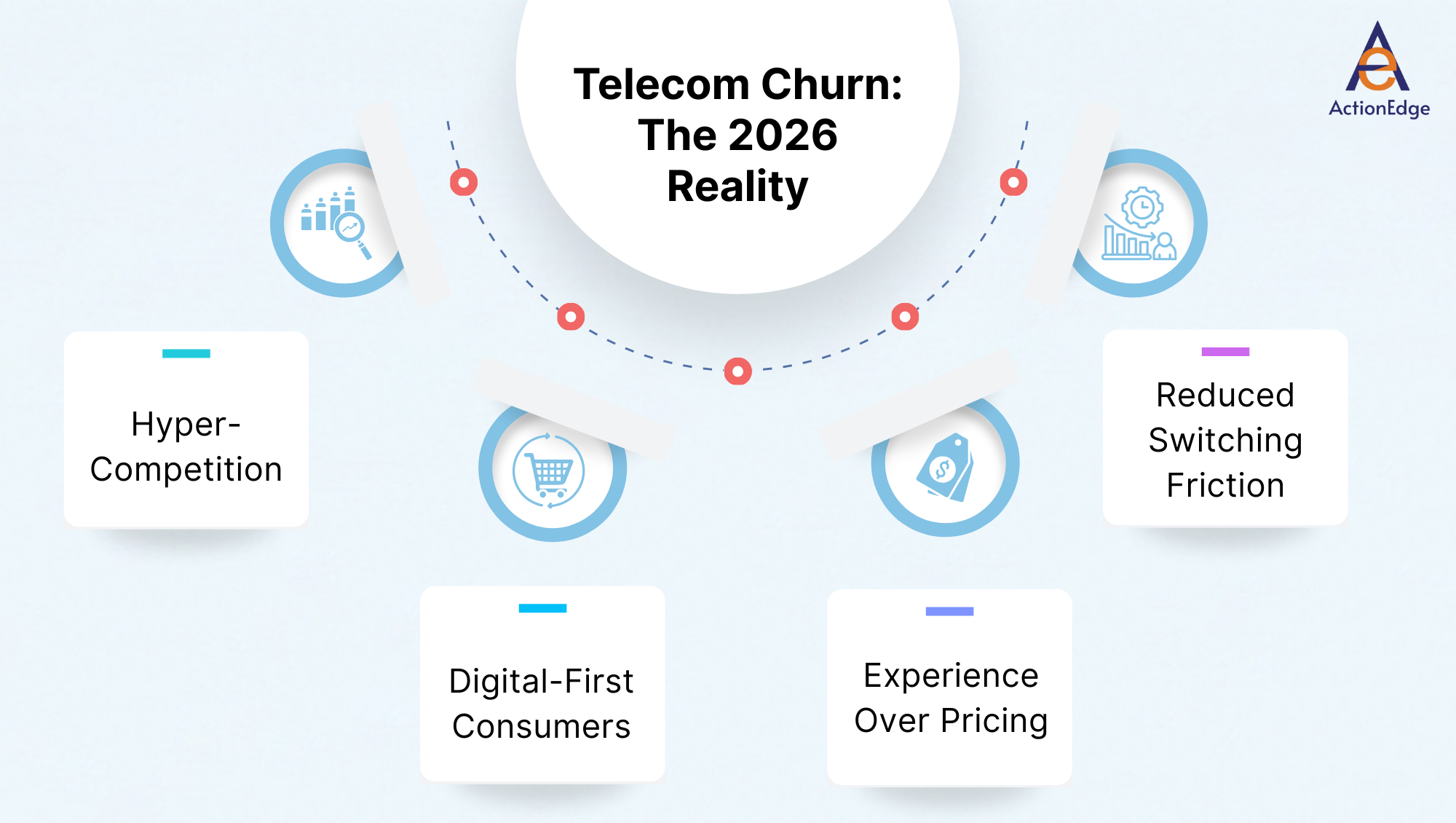
Hyper-Competition
Customers are flooded with near-identical plans, flash discounts, and loyalty incentives. Differentiation is shrinking, making price the easiest comparison point.
Digital-First Consumers
Subscribers now expect app-based onboarding, AI-driven support, and real-time issue resolution. Any friction accelerates dissatisfaction.
Experience Over Pricing
Research within the Telecommunications Industry Market Research consistently shows that churn is driven less by cost and more by service quality, billing transparency, and support interactions.
Reduced Switching Friction
With eSIMs, number portability, and instant activation, changing providers has become effortless.
For Example: A user experiencing repeated call drops may once have tolerated the inconvenience. Today, they can switch providers within minutes via a mobile app.
The Cost of Customer Churn for Telecom Operators
Churn is expensive. Much more than most dashboards reveal. In saturated markets, the financial impact is dramatic. A modest 1–2% increase in churn can wipe out nearly $120 million in annual revenue for a mid-sized operator with 1 million subscribers and an ARPU of $50.
- Revenue Loss: Every departing subscriber represents lost ARPU and unrealized lifetime value.
- Higher Acquisition Costs: Replacing lost customers requires marketing spend, sales incentives, and onboarding resources.
- Brand Erosion: Frequent churn signals underlying dissatisfaction that spreads through reviews and word of mouth.
- Operational Disruption: Customer exits often follow unresolved complaints, increasing pressure on support teams.
For Example: If a telecom operator loses 50,000 high-value subscribers annually, the compounded loss includes subscription revenue, cross-sell opportunities, and upsell potential.
This is why leading Telecom market research companies emphasize churn prevention over churn analysis.
What Is Predictive Research in Telecom?
Predictive research in telecom goes beyond describing customer behavior; it anticipates it. Instead of relying purely on historical churn reports, operators use forward-looking intelligence to identify which subscribers are likely to disengage, downgrade, or switch providers.
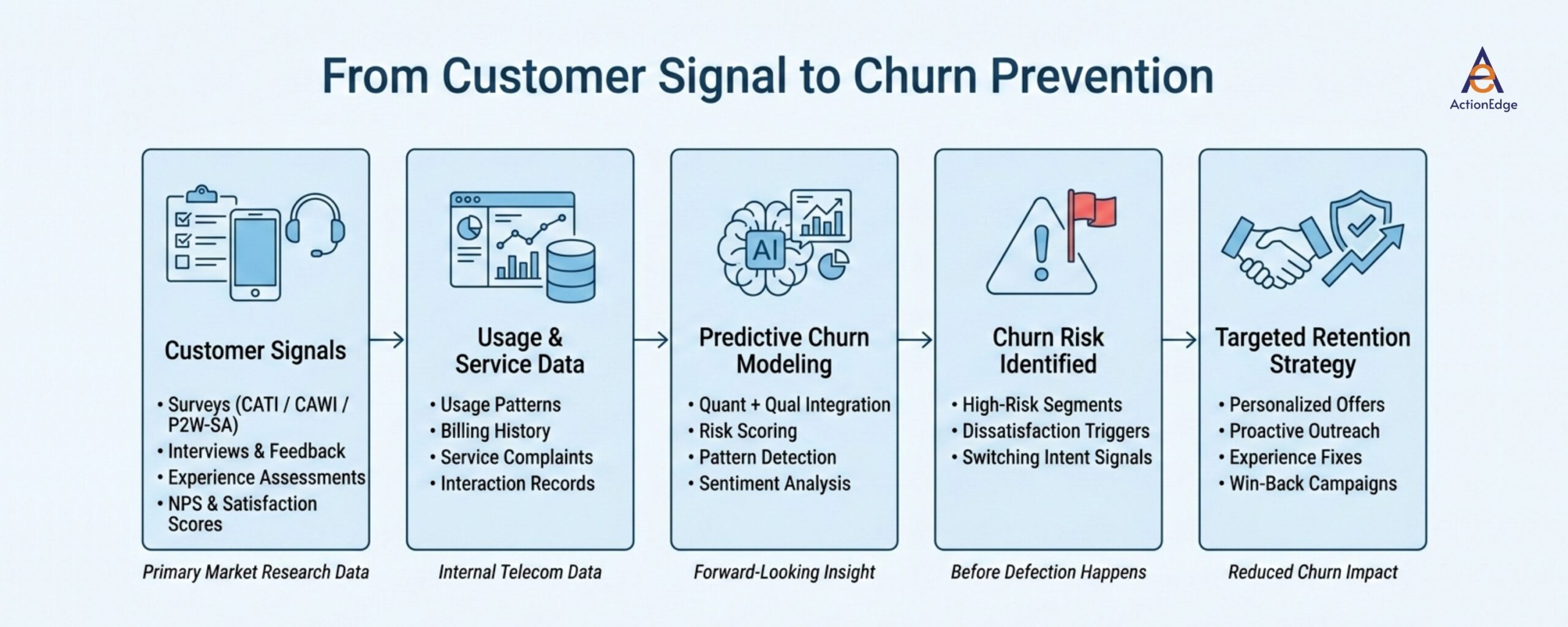
At its core, predictive research integrates behavioral analytics with primary market research. While internal data reveals what customers are doing, primary research uncovers why they are doing it. This distinction is critical because churn is rarely triggered by a single event. It is driven by perceptions, unmet expectations, and evolving needs.
Role of Primary Research Data in Reducing Churn
Operational datasets capture usage patterns, billing records, and service interactions. However, they often miss early emotional and perceptual signals such as:
- Declining satisfaction
- Frustration with network quality
- Perceived value erosion
- Competitor consideration
This is where primary market research becomes indispensable. Direct customer feedback gathered through structured surveys, interviews, and experience assessments exposes dissatisfaction before it translates into defection.
For example, a subscriber may maintain stable usage levels while quietly losing confidence in network reliability. Without primary research data, this churn risk remains invisible.
A capable primary market research company helps telecom operators design instruments that detect these subtle but decisive warning signs.
Importance of Quantitative and Qualitative Research
Reducing churn requires both measurement and interpretation.
Quantitative research delivers scale, statistical confidence, and trend visibility:
- Churn likelihood scoring
- Satisfaction tracking
- NPS shifts
- Service performance ratings
Qualitative research provides context and depth:
- Root causes of dissatisfaction
- Emotional triggers
- Decision-making dynamics
- Hidden pain points
Quant answers how many and how often.
Qualitative explains why and how.
Benefits of Combining Quant and Qual
When quantitative and qualitative research are combined, telecom operators gain:
- Early detection of churn drivers
- Deeper understanding of subscriber motivations
- More accurate churn prediction models
- Stronger retention strategy alignment
For instance, quant data may show declining satisfaction among prepaid users, while qualitative interviews reveal that the real trigger is perceived unfair data throttling.
Together, they transform raw metrics into actionable intelligence.
Methodology-Agnostic Approach
Predictive research should never be constrained by a single methodology. Different customer segments, markets, and research objectives demand different tools.
An experienced primary market research company remains methodology-agnostic, selecting the best approach for each brief:
- CATI for structured, high-engagement interviews
- CAWI for rapid, large-scale digital feedback
- Phone-to-Web via Screen Access for guided digital experiences
What this really means is simple: research design must serve the business problem, not the other way around.
The Growing Need for Multi-Country Telecom Research
Telecom operators increasingly serve customers across borders. Yet churn drivers vary widely:
- Network expectations
- Pricing sensitivity
- Customer service norms
- Digital adoption levels
Effective multi-country telecom research ensures strategies are not blindly replicated across markets.
This is where experienced Telecom market research companies bring structured methodologies and localized execution.
How ActionEdge Helps Telecom Companies Reduce Customer Churn
Reducing telecom churn requires a combination of strategic research design, multi-mode primary research, and predictive insight generation. ActionEdge partners with operators to transform customer intelligence into measurable retention outcomes.
Survey Types
- Customer experience surveys capturing satisfaction across network quality, billing, digital touchpoints, and customer support interactions.
- Churn and loyalty studies identifying switching triggers, retention drivers, and early signals of disengagement.
- Usage and attitude research linking behavioral patterns with perceptions, expectations, and service evaluation.
- Win-back research uncovering reasons for defection and factors influencing reactivation decisions.
- Segment-focused studies designed for prepaid, postpaid, SME, and enterprise audiences.
ActionEdge’s Key Differentiators
- Purpose-built to engage hard-to-reach B2B and premium B2C audiences through specialised recruiters and curated databases, ensuring verified responses from true decision-makers.
- Methodology-flexible approach combining CATI, CAWI, Phone-to-Web via Screen Access (P2W-SA), and qualitative techniques based on research objectives and audience dynamics.
- Consultative engagement model starting with a business context session to design research that informs decisions rather than simply generating data.
- Proprietary P2W via Screen Access (P2W-SA) capability introducing live human validation during online surveys to enhance authenticity, prevent fraud, and strengthen response quality.
- Global operational reach across 65+ countries and 20+ languages, balancing scale with strong local execution and cultural understanding.
- ISO 9001, ISO 27001, and ISO 20252 certified, with strict adherence to GDPR, CCPA, and ESOMAR guidelines.
Conclusion
In 2026, churn management is shifting from reactive reporting to proactive prevention.
Operators that integrate predictive research with multi-mode surveys gain a critical advantage:
- Early risk detection
- Precision-driven retention
- Improved customer experience
- Stronger revenue stability
The telecom market is not slowing down. Competition will intensify. Consumer expectations will rise further.
The real question is not whether churn will continue. It is whether operators are equipped to anticipate and reduce it.
Partnering with an experienced Market research service provider can transform churn from a persistent threat into a controllable variable.
Ready to strengthen your retention strategy? Contact ActionEdge to design predictive, insight-driven churn reduction programs.