
When business decisions fall short, it’s rarely because of a lack of data. The real issue is often choosing the wrong research design. Teams pore over dashboards full of metrics yet still struggle to understand what went wrong and what to do next.
Deciding between qualitative and quantitative research is one of the most critical choices before starting a study. Each serves a distinct purpose. When applied correctly, insights drive confident action. Applied incorrectly, even accurate data can mislead teams.
The trick is knowing whether you need to understand why something is happening or how much it is happening. This guide breaks down qualitative, quantitative, and hybrid approaches in practical terms, helping you choose the right research design and the right partner for your next decision.
Start with the real question you are trying to answer
Before thinking about tools, samples, or timelines, pause and ask one thing:
Are you trying to understand why something is happening, or how much it is happening?
That single distinction determines whether qualitative research, quantitative research, or a mix of both is the right fit.
What qualitative research is really good at
Qualitative research focuses on depth, context, and meaning. It helps you understand how people think, feel, and make decisions.
You should lean toward qualitative methods when:
- The problem is not clearly defined yet
- You want to explore motivations, beliefs, or emotions
- You are testing early-stage ideas, concepts, or messaging
- You need to understand the language customers use
For Example:
A fintech company saw low adoption of a newly launched feature. Quantitative data confirmed the drop-off, but offered no explanation. Through in-depth interviews, the team learned that users found the feature intimidating and misunderstood its purpose. That insight led to clearer messaging and a redesigned onboarding flow, improving adoption more than any pricing or incentive change could have.
This is where qualitative research excels. It uncovers the reasons behind behavior, not just the behavior itself.
Where quantitative research delivers clarity
Choose quantitative methods when you need to:
- Measure awareness, usage, or satisfaction
- Compare segments, regions, or time periods
- Track performance over time
- Validate hypotheses at scale
For Example:
A retail brand narrowed three campaign messages down to two through qualitative testing. To decide which one to scale, they ran a large-sample survey. The results showed one message resonated more with first-time buyers, while the other performed better with loyal customers. That evidence informed a segmented media strategy, resulting in higher ROI.
The most common mistake teams make
Many teams default to quantitative research because numbers feel safer and more convincing. The risk is starting with measurement before understanding what truly matters.
Others rely solely on qualitative research, which can yield strong insights but leave them without a way to prioritize or generalize findings.
Treating qual vs. quant as an either-or choice is where research design often breaks down.
Why the best research designs use both
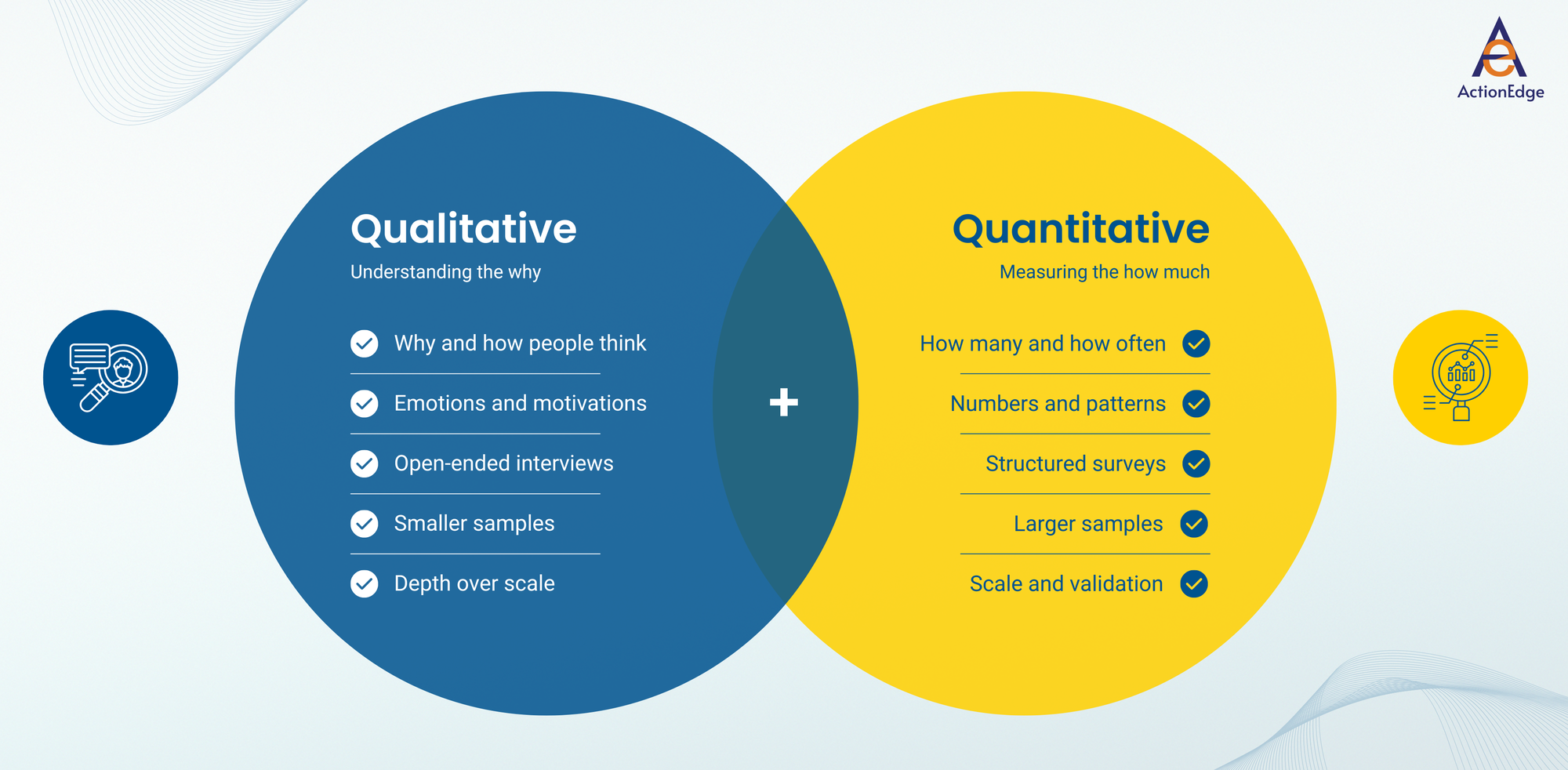
In real decision-making, the strongest outcomes often come from combining both approaches.
A practical flow looks like this:
- Use qualitative research to explore the problem, uncover drivers, and shape the right questions
- Use quantitative research to validate those insights, measure impact, and size the opportunity
Sometimes this happens sequentially. Other times, especially when timelines are tight, both run in parallel.
For Example:
A healthcare organization set out to improve patient experience. The team began with in-depth interviews to uncover pain points across the care journey. Those insights were then translated into a structured survey sent to thousands of patients, allowing the organization to quantify which issues mattered most and where improvements would have the greatest impact.
The result was clarity on priorities, confidence in the decisions, and action grounded in evidence.
A simple framework to guide your choice
Use this as a quick reference when planning your next study:
- Exploring a new issue or unclear problem? Choose qualitative research
- Validating assumptions or tracking performance? Choose quantitative research
- Making a high-stakes decision? Combine both
The right research design always follows the decision you need to make, not the method you are most familiar with.
Choosing the right research partner matters
Even the best-designed study can fall short if execution lacks rigor, scale, or flexibility. The right research partner does more than run methods. They help you step back, challenge assumptions, and choose the right approach based on your objectives, timelines, and risk. Before making that choice, it’s worth evaluating a partner’s strengths, gaps, and fit for your needs. We’ve outlined a practical way to do this in our blog on how to conduct a SWOT analysis before choosing your research partner.
At ActionEdge, we support research end-to-end across both qualitative and quantitative approaches. We give you the freedom to choose the right methodology, not a predefined approach, so your study is shaped by the decision you need to make.
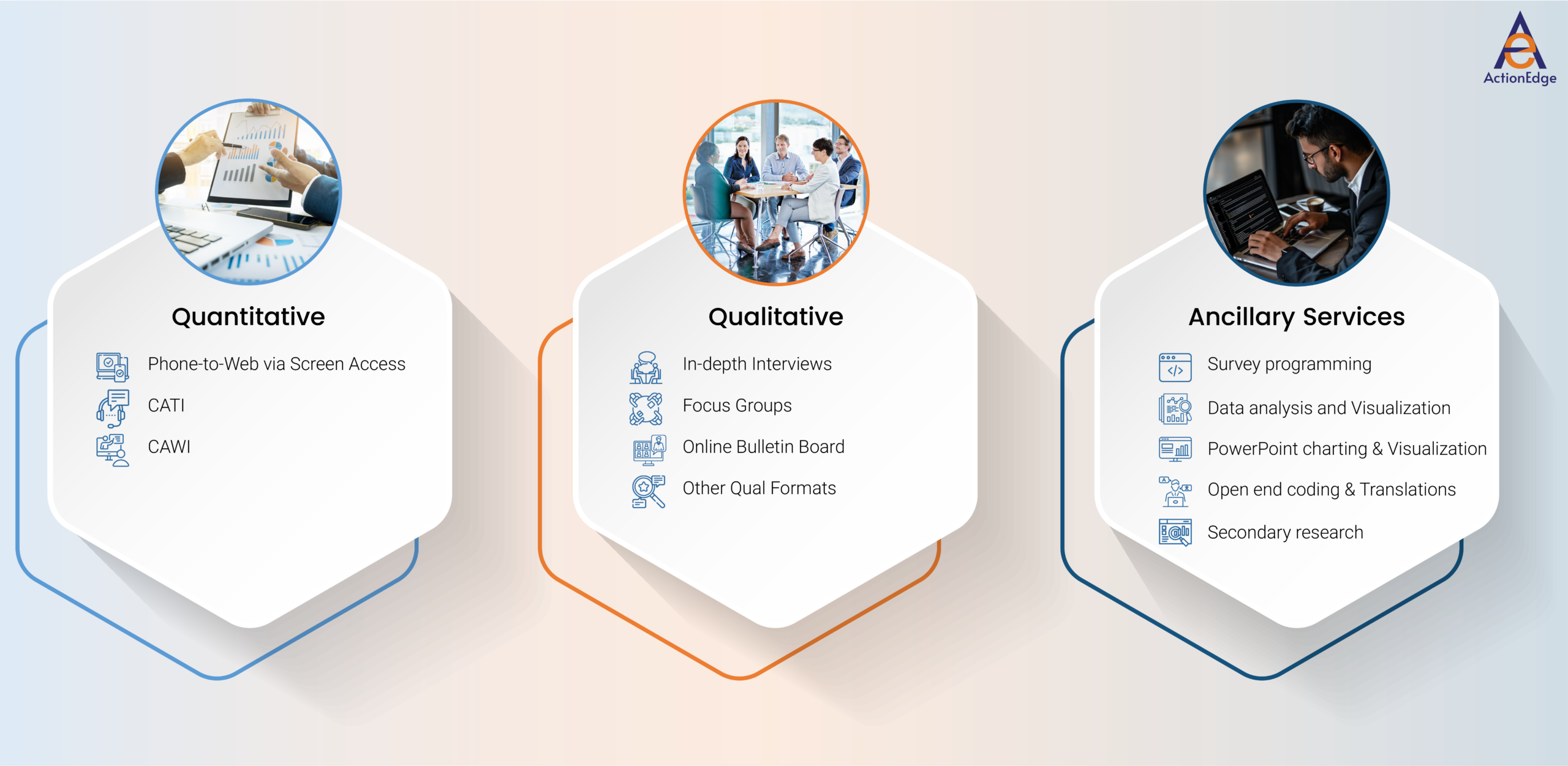
This integrated approach ensures you are not locked into a single method or a fragmented workflow. You get a connected research process designed to deliver clarity, confidence, and actionable insight.
Final thoughts
Choosing the right research design is not about qualitative versus quantitative. It’s about clarity. Qualitative research helps you understand what’s really driving behavior. Quantitative research tells you how far those insights extend and where to act. The strongest outcomes come when both are used intentionally.
When your research approach aligns with the question you need answered, insights stop being interesting and become useful. Decisions become clearer, risks more visible, and momentum follows.
If you are planning a study and weighing your options, start with the decision you need to make, not the method you are used to. At ActionEdge, we help teams choose the right approach based on their objectives, timelines, and risk tolerance.
Data alone does not drive decisions. Understanding does.