
A telecom provider can offer competitive prices, generous data allowances, and extensive network coverage, yet still lose customers to a rival. Why? Because customers do not choose a provider based on features alone. They choose the one they believe offers the best overall experience.
In a market where connectivity is essential for work, entertainment, and everyday communication, understanding what competitors offer is only half the picture. Telecom companies also need to understand how customers perceive those offerings, what builds trust, and which factors influence their decisions.
This is where telecom market research becomes valuable. By examining customer perceptions, brand associations, service experiences, and switching behavior, providers can evaluate their competitive position and identify opportunities to stand apart.
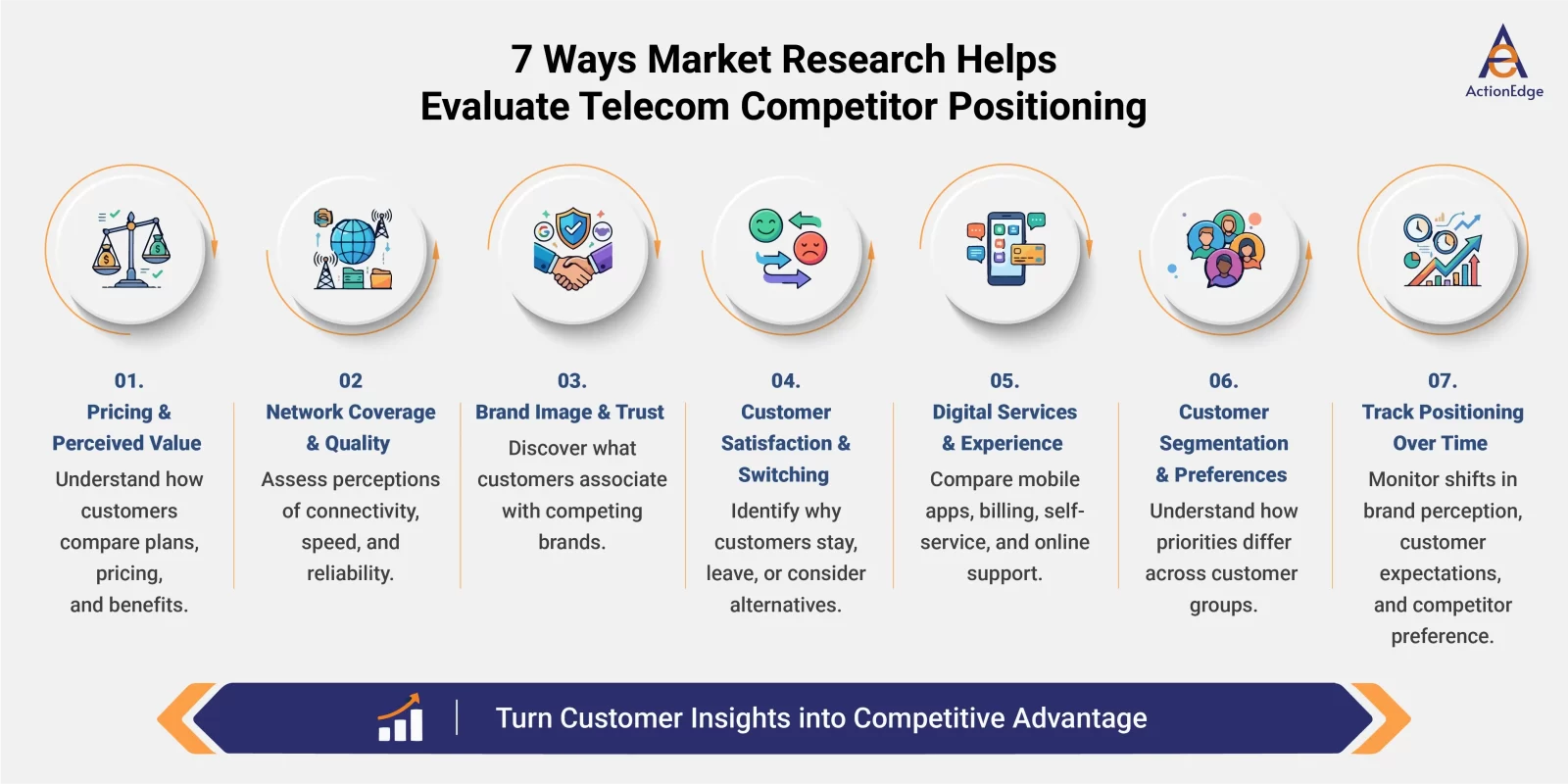
7 Ways Market Research Helps Telecom Companies Evaluate Competitor Positioning
Effective telecom competitor analysis goes beyond comparing tariffs and network specifications. It examines the factors that shape customer preferences and influence purchasing decisions.
Here are seven ways market research can help telecom companies develop a clearer picture of their competitive landscape.
Compare Pricing and Perceived Value
A lower-priced plan does not automatically represent better value. Customers may willingly pay more for reliable connectivity, flexible data allowances, responsive customer support or useful bundled services.
Research can assess how customers compare monthly plans, additional charges, roaming benefits, family packages, and streaming subscriptions. It can also reveal whether a provider is perceived as affordable, premium, or worth the extra cost.
For example, a telecom operator might discover that customers consider its premium plans expensive because they do not understand the additional benefits. The opportunity may lie in communicating those benefits more effectively rather than reducing prices.
By comparing advertised offers with perceived value, market research for telecom companies helps identify where pricing, packaging, and messaging need to change.
Understand Network Coverage and Service Quality Perceptions
Network performance is a major consideration when customers evaluate telecom providers. However, technical performance and perceived reliability do not always align.
A provider may have invested heavily in network infrastructure, but customers in particular locations might still experience dropped calls, inconsistent indoor coverage, or slow data speeds.
Research can compare customer perceptions of coverage, connectivity, call quality, and reliability across regions and user groups. It can also identify differences between a company’s intended positioning and customers’ actual experiences.
For instance, if a provider promotes itself as the preferred choice for remote workers, research could examine whether customers experience reliable connectivity during video calls, at home and while traveling.
These findings help companies understand whether their service reputation reflects their network capabilities and where improvements could make the greatest difference.
Evaluate Brand Image and Customer Trust
Two telecom brands may offer similar services but occupy very different positions in customers’ minds. One might be associated with reliability and transparency, while another is known for affordable plans or attractive promotions.
Understanding these associations is essential to telecom brand positioning.
Research can explore how customers describe competing brands, which attributes they associate with each provider, and how strongly those perceptions influence their choices.
It can also reveal whether a brand’s intended identity matches its actual reputation. A company seeking to position itself as innovative, for example, may discover that customers primarily associate it with conventional voice and data services.
These insights help telecom marketers identify meaningful points of differentiation, strengthen brand communication, and build trust through claims that reflect customers’ experiences.
Identify Customer Satisfaction and Switching Drivers
Customer churn rarely tells the complete story. Knowing how many customers leave is useful, but understanding why they leave is more valuable for competitive decision-making.
Telecom market research can investigate the factors behind switching intentions and provider loyalty, including unexpected charges, poor connectivity, unresolved complaints, promotional offers, and better competitor packages.
Consider a provider that assumes customers are leaving because of cheaper plans elsewhere. Interviews might reveal that the underlying issue is repeated frustration with customer support. A competitor’s lower price may simply make switching easier.
This distinction matters. A pricing response will not necessarily solve a service-related problem.
By examining why customers stay, leave, or consider alternatives, telecom companies can identify competitive weaknesses, prioritize service improvements, and develop more relevant retention strategies.
Assess Digital Services and Customer Experience
Customers increasingly interact with telecom providers through mobile applications, websites, digital payment systems and online support channels. These interactions influence how convenient and dependable a provider feels.
Research can evaluate the usability of self-service applications, clarity of billing information, ease of recharging, account management and the effectiveness of digital complaint resolution.
For example, customers may appreciate an operator’s network quality but find its application difficult to navigate when changing a plan or disputing a charge. A competitor offering simpler digital processes could gain an advantage without having better network coverage.
Comparing these experiences helps companies identify friction points and opportunities to improve customer satisfaction.
For telecom providers, a stronger digital experience can become a competitive advantage when it addresses real customer needs rather than adding features customers rarely use.
Segment Customers and Compare Competitive Preferences
Not every customer evaluates telecom providers in the same way. A frequent traveler may prioritize roaming benefits, while a household may value bundled services. A business customer may focus on uptime, service-level commitments, and technical support.
Broad market averages can hide these differences.
Competitor analysis in the telecom industry can use customer segmentation to compare brand preference, perceived value and service expectations across demographics, locations, usage patterns and customer value groups.
Quantitative surveys can establish which providers perform better among particular segments. Follow-up interviews can explain why those preferences exist.
This allows telecom companies to identify underserved audiences, tailor their propositions, and understand where they have a credible advantage over competitors.
Track Positioning Changes Over Time
Competitive positioning is not fixed. New tariffs, network upgrades, partnerships, regulatory changes, and customer expectations can all influence how providers are perceived.
A single research study provides a snapshot. Recurring research reveals how that picture changes.
Telecom companies can track brand awareness, customer preference, satisfaction, perceived reliability, and value over time. They can then compare results before and after a new campaign, service launch, or network investment.
For example, a company might introduce a simplified prepaid plan and monitor whether customers increasingly associate its brand with transparency and affordability.
Consistent measurement helps distinguish meaningful changes in perception from temporary fluctuations, allowing companies to respond to emerging threats and opportunities with better evidence.
Which Research Methods Can Telecom Companies Use?
Different research methods answer different questions. Combining them creates a more complete view of competitive performance.
- Quantitative research: Measures brand awareness, customer preferences, perceived value, satisfaction, and competitor performance across larger samples. It helps establish what customers think and how widely those views are shared.
- Qualitative research: Explores the motivations, expectations, and frustrations behind customer decisions. It helps explain why customers prefer one provider, distrust another, or consider switching.
- In-Depth Interviews (IDIs): Allow researchers to examine individual experiences in detail, uncover unmet needs, and understand the reasoning behind provider selection.
- CATI (Computer-Assisted Telephone Interviewing): Collects structured feedback through telephone interviews, supporting research among customer groups that may be difficult to reach through online channels alone.
- CAWI (Computer-Assisted Web Interviewing): Uses online surveys to gather customer perceptions, service evaluations, and brand comparisons across relevant audiences.
- Phone-to-Web via Screen Access (P2W-SA): Combines interviewer-led telephone interaction with on-screen survey content, supporting structured self-completion with interviewer oversight.
Together, these methods help telecom companies measure competitive differences and understand the experiences driving them. The appropriate approach depends on the research objectives, target audience, markets, and information required.
Turning Competitive Insights Into Strategic Decisions
Research creates value when findings inform decisions, not when they simply populate reports.
Telecom companies can translate competitive insights into practical priorities:
- Pricing and packaging: Refine plans and bundles around the benefits customers value most.
- Brand communication: Emphasize attributes that distinguish the company and matter to its target audience.
- Service improvement: Address network, billing, and support issues that weaken customer perceptions.
- Customer retention: Develop targeted responses to the issues that influence switching decisions.
- Market opportunities: Identify customer segments whose needs remain underserved by existing providers.
The goal is not to imitate every successful competitor initiative. It is to understand which customer expectations matter most, where competitors meet them effectively, and where a provider can offer a more compelling alternative.
Conclusion
Telecom competition extends far beyond pricing and network specifications. Trust, service quality, digital convenience, and perceived value all shape how customers evaluate providers.
A structured research program helps companies understand these factors, identify gaps in competitor offerings, and make evidence-based positioning decisions. Strong telecom customer insights can also help distinguish genuine competitive advantages from assumptions that have not been tested with customers.
As a market research company, ActionEdge conducts quantitative and qualitative research projects in telecommunications, covering customer preferences, competitor positioning, service experiences, and evolving market needs through targeted respondent recruitment and fieldwork across markets.
Our data collection capabilities help providers understand customer perceptions, evaluate competitor positioning, and assess service experiences. These insights help inform decisions around pricing, brand positioning, and service differentiation.
To know more about our services and request a quote, please email us at rfp@action-edge.com